Friday, September 1, 2017

Joseph and Tamar Comparisons


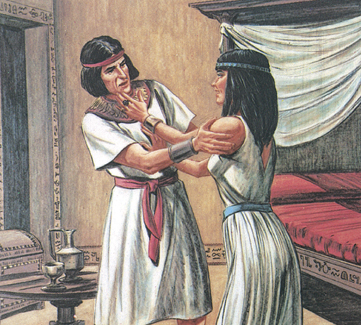
Image result for potiphar's wife and joseph

by

 Damien F. Mackey


A parent’s favourite, given a special cloak, sold out by brothers, mocked, sexually harrassed, emerging from the desert on a spices-laden camel train, imprisoned, though much admired, capable of good management, ruling in Egypt as second only to Pharaoh.
These are just some of the similarities that Tamar at the time of King David shared with Joseph.


This article presupposes my multi-identifications of Tamar as developed in:

The vicissitudinous life of Solomon's pulchritudinous wife


“Conclusion 2: Abishag, of uncertain name, the same as Tamar (her given Hebrew name), hailing from Shunem, was hence “the Shunammite” of King Solomon’s Song of Songs. Ethnically, she may have been Egypto-Canaanite, which thought will lead to the consideration … that she was also Velikovsky’s Hatshepsut = “Queen of Sheba”.”


Some of the Comparisons

Joseph, beloved of his father (Genesis 37:3): “Now Israel [Jacob] loved Joseph more than any of his other sons …”, was hated by his brothers (v. 4): “ When his brothers saw that their father loved him more than any of them, they hated him and could not speak a kind word to him”.

The “Shunammite” was (Song of Solomon 6:9): “… the favourite of her mother, perfect to the one who gave her birth”, but mis-treated by her brothers (1:6): “My mother’s sons [brothers] were angry with me and made me take care of the vineyards”.

Joseph’s father “made an ornate robe for him” (Genesis 37:3).

Tamar “was wearing an ornate robe, for this was the kind of garment the virgin daughters of the king wore” (2 Samuel 13:18).

The exact same Hebrew words to describe “ornate robe”, or “coat of many colours”, are used in the case of Joseph and of Tamar, ketonet passim (כְּתֹנֶת פַּסִּים).

Jacob sent Joseph to his brothers (Genesis 37:13): ‘As you know, your brothers are grazing the flocks near Shechem. Come, I am going to send you to them’.
‘Very well’, he replied.

David sent Tamar to her ‘brother’, Amnon (2 Samuel 13:7, 8): “David sent word to Tamar at the palace: ‘Go to the house of your brother Amnon and prepare some food for him’.
So Tamar went …”.

From “Hebron ….” (Genesis 37:14).

Six of Tamar’s ‘brothers’ were born to David at “Hebron” (I Chronicles 3:1-4).

Joseph asks a man at Shechem (Genesis 37:16): ‘I’m looking for my brothers. Can you tell me where they are grazing their flocks?’

Similarly the Shunammite asks her beloved (Song of Solomon 1:7): ‘Tell me, you whom I love, where you graze your flock and where you rest your sheep at midday’.

Joseph’s brothers “plotted to kill him” (Genesis 37:18).

Tamar was a pawn in a conspiratorial plot by Absalom and his adviser to kill Amnon (see above article).

“So when Joseph came to his brothers, they stripped him of his robe—the ornate robe he was wearing” (Genesis 37:23).

“Tamar … tore the ornate robe she was wearing” (2 Samuel 13:19).

Joseph’s brothers “looked up and saw a caravan of Ishmaelites coming from Gilead” (Genesis 37:25).

Were they “flock of goats”-like?
(Song of Solomon 4:1): ‘Your hair is like a flock of goats descending from the hills of Gilead”.

“Their camels were loaded with spices, balm and myrrh, and they were on their way to take them down to Egypt” (Genesis 37:25).

(I Kings 10:1, 2): “… the Queen of Sheba … came … to … Jerusalem with a very great caravan—with camels carrying spices …”.

“Judah said to his brothers, ‘… after all, he is our brother’.” (2 Genesis 37:26, 27).

“Her brother Absalom said to [Tamar], ‘…. Be quiet for now, my sister; he is your brother’.” (2 Samuel 13:20).

“… his brothers pulled Joseph up out of the cistern and sold him for twenty shekels of silver” (Genesis 37:28).

“Solomon had a vineyard in Baal Hamon; he let out his vineyard to tenants. Each was to bring for its fruit a thousand shekels of silver” (Song of Solomon 8:11).

“… the Ishmaelites … took [Joseph] to Egypt” (Genesis 37:28).

‘I liken you, my darling, to a mare among Pharaoh’s chariot horses’ (Song of Solomon 1:9).

“Reuben returned to the cistern and saw that Joseph was not there, he tore his clothes. He went back to his brothers and said, ‘…. Where can I turn now?’ (Genesis 37:29, 30).

‘What about me? Where could I get rid of my disgrace? And what about you? You would be like one of the wicked fools in Israel’ (2 Samuel 13:13).

“Then Jacob tore his clothes, put on sackcloth and mourned for his son many days. All his sons and daughters came to comfort him …” (Genesis 37:34-35).

“The king stood up, tore his clothes and lay down on the ground; and all his attendants stood by with their clothes torn” (2 Samuel 13:31).

Given the above similarities, it would be no accident that the narrative concerning Joseph is suddenly interrupted by Genesis 38, the account of Judah and another “Tamar” who is treated with some disrespect by Joseph’s brother, Judah.

“Joseph found favour in his eyes and became his personal attendant. Potiphar put him in charge of his household, and he entrusted to his care everything he owned” (Genesis 39:4).

“Abishag … took care of the king and waited on him …” (I Kings 1:4).
“And Achitophel said to Absalom. ‘Go in unto thy father’s concubines, which he hath left to keep the palace …’ (2 Samuel 16:21).

“Now Joseph was well-built and handsome …” (Genesis 39:6).

“… Tamar, the beautiful sister of Absalom son of David” (2 Samuel 13:1).
“… they searched throughout Israel for a beautiful young woman and found Abishag, a Shunammite” (I Kings 1:3).
‘O thou fairest among women …’ (Song of Solomon 1:8).
“… Hatshepsut still described herself as a beautiful woman, often as the most beautiful of women …” (https://en.wikipedia.org/wiki/Hatshepsut).

“… after a while his master’s wife took notice of Joseph and said, ‘Come to bed with me!’” (Genesis 39:7).

“In the course of time, Amnon … grabbed her and said, ‘Come to bed with me’ …” (2 Samuel 13:1, 11).

{So Judah with the other Tamar ‘Come now, let me sleep with you’ (Genesis 38:16), before his having to concede: ‘She is more righteous than I …’ (v. 26) – something Amnon would fail to do in the case of the other Tamar}.

“But he refused. ‘…. My master has withheld nothing from me except you, because you are his wife. How then could I do such a wicked thing and sin against God?’” (Genesis 39:8, 9).

‘No, my brother!’ she said to him. ‘Don’t force me! Such a thing should not be done in Israel! Don’t do this wicked thing’ (2 Samuel 13:12).

‘When he heard me scream for help, he left his cloak beside me and ran out of the house’ (Genesis 39:15).

“Tamar put ashes on her head and tore the ornate robe she was wearing. She put her hands on her head and went away, weeping aloud as she went” (2 Samuel 13:19).

“When his master heard the story his wife told him … he was furious” (Genesis 39:19).

“When King David heard all this, he was furious” (2 Samuel 13:21).

“Joseph’s master took him and put him in prison, the place where the king’s prisoners were confined’ (Genesis 39:20).

“[Amnon] called his personal servant and said, ‘Get this woman out of my sight and bolt the door after her’.” (Genesis 39:17).
“And Tamar lived in her brother Absalom’s house, a desolate woman” (39:20).

“When two full years had passed …” (Genesis 41:1).

“Two years later …” (2 Samuel 13:23).

Wednesday, April 26, 2017

St. Stephen (like Achior) Descent from Abraham


 Image result


Stephen ‘Protomartyr’,

like Achior, an Israelite


Part One (b)

Emphasises his Descent from Abraham


by


Damien F. Mackey


‘Then a famine struck all Egypt and Canaan, bringing great suffering,

and our ancestors could not find food’.


Acts 7:11


“Achior” of the Book of Judith was, as I have argued on various occasions, the Israelite Ahikar, a “nephew” of Tobit of the tribe of Naphtali (Tobit 1:1, 22).

However “Achior”, when informing “Holofernes” of the identification of the mountain folk who were resisting the Assyrian army - these folk, too, being Israelites - in a speech reminiscent of St. Stephen’s to the Sanhedrin, will, unlike Stephen, refer to ‘their ancestors’.

Stephen, on the other hand, will claim the same people as ‘our ancestors’.

Firstly, to “Achior”, who will declare (Judith 5:6-8):


These people are the descendants of some Babylonians who abandoned the ways of their ancestors in order to worship the God of heaven. Finally, they were driven out of their land because they refused to worship their ancestors' gods. Then they fled to Mesopotamia, where they settled and lived for a long time’.


Stephen, by contrast, will proclaim (Acts 7:2-3, 11-12, 15, 18-19, 37-39, 44-45):


‘Brothers and fathers, listen to me! The God of glory appeared to our father Abraham while he was still in Mesopotamia, before he lived in Harran. ‘Leave your country and your people,’ God said, ‘and go to the land I will show you.’

….

Then a famine struck all Egypt and Canaan, bringing great suffering, and our ancestors could not find food. When Jacob heard that there was grain in Egypt, he sent our forefathers on their first visit.


….

Then Jacob went down to Egypt, where he and our ancestors died.


….

Then ‘a new king, to whom Joseph meant nothing, came to power in Egypt. He dealt treacherously with our people and oppressed our ancestors by forcing them to throw out their newborn babies so that they would die.

….

This is the Moses who told the Israelites, ‘God will raise up for you a prophet like me from your own people.’ He was in the assembly in the wilderness, with the angel who spoke to him on Mount Sinai, and with our ancestors; and he received living words to pass on to us. But our ancestors refused to obey him.

….

Our ancestors had the tabernacle of the covenant law with them in the wilderness. It had been made as God directed Moses, according to the pattern he had seen. After receiving the tabernacle, our ancestors under Joshua brought it with them when they took the land from the nations God drove out before them. …’.


It is at this point, however, that St. Stephen will make a dramatic switch of possessive pronoun. His former use of our ancestors now becomes - as Stephen reflects back upon those ancestors of his who had proven to be faithless - ‘your ancestors’ (Acts 7:51-53):


You stiff-necked people! Your hearts and ears are still uncircumcised. You are just like your ancestors: You always resist the Holy Spirit! Was there ever a prophet your ancestors did not persecute? They even killed those who predicted the coming of the Righteous One. And now you have betrayed and murdered him— you who have received the law that was given through angels but have not obeyed it’.

Thursday, April 6, 2017

Faithfulness of God and Abraham


Pope Francis: Reflect on the faithfulness of God


(Vatican Radio) God is always faithful to His Covenant: He kept faith with Abraham and He is faithful to the salvation promised in His Son. That was the message of Pope Francis during the morning Mass on Thursday at the Casa Santa Marta. The Pope called on those present to pause during the day to reflect on their own life story, in order to discover the beauty of the love of God, even in the midst of difficulties, which afflict everyone in this life.


Pope Francis delivers the homily at the daily Mass at the Casa Santa Marta on Thursday.

06/04/2017 13:43

Listen to Christopher Wells' report: 
“Put to the test, after having had a child, a boy, a young child, he was asked to offer him in sacrifice: he obeyed, and went forward against all hope. And this is our father Abraham, who goes forward, forward, forward; and when Jesus says Abraham saw his day, saw Jesus, he was full of joy. He saw Him in promise, he saw that joy of seeing the fullness of the promise of the covenant, the joy of seeing that God had not deceived him, that God – as we prayed in the responsorial psalm – is always faithful to His covenant.”
The psalm also invites us to call to mind the wonders God performs. For us, the descendants of Abraham, it’s like thinking of our father who has passed away, and yet we remember the good things about him and we think: “He was a great father!”

Abraham obeys and believes against all hope
The Covenant, on Abraham’s part, consists in having always obeyed, the Pope said. On God’s part, He has promised to make Abraham “the father of a multitude of nations.” “No longer shall you be called Abram, but Abraham,” the Lord says. And Abraham believed. Then, in another dialogue, God tells him that his descendants will be as numerous as the stars in the heavens and as the sand on the seashore. And today we are able to say, “I am one of those stars. I am a grain of sand.”

Looking to history: we are a people
Between Abraham and us, there is another Story, the Pope said, the story of the heavenly Father and of Jesus. This is why Jesus told the Pharisees that Abraham exulted in the hope of seeing “my day” – “he saw it, and was glad.” This is the great message; and the Church today invites us to pause and to look to “our roots,” “our father,” who “has made us a people, a heaven full of stars, a beach full of grains of sand”:


“Looking to history: I am not alone, I am a people. We go together. The Church is a people. But a people dreamed of by God, a people He has given a father on Earth who obeyed; and we have a Brother who has given His life for us, to make us a people. And so we are able to look upon the Father, to give thanks; to look upon Jesus, to give thanks; to look upon Abraham and ourselves, who are part of the journey.”

God is faithful: we should pause in order to discover, even amid the difficulties of this life, the beauty of the love of God
The Holy Father then invited us to make today “a day of memory,” pointing out that “in this great Story, in the framework of God and Jesus, there is the little story of each one of us”:


“I invite you today to take five minutes, ten minutes, to sit down – without the radio, without the television – to sit down and reflect on your own story: the blessings and the troubles, everything. The graces and the sins, everything. And to see there the faithfulness of that God who remained faithful to His Covenant, remained faithful to the promise He made to Abraham, remained faithful to the salvation He promised in His Son, Jesus. I’m certain that in the midst of all of the perhaps ugly things – because we all have them, so many ugly things in this life – if we do this today, we will discover the beauty of the love of God, the beauty of His mercy, the beauty of hope. And I am sure that we will all be full of joy.”
....


Taken from: http://en.radiovaticana.va/news/2017/04/06/pope_francis_reflect_on_the_faithfulness_of_god/1303892