Showing posts with label Imhotep Joseph Step Pyramid material icon father Jacob’s vision stairway to Heaven. Show all posts

Wednesday, April 8, 2015

The Instruction of Ptah-hotep: Joseph in Egypt


Taken from: http://www.askelm.com/doctrine/d040501.htm


“The Instruction of Ptah-Hotep”


This brings us to consider the author of an early Egyptian work called “The Instruction of the Vizier [the Prime Minister] Ptah-Hotep.” The man who wrote this document of proverbial teaching was so close to the Pharaoh that he was considered Pharaoh’s son — from his own body. This does not necessarily mean that the author was the actual son of the Pharaoh. It is a designation which means that both the author (the Prime Minister) and the Pharaoh were one in attitude, authority, and family. 6
Could this document be a composition of the patriarch Joseph? There are many parallels between what the document says and historical events in Joseph’s life. Indeed, the similarities are so remarkable, that I have the strong feeling that modern man has found an early Egyptian writing from the hand of Joseph himself. Though it is evident that the copies that have come into our possession are copies of a copy (and not the original), it still reflects what the autograph said; in almost every section it smacks of the attitude and temperament of Joseph as revealed to us in the Bible. Let us now look at some of the remarkable parallels.
This Egyptian document is often called “The Oldest Book in the World” and was originally written by the vizier in the Fifth (or Third) Dynasty. The Egyptian name of this vizier (i.e., the next in command to Pharaoh) was Ptah-Hotep. This man was, according to Breasted the “Chief of all Works of the King.” He was the busiest man in the kingdom, all-powerful (only the Pharaoh was over him). He was the chief judge and the most popular man in Pharaoh’s government. 7
The name Ptah-Hotep was a title rather than a proper name, and it was carried by successive viziers of the Memphite and Elephantine governments. The contents of this “Oldest Book” may direct us to Joseph and to the later teachings of Israel.
Notice what this Ptah-Hotep (the second in command in Egypt) had to say of his life on earth. How long did he live? The answer is given in the concluding statement in the document:
“The keeping of these laws have gained for me upon earth 110 years of life, with the gift of the favor of the King, among the first of those whose works have made them noble, doing the pleasure of the King in an honored position.”
  • “The Instruction of Ptah-Hotep,” Precept XLIV
This man, with the title Ptah-Hotep, was one who did great construction works. Joseph was supposed to have done mighty works — traditionally, even the Great Pyramid was built through the dole of grain during the seven years of low Niles. And remember, Joseph also lived 110 years (Genesis 50:26) just as did this Ptah-Hotep. He resembled Joseph in another way.
“If you would be held in esteem in the house wherein you enterest, whether it be that of a ruler, or of a brother, or of a friend, whatever you do enter, beware of approaching the wife, for it is not in any way a good thing to do. It is senseless. Thousands of men have destroyed themselves and gone to their deaths for the sake of the enjoyment of a pleasure which is as fleeting as the twinkling of an eye.”
  • Precept XVIII
Here again we have Joseph! Even though adultery was the common thing in Egypt (thousands of men were doing it), only one uncommon example shines out in its history — that of Joseph. This virtue of Joseph was so strong, that its inclusion into these “Precepts” again may indicate that Joseph had a hand in writing them.
Now look at the beginning of Precept XLIV. Ptah-Hotep says that if the laws of the master were kept, a person’s father will give him a “double good,” i.e., a double portion. Joseph did in fact receive the birthright and with it the “double good” (double blessing, Deuteronomy 21:15–17). This birthright blessing is repeated in Precept XXXIX.
“To hearken [to your father] is worth more than all else, for it produces love, the possession doubly blessed.”
  • Precept XXXIX

Ptah-Hotep Was a Great Man

There is much more that is like Joseph in the document of Ptah-Hotep. Notice Precept XXX:
“If you have become a great man having once been of no account, and if you have become rich having once been poor, and having become the Governor of the City [this exactly fits Joseph’s experience], take heed that you do not act haughtily because you have attained unto a high rank. Harden not your heart because you have become exalted, for you are only the guardian of the goods which God has given to you. Set not in the background your neighbor who is as you were, but make yourself as if he were your equal.”
  • Precept XXX
The instruction above almost sounds as if it came from the Bible itself! The parallel to such high ethical teaching could be an indication that Joseph wrote it. There is also, in these Precepts, an emphasis on obedience, especially to one’s father(s).
“Let no man make changes in the laws of his father; let the same laws be his own lessons to his children. Surely his children will say to him ‘doing your word works wonders.’”
  • Precept XLII
“Surely a good son is one of the gifts of God, a son doing better than he has been told”
  • Precept XLIV
“When a son hearkens to his father, it is a double joy to both, for when these things are told to him, the son is gentle toward his father. Hearkening to him who has hearkened while this was told him, he engraves on his heart what is approved by his father, and thus the memory of it is preserved in the mouth of the living, who are upon earth.”
  • Precept XXXIX
“When a son receives the word of his father, there is no error in all his plans. So instruct your son that he shall be a teachable man whose wisdom will be pleasant to the great men. Let him direct his mouth according to that which has been told him [by his father]; in the teachableness of a son is seen his wisdom. His conduct is perfect, while error carries away him who will not be taught; in the future, knowledge will uphold him, while the ignorant will be crushed.”
  • Precept XL
The emphasis of Ptah-Hotep is that his own greatness depended upon his attendance to the laws of his fathers. He encouraged all others to do the same. This gave him the reason for recording for posterity these basic laws, and he says that these words of his fathers “shall he born without alteration, eternally upon the earth” (Precept XXXVIII).
“To put an obstacle in the way of the laws, is to open the way before violence”
  • Precept V
“The limits of justice are unchangeable; this is a law which everyman receives from his father.
  • Precept V
Some of those teachings are so biblical and right! It could well be a fact that these principles and good teachings came from Abraham, Isaac, and Jacob, and are here recorded by Joseph, the one respecting the teachings of his fathers. Notice this Precept:
“The son who receives the word of his father shall live long on account of it.’
  • Precept XXXIX
Compare this with the Fifth Commandment:
“Honor thy father and mother: that the days may be long upon the land which the Lord your God gives you.”
  • Exodus 20:12
Could it be that many of the laws that became a part of the Old Covenant which God made with Israel at the Exodus were known long before — in the times of Abraham, Isaac, and Jacob? We are told that the early patriarchs knew some of God’s laws (Genesis 26:5).
The biblical agreements, however, do not stop with this reference. They are throughout the work.
“When you are sitting at meat at the house of a person greater than you, ... look at what is before you.”
  • Precept VII
And now, notice Proverbs 23:1. The agreement with the above of Ptah-Hotep is exact.
“When you sit to eat with a ruler, consider diligently what is before you.
  • Proverbs 23:1
Professor Howard Osgood, who translated into English these “Precepts of Ptah-Hotep,” has a note to the one precept mentioned above.
“This passage is found in the Proverbs of Solomon, chapter 23. The Hebrews knew then, if not the whole of the maxims of Ptah-Hotep, at least several of them which have passed into proverbs.”
  • Howard Osgood, Records of the Past 8
Why of course. Many of Solomon’s proverbs were those of ancient men. Solomon nowhere claimed to have originated all his proverbs. On the contrary, he clearly states that many of them were “words of the wise men, and their dark sayings” (Proverbs 1:6). Look at another precept of Ptah-Hotep:
“If you are a wise man, train a son who will be well pleasing to God.”
  • Precept XII
Compare this with Proverbs 22:6:
“Train up a child in the way he should go: and when he is old, he will not depart from it.”
  • Proverbs 22:6
Solomon merely recorded many of the proverbs and laws, which were handed down in Israel generation after generation. He, of course, augmented the proverbs but he did not originate them all. In fact, it seems certain that many of them were from Joseph who further recorded for us the teachings of Abraham, Isaac, and Jacob.
But let us go on with the Precepts of this second in command to Pharaoh.
“In doing homage before a greater man than yourself you are doing what is most pleasing unto God.”
  • Precept X
“Labor diligently while you have life, and do even more than you have been commanded to do.”
  • Precept XI
“Neglect not to add to your possessions daily, for diligence increases wealth, but without diligence riches disappear.”
  • Precept XI
“None should intimidate men, for this is the will of God.”
  • Precept VI
“Terrify not men, or God will terrify you.”
  • Precept VI
“If you would be wise, rule your house, and love thy wife wholly and constantly. Fill her stomach and clothe her body [i.e., support her], for these are her necessities; love her tenderly and fulfill all her desire for she is one who confers great reward upon her lord. Be not harsh to her, for she will be more easily moved by persuasion than by force.”
  • Precept XXI
This type of teaching for the husband to his wife seems almost like that of the New Testament. It is very different from the normal beliefs of ancient times.
“Take care of those who are faithful to you, when your affairs are of low estate. Your merit then is worth more than those who have done you honor.”
  • Precept XXXV
“The man who hurries all the day long has not one good moment; but he who amuses himself all day long does not retain his house.”
  • Precept XXV
In other words, work hard but learn to relax as well, do not amuse yourself all the time.
“Treat well your people as it behooves you; this is the duty of those God has favored.”
  • Precept XXII
Continuing, he says that if you have been given a job to do, “never go away, even when thy weariness makes itself felt” (Precept XIII).
“If you are accustomed to an excess of flattery and it becomes an obstacle to your desires, then your feeling is to obey your passions.”
  • Precept XIV
“A man is naturally annoyed by having authority above himself, and he passes his life in being weary of it ... but a man must reflect, when he is fettered by it, that the annoyance of authority is also felt by his neighbor.”
  • Precept XXXI
Or, since authority is necessary, learn to put up with it.
“If you desire that your conduct be good and kept from all evil, beware of all fits of bad temper. This is a sad malady which leads to discord, and there is no more life at all for the one who falls into it. For it brings quarrels between fathers and mothers, as between brothers and sisters; it makes the husband and wife to abhor each other, it contains all wickedness, it encloses all injuries. When a man takes justice for his rule, walks in her ways, and dwells with her, there is no room left for bad temper.”
  • Precept XIX

Ptah-Hotep Was a Great Ruler

There are a great many laws found in this “Oldest Book” which echo over and over the rule of Joseph in Egypt. This man was the chief judge except for Pharaoh throughout the land. Notice Precept XVII:
“If you have the position of a Judge listen to the discourse of the petitioner. Do not ill-treat him; that would discourage him. The way to obtain a true explanation is to listen with kindness.”
  • Precept XVII
“If you have the position of leader prosecuting plans according to your will, do the best things which posterity will remember; so that the word which multiplies flatteries, excites pride and produces vanity shall not succeed with you.”
  • Precept XVI
The next Precept could certainly come from the experiences of Joseph. Notice it:
“Be not puffed up because of the knowledge which you have acquired, and hold converse with unlettered men as with the scholar; for the barriers of art are never closed, no artist has ever possessed the full limit of the knowledge of his art.”
  • Precept II
In other words, no one knows it all, even of his own profession. Even the unlettered may instruct at times.
“If you are in the position of leader, to decide the condition of a large number of men, seek the best way, that your own position may be without reproach.”
  • Precept V
“Do not speak to the great man more than he asks, for one does not know what might displease him. Speak when he invites you to do so, and your word will please.”
  • Precept VII
And finally:
“As to the great man [i.e., the ruler, master or Pharaoh] who has behind him the means of existence, his line of conduct is as he wishes. But as this means of existence is under the will of God, nothing [not even the great man] can revolt against that.”
  • Precept VII

Conclusion

The foregoing has been a selection of the remarkable precepts of this vizier. And, amazingly, throughout this document there is complete agreement to Bible principles. No paganism is found within it. The name Osiris is found once when Ptah-Hotep said that no laws had been changed since the time of Osiris. See Precept V. 9 There is hardly anything wrong with that passage.
The only possible objection is found in Precept XLII where we find: “A son who hearkens, is like a follower of Horus; he is happy because he has hearkened.” The fact is, the name Horus became a general title for all kings of Egypt. The Horus-name was applied to Pharaohs. Even Joseph possessed it! The name Horus in this passage is not necessarily a reference to the personal Horus of the First Dynasty. The monotheistic contents of these Precepts of Ptah-Hotep predominate. The Horus name is merely a title and does not reflect paganistic tendencies. Even names like “Ptah-Hotep” or like “Im-Hotep” were normally titles that could refer to people like Joseph. Note (in the comparison below) the remarkable literary agreements. 10
All indications are that the narrative about Ptah-Hotep appears to be referring to the biblical character we know as Joseph. Understand that non-biblical works may have had mistaken or untrue elements added to the narrative. Thus, they may not 100% correspond to the biblical narrative. However, that does not seem to be the case with Ptah-Hotep. Below are some side-by-side comparisons between Ptah-Hotep and Joseph.
Ptah-Hotep Precepts
:
Joseph’s History 
(1)    He lived to be 110 years old (XLIV). (1)     He lived to be 110 years old (Genesis 50:26).
(2)    He lived in the Third Dynasty. 11 (2)     The Third Dynasty saw seven years of low Niles.
(3)    The name Ptah-Hotep was a title of all Memphite viziers, those second in command to Pharaoh himself. 12 (3)     Joseph was second in command to Pharaoh. He was the vizier, as all scholars admit (Genesis 41).
(4)    Ptah-Hotep was the chief judge in ancient Egypt but had been raised to the highest office (XXX).  (4)     Pharaoh required all Egyptians to submit to the judgeship of Joseph (Genesis 41:41–44).
(5)    Ptah-Hotep was once of no account in Egypt but had been elevated to the Prime Ministership (XXX). (5)     Joseph was raised from the dungeon to sit on the very throne of Pharaoh (Genesis 41:14, 41–44).
(6)    Out of thousands who went into their neighbor’s wives, Ptah-Hotep did not, and taught people not to do so (XVIII). (6)     Joseph refused to submit to the advances of his master’s wife (Genesis 39).
(7)    Ptah-Hotep received from his father divine laws; even one of the Ten Commandments was quoted (XXXIX). (7)     Joseph was taught the divine laws from Abraham, Isaac and Jacob (Genesis 26:5).
(8)    Ptah-Hotep was a monotheist. No idolatry is mentioned. (8)     Joseph believed only in the God of Israel, not idols.
(9)    Many of Ptah-Hotep’s teachings went directly into the Bible especially Proverbs. 13 (9)     Solomon quoted from the ancient wise men of Israel and copied their teachings and proverbs (Proverbs 1:6).
(10)  Ptah-Hotep received a double possession from his father because of his obedience (XXXIX and XLIV). (10)   Joseph likewise received the birthright the double possession (1 Chronicles 5:2).
(11)  Ptah-Hotep warns those of advanced knowledge, such as he had, to shun being puffed up (II). (11)   There was none considered wiser in all the land of Egypt than Joseph (Genesis 41:39), but he was also humble (Genesis 45:15).
(12)  Ptah-Hotep was the first in Egypt whose great public works made him famous. (XLIV) (12)   Joseph, traditionally, built the Great Pyramid, the Labyrinth, the canal system of Egypt, and many other great public works.

Tuesday, April 1, 2014

A View on Jacob's Ladder to Heaven


Where the Ladder to Heaven stood

We saw above that for the distance between Ark and Altar, the Temple designer had used a value of pi in the same accuracy range as that computed by the later Greek mathematician Archimedes (287 to 212 BCE). An even more accurate example of that constant turns up in another symbolically very important spot in the Temple layout, a spot that also incorporates the numbers of the heavenly bodies, or the cycles of the moon before the stars and of the sun in the solar year.

Let me explain how to arrive at that spot, beginning with the overall plan of the Temple precinct and the type of thinking that led to it. We discussed earlier the ancient practice of building temples to reflect the cosmos, as described by scholars of comparative religion such as Mircea Eliade1.

The mythical thinking behind this “as above, so below” identification often used symbols in a recursive manner on successive levels that reflected the structure of the society.

For instance, the archaeologists Philip J. King and Lawrence E. Stager argue that the ancient Israelite society perceived itself as a series of households that were nested one inside the other:

“Just as a father exerted authority over his household, so the king ruled his ‘children’, the people, -- and God was father over the ‘children of Israel’.”2

The same view of the world as a series of ever more central and ever more concentrated items, nested one inside the other like a set of Russian dolls, was reflected in this description from the Rabbinic period:

“Just as the navel is found at the center of a human being, so the land of Israel is found at the center of the world (...) and it is the foundation of the world. Jerusalem is at the center of the land of Israel, the Temple is at the center of Jerusalem, the Holy of Holies is at the center of the Temple, the Ark is at the center of the Holy of Holies, and the Foundation Stone is in front of the Ark, which spot is the foundation of the world.”3

We find a comparable recursiveness also in the literary chiasms, or nested reflections of similar story elements, that appear most prominently in the biblical story of Jacob and the ladder to heaven4.

Since the themes of successive nesting and reflecting played such a prominent role in the Hebrew traditions, particularly those connected with the ladder to heaven, it seems reasonable to investigate whether the architect of the Jerusalem Temple also incorporated these culture- reflecting concepts in the design.

The most obvious place for doing so would probably have been the spot for the ladder to heaven, the spot where David had seen the Angel of Pestilence standing between heaven and earth and that thereby reflected the function of the entire Temple project which was also meant to connect these two.

Let us therefore suppose that the square innermost Sanctum of the Temple may have been meant to reflect the entire square within the outer walls, the way God’s presence in that Sanctum reflected his presence in the nation and world at large. Continuing the metaphor, a further reflection of that precinct within the Sanctum would have produced the spot for that ladder where that Sanctum wound up in this further reflection nested within itself.


The drawings here are based on the dimensions from the Rabbinic tradition discussed on the page about Temple dimensions. The first view shows the location of the Temple and its rectangular Court within the original 500 cubit square Temple Mount. The distances from the Court to the outer walls are those the archaeologist Leen Ritmeyer cites from a 16th century commentary on the 2nd century CE Middot tractate that transmitted the other dimensions.

This source is late and therefore open to question, but its distances match those Ritmeyer scaled from his proposed ancient locations for the Holy of Holies foundation trenches to the ancient outer walls of which he located the four corners.

As to the locations on the drawing of the gates and other structures outside the outer wall, I scaled these from Ritmeyer’s ground plan of the Temple Mount during Hezekiah’s time5.

I further drew a plan view of the Holy of Holies, with the Ark oriented east- west, as proposed by Ritmeyer, and the two gold- covered cherubim stretching their wings above it, as in the biblical account. The outline of the cherubim is based on the proportions of a winged sphinx or cherub in a Phoenician ivory carving from the eighth or ninth century BCE.

Then I reduced the Temple Mount drawing so that the area inside its walls would fit inside the Holy of Holies, and I reflected it to line up the entrances into the same direction.

This required two assumptions, about the inside length of the Temple Mount and about which gate was its main entrance.

The inside dimensions of the Temple Mount square are not transmitted, but it seems likely that they were 480 x 480 cubit. The scribe of 1 Kings 6:1 clearly associated the number 480 with the nationhood of Israel when he said that Solomon began the construction of the Temple in the 480th year after the Exodus. This time span fits no archaeologically plausible chronology, but its number supplies the proper symbolic contrast when you compare it with the 500 cubit outside length.

According to an ancient Hebrew Myth,

“the earth was so large that it would take a man five hundred years to walk across from east to west, if he lived to finish it, and a walk from north to south would take him another five hundred years”6.

If the 500 cubit outside length of the Temple Mount represented those 500 years which corresponded to the entire earth, then the inside would have symbolized Israel at the center of that outside world since the Temple was its exclusive emblem. And what number could have symbolized that nation better in this context than the 480 years since its people were said to have become independent?

The association between the essence of Israel and that number survives in the Jewish folklore which counted 480 synagogues in Jerusalem7.

In the symbolic world view it did not matter whether the date or number was fictitious or not. It was more significant that 480 is 8 x 60 as well as 12 x 40, and that all these were holy and symbolically charged numbers for divinity and/or completeness that are often emphasized in the Bible. These accumulated holy numbers may here have reinforced each other’s meanings the way multiple magic spells were often deemed more potent than a single invocation.

The wall thickness that results from this postulated inside measurement is ten cubits. This is in the right range for such an outer defense, compared with a Herodian section of the Western retaining wall that Ritmeyer listed as just under nine cubit thick8.

Having thus reduced the layout of the 480x480 inside square to fit it into the 20x20 inside of the inner sanctum, I reflected that reduced projection so that its main entrance into the Temple Mount would face in the same direction as the entrance into the Holy of Holies.

This brings us to the second of the above assumptions, that about the main entrance into the Temple Mount.
Fortunately, the choice which entrance was the principal one is easy. The only entrance to the Temple Mount that has in Ritmeyer’s drawing a special gate building is the “Prison Gate” to the north.


To have the main gate in the north may seem counter- intuitive since the people of Jerusalem lived south of the Temple, but the Temple precinct was the domain of God, and God was believed to dwell in the north. North was the direction from which he came in the prophet Ezekiel’s first vision (1:4) and where Psalm 48:2 located his city, so I took this architecturally emphasized gate to the north as the symbolically important entrance.

The Holy of Holies opened to the east from where God entered the Temple in Ezekiel’s second and third visions (10:4 and 43:2-5). I reflected therefore the projection of the Temple Mount across its southeast to northwest diagonal to match this orientation, as you can see in the detail view here Figure 5.


These simple mathematical transformations place the reflected image of the Altar right before the Ark of the Covenant, touching its front edge, and just over one finger’s width offset from the east- west centerline, the way the outside Altar is offset by one cubit from the north- south centerline of the Temple Mount.

This spot, right before the Throne of God, was surely also the most likely location for the Altar made of cedar wood which Solomon had placed into the Inner Sanctum (1 Kings 6:20). The excellence of the fit suggests that the proposed 480 cubit dimension on which this projection is based as well as the method and orientation of the projection were indeed part of the original plan.

The reflected center of the Holy of Holies becomes in the reduced projection a spot 4.6667 cubit south of the 20x20 square’s east- west centerline, and 2.8125 cubit east of its north- south centerline.

As suggested above, this spot must have been specially important. If the Temple complex symbolized a connection to heaven, and the actual Holy of Holies in it concentrated that connection, then the area corresponding to the reflected Holy of Holies within the actual one must have focused that contact even more intensely onto an even smaller spot.

The Jewish traditions emphasize this particular spot. According to the dimensions of the cherubim in 1 Kings 6:23-27 and 2 Chronicles 3:10-14, the reflected Holy of Holies winds up just before the front legs of the cherub to the south of the Ark. The two cherubim that flanked the Ark formed the Throne of God, and if its occupant was thought to face east towards the entrance, those front legs of the southern cherub were the right leg of the Throne.

In this privileged place stood “the celestial ladder whose first edge is on the earth and second edge on the right leg of the Throne of Glory”, as quoted here from Hekhalot Rabbati9, a set of Rabbinic texts tentatively dated from the second to the fourth century CE that guide the reader on detailed tours of the Hekhalot or “Heavenly Palace”.

To the right of God’s Throne is also where David, the king chosen by God and ancestor of the Messiah, was placed in Psalm 110:1. This tradition survives in the Christian image that David’s descendant Jesus, the embodied link between earth and heaven and thus symbolic equivalent of the ladder between these, stands at God’s right hand (Acts 7:56).

The location of the ladder foot on earth would of course have reflected that of its top in heaven, so its most likely place was before the right leg of the Throne replica on earth where the front legs of the right cherub defined the spot. This is precisely where the reflected Holy of Holies winds up. Its mathematically projected presence there makes that spot an excellent candidate for the place where the builders believed the ladder to heaven to have stood, the navel of the earth around which the world had been created.

Earlier, the Patriarch Jacob had seen this ladder at Beth- el, another “House of God” and gate to heaven. Bethel was an old holy spot where Abraham had sacrificed and where the Ark of the Covenant was kept in the days of the Judges, but the ladder had to move to Jerusalem when that royal city became the religious center of Israel and the Temple its sole official contact with heaven.

The new location of the ladder was probably the place above which David saw the Angel of Pestilence “standing between earth and heaven” (1 Chronicles 21:16). As Ritmeyer pointed out10, the place of this link to the upper realm would have belonged inside the Holy of Holies when David decreed right after his vision where to build the Altar and where the Temple.

Figure 6 and the list below give the distances of this “ladder spot” in relation to the centers of the Temple Mount and of the Altar:

Ladder distance north from east- west Temple Mount centerline:
Ladder to north =
62.83333
cubit
20 pi =
62.83185
D = 0.002356%
Ladder distance west from north- south Mount centerline, and days in four sidereal months:
Ladder to west =
109.1875
cubit
4 x 27.3217 =
109.2868
D = 0.09094%
Direct distance from Ladder to Altar center, and reciprocal of days in 40 solar years:
Ladder to Altar =
109.4893
cubit
40,000 / 365.2422 =
109.5164
D = 0.02477%
Distance from Ladder to Temple Mount center, divided by Mount center to Altar center, both in cubit, and reciprocal of days in solar year:
125.9759 / 46.0109 =
2.737961
1,000 / 365.2422 =
2.737909
D = 0.001873%


Please note how well that one spot brings down pi the sun and the moon’s travel before the stars to fasten them mathemagically to the Rock, together with the biblically important period of 40 years.

The multiplier 20 for pi matches the location of that spot in the Holy of Holies which was 20 cubits long and 20 each broad and high. The 20 pi distance thus joins a circle of 20 to the square and cube of this number. This is one up on those who tried to merely square the circle -- or twenty up since the Temple designer’s solution for combining these incommensurable quantities worked, at least in symbolical terms.

That the reciprocal of 40 years was intended seems confirmed by the inclusion of the reciprocal for a single year, as if to indicate that this was the unit used for that prominently biblical group of forty. Forty years was the length for each of Moses’ three life phases, of the Israelites' stay in the wilderness after their flight from Egypt, and of both David’s and Solomon’s reigns. These may well be symbolically determined periods, just like the 12 x 40 years between the Exodus and the start of building the Temple.

The accuracy of the astronomical numbers embedded in these dimensions corresponds to the reputation of the ancient Israelites for the excellence of their calendar data. For instance, the traditional Hebrew value for the synodic lunar month was 29.530594 days, compared with the modern computation for recorded history over the last 5,000 years which yields an average month length of 29.530596 days. The difference amounts to 0.000006772%, less than one part in ten million.

A recent reviewer of a book dealing with this topic wondered:

“It has never been clear just where the extremely accurate Hebrew value came from.”11

(Just as it has never been clear how king Hezekiah’s surveyors solved their extremely tough tunnel measuring task?)

The value of pi in the north- south coordinate of the ladder spot is more than ten times closer than the much celebrated approximation of Archimedes.

This is no reflection on Archimedes who could easily have computed a much narrower range but may have had better things to do than to continue a tedious, repetitive, and to him utterly useless calculation. He may not have striven for a mention in Guinness’ Book of World Records to which he did not even subscribe.

On the other hand, if some ancient Near Eastern priests sought divine secrets or magical powers in this mysterious number so closely associated with the sun, then they and their many well- schooled assistants could easily have performed a great many such calculations instead of watching the TV programs from back then.

The closeness of this symbolically important distance in the Temple layout to the value of 20 pi suggests that the ancient Hebrews were able to compute not only astronomical periods with great precision but also mathematical constants, never mind the long- standing smear campaign against Solomon’s pi.

The precision of the matches seems to imply that the designer of the Temple plan established this ladder spot first, with relative freedom to pick its coordinates. Once it was nailed down, and the ends of the Ark- to- Altar line, their locations defined the centerlines of the Temple Mount and their grid.

The rest of the layout then followed the constraint of using whole or at best half cubits for the various dimensions. This limits, of course, the accuracy of further matches with target numbers to expressions with relatively small integers which do not always cooperate smoothly but require much computing and careful planning to be so harnessed.

The close matches which the ladder spot dimensions yield with 20 pi and with the astronomical as well as specific symbolic periods would be hard to explain as random coincidences.

Considering the constraints for arriving at this spot, you are about as likely to encounter such a constellation of mathematical and astronomical constants as you are to get hit by lightning, on a calm day, and in your basement. The Jerusalem Temple precinct was clearly laid out with superb skill around that ladder spot to produce these heavenly and holy ratios, particularly since the presence of this purported point of contact with heaven was the reason for building the Temple there to begin with.

The construction of those closely interrelated spots within the grid of the Temple Mount square also seems to imply that Solomon’s builders knew not only their pi and how to compute it, but that they used an x-y coordinate system of analytical geometry similar to our modern one which was invented by René Descartes (1596 to 1650) and Pierre de Fermat (1601 to 1665).

Many historians of science rank this invention as one of the two milestones that mark the beginning of modern mathematics12.
The numerical matches at this ladder spot also validate the authenticity of the distances from Temple Court to Temple Mount that Ritmeyer found in the 16th century commentary on the older Middot tractate. Those distances are such an integral part of the overall numerical theme that they convey two things:
  • the commentary was based on correctly transmitted data for the same structure as the other Middot dimensions, and
  • the layout of the Temple Mount described in that source had been included in the transmitted design, whether Solomon built any of it, or all, or none.

Tuesday, October 1, 2013

Joseph, son of Jacob (Israel), was Imhotep, of Egyptian History


Taken from: http://theegyptianidentityofjoseph.wordpress.com/2012/02/20/joseph-son-of-jacob-israel-was-imhotep-of-egyptian-history/

....

· Barriers to equating Joseph with Imhotep, The Egyptian Identity of Joseph son of Jacob, Who was Imhotep


Authors

Joseph, son of Jacob (Israel), was Imhotep, of Egyptian History


Egyptian History is consistent with the Bible

Joseph was the 11th son of Jacob, the Patriarch of Israel. Joseph was 30 years old when he became the sage or visier to Pharaoh and lead Egypt through seven years of famine. The Pharaohs became wealthy and powerful because of Joseph. Joseph brought up all the land of Egypt (except for that of the priest’s) and reduced the Egyptian people to servitude. He married the daughter of the High Priest in Heliopolis (Capital city ‘On’). He lived to the age of 110 and ensured the survival of the Israelites.

Egyptian history records a visier to Pharaoh Djoser of the third dynasty by the name of Imhotep who lived for 110 years and saved Egypt from a seven year famine and made Egypt very wealthy. He is said to have designed the first pyramid, been the first to used columns in architecture, performed operations and established the practice of embalming. He wrote many literary works and was the first to use papyrus.
Could Joseph and Imhotep have been the same person?

Joseph and Imhotep were the same person


Introduction

This article looks at the person of Joseph, son of Jacob, in the Bible, and whether or not there is any non-Biblical Egyptian historical or archeological evidence of his existence.
Joseph is responsible for saving Egypt from a seven year famine and may have built the massive underground silos that can be found in many cities of Egypt. [1] [2] [3] In particular, he may have built the silos associated with the first pyramid built in Egypt (The Step Pyramid which is part of the Djoser Pyramid complex at Saqqara, designed by Imhotep). [4] [5] [6] [7]
There are many similarities between the profile of Joseph and Imhotep. [8] [9] [10] [5] Imhotep is also credited with saving Egypt from a seven year famine after hearing of the Pharaoh’s dream. Imhotep, like Joseph, was a commoner with some divine connection and was placed second in charge of Egypt by the King (Netjerikhet). [8]
Joseph brought up all the land for Pharaoh by selling the grain he stored during the seven years that preceded the famine [11] ; a feat that could only have been performed once, early in Egypt’s history, and explains how the Pharaohs became so powerful and able to built the pyramids.
Given that Joseph was one of the Patriarchs of Israel, and figures very early in the Biblical record, less than 1000 years after the flood of Noah, it is quite possible that he may have figured in the early parts of Egyptian history, namely the Third Dynasty of Pharaoh Djoser. [9] [12] [13]
Until recently, the most compelling argument against Joseph and Imhotep being the same person, has been the discrepancy between the estimated times during which they lived. [4] [14]
In the last 50 years, evidence has accumulated to suggest that Egyptian dynasties may overlap and may not date back as far as was once thought. [15] [16] [17] [18] Egyptian records are not chronological. [12] Furthermore, the pyramids were probably constructed much later that many historians have estimated. [19]
If this “modern alignment” of the Egyptian dynasties is correct, it is highly likely that Joseph and Imhotep were the same person [20] [21] [22] [23] [18] and Egyptian History would be consistent with the Bible.
If it can be generally accepted that Joseph and Imhotep were the same person, this would give historians an anchor in history in order to further correlate the history of Egypt, Israel and Mesopotamia.

Biblical References to Joseph

References to Joseph can be found in the Book of Genesis in the Holy Bible, the Torah and The Koran.
These are the Holy scriptures of the Christian faith, Judaism and Islam respectively.
The story of Jospeh is told in Genesis Chapters 37-50.
Genesis is the first book of the Bible and no Biblical scholars would dispute the historical nature of this part of the Book.
Any suggestion that Joseph was a symbolic, mythical or a fictional character would be deeply offensive to these religions.

  • Biblical Genealogy

After the Flood [24] and the dispersion of Babel [25] , people spread out over all the Earth.
Terah set out from Ur of the Chaldeans with his Son Abraham to go to Canaan but stopped at Haran. [26]
This is where Abraham was called by God. God promised to make him into a great nation and to bless all nations through him. [27]
God made a covenant with Abraham and promised him the land of Canaan which his descendants would take possession of after serving as slaves in a foreign land (Egypt) for 400 years (4 generations). [28]
Abraham was to become the father of many nations centered around the middle east as we know it today.
He had Ishmael (Ishmaelites) to Hagar, his wife’s maid servant. [29] Ishmael became the Patriach of the Islamic religion.
Then at the age of 100 Abraham had Issac to his wife Sarai. [30]
It was to be thru Issac that God would fulfill his promise to Abraham and so Ishmael was sent away. [31]
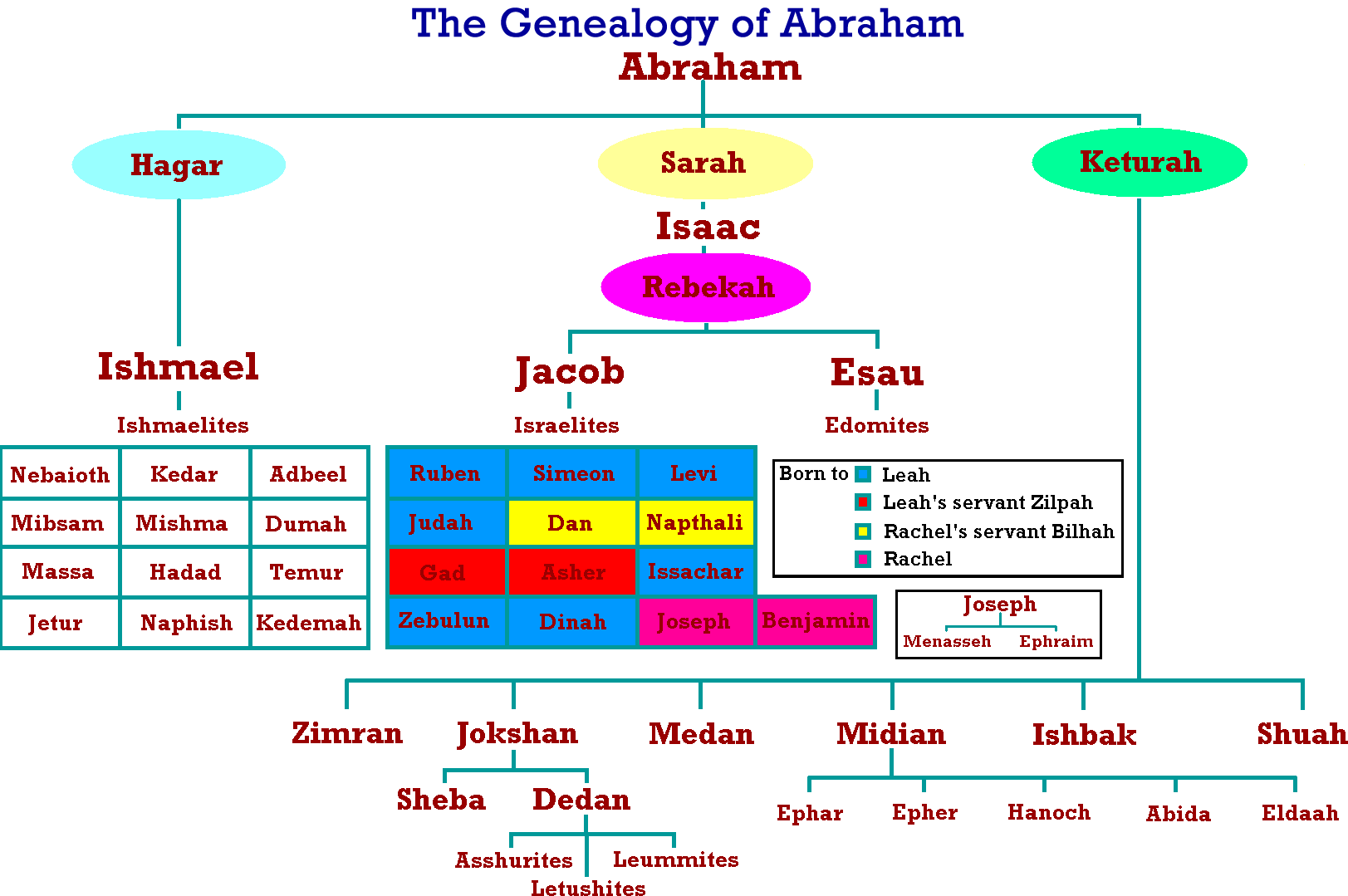
Issac married Rebeka who bore Esau (the Edomites) and Jacob (the Israelites). Abraham had a third wife Keturah who bore many children who were sent to the middle east and became fathers of nations there too. [32]
Jacob eventually bore 12 sons and a daughter. The eleventh son was Joseph. Joseph was the first son of Rachael (Jacob’s second wife). [33] Jacob had an encounter with God one night and was renamed Israel. [34] His descendants (the Jews) became the Nation of Israel (from which comes Judaism) out of which came Christ (Christianity) with whom God would fulfill his promise to Abraham. [35]
Genealogy of Noah (according to the Bible)

Genealogy of Noah (according to the Bible)

Genealogy of Abraham (according to the Bible)

Genealogy of Abraham (according to the Bible)


  • Biblical History

In the Biblical account, (Genesis 37-50) Joseph was the first born Son of Rachael (Jacob’s second wife). Jacob (Israel) favored Joseph over his other children. Joseph had a dream that one day he would rule over his brothers. His brothers became jealous of him and so sold him to slave traders who took him to Egypt. [36] He was subsequently sold to Potiphar in Egypt as a slave and was subsequently wrongfuly imprisoned.
It was in prison where he came to the attention of Pharaoh through his cupbearer who informed Pharaoh of Joseph’s ability to interpret dreams by the power of God. Pharaoh needed counsel about his own dreams and was not able to find anybody from his own kingdom to help.
Joseph was able to tell Pharaoh the meaning of his dreams which fortold of a coming famine lasting seven years but preceded by seven years of abundance. Pharaoh made Joseph second in charge over his all his kingdom. During the seven years of abundance, Joseph was able to build silos in every city and store enough grain to feed the Nation during the seven years of famine that followed. [37]

  • Joseph’s achievements in Egypt

When Joseph was 30 yrs old, Pharaoh put him in charge of the whole land of Egypt. Pharaoh gave Joseph his signet ring, dressed him in fine linen and put a gold chain around his neck. He was given a chariot to ride around Egypt as second in command. Joseph’s name was changed to Zapheneth Paneah and he was given a wife Asenath (Daughter of Potiphera, priest of On). [1]
During the seven years of abundance, Joseph stored up huge quantities of grain in each city from the fields surrounding them. [2]
He had two sons to Asenath, Mannaseh & Ephraim. [38]
Joseph saved Egypt and Caanan by selling the people grain during the 7 year famine. When the people had run out of money, Joseph brought their livestock. When they had run out of livestock he brought the land titles. [3]
Joseph brought up all the land in Egypt for Pharaoh. The priests did not have to sell their land as Pharaoh gave them a supply of food. [11]
Joseph’s family were saved. [39] Jacob (Israel) and his eleven other sons along with their wives and servants were invited by Pharaoh to come and live in Egypt. [40] They settled in Rameses and became numerous in number. [41]
Jacob died and was afforded an Egyptian burial [42] after blessing his children and those of Joseph. [43] [44] Joseph reassures his brothers after Jacobs death. [45] Eventually Joseph dies at the age of 110 and is given an Egyptian style burial aswell. [46]
After 430 years passed, the Israelites numbered over 2 million. They were eventually lead out of Egypt by Moses through the Red Sea (the exodus). [47]

Is Joseph likely to have figured in Egyptian records?

If Joseph was placed second in charge of Egypt by Pharaoh, there should be some note of this in Egyptian records. [1]
Joseph helped to save Egypt and the surrounding nations from a famine lasting seven years. [2]
Joseph would have had to construct massive grain silos for storing grain in many Egyptian cities and indeed, massive silos can be found in many historical significant Egyptian cities today (eg Saqqara).
Joseph married the daugher of one of the High Priests in Egypt. [1] He saved his country from a seven year famine and brought up all the land of Egypt except for that of the priests who did not need to sell their land because Pharaoh supplied them with food. The people became loyal subjects of Pharaoh because of what Joseph had done. [3]
Joseph was, therefore, responsible for making the Pharaoh’s wealthy and powerful. [11]
Joseph served the Pharaohs from the age of thirty. [1] He died at the age of 110 years of age and was given a Royal Egyptian burial. [46] It is quite possible that he may have been involved with the design of the first and maybe the second pyramid.
His family, the descendants of Jacob (Israel), produced mud bricks and became numerous in number in the 430 years that they lived in Egypt. There were over 600 thousand adult males (not counting women and children) who were lead out of Egypt by Moses during a time of great disaster in Egypt. [47]
With a list of accomplishments like this, it would be hard to conceive that Joseph would not be mentioned in Egyptian heiroglyphics or memorialized some other way.

Where does Joseph fit into Egyptian History?

Estimates of dates have long been the common denominator used by archaeologists and historians alike when trying to piece together ancient history.
Various teams of archaeologist have used a number of different dating methods to estimate how old a particular artifact is. For example, the type of pottery that is predominant in a layer can be used to date the layer.
Assumptions behind various dating techniques are not alway right. This can sometimes lead to artifacts being incorrectly dated by as much as 1000 to 2000 years.
If history is pieced together based only upon the estimated dates of particular dynasties, the results can be quite erroneous and it will be little wonder why Egyptian and Hebrew history does not fit together and why no Egyptian equivalent of Joseph has been found using the dates traditionally ascribed to various Egyptian dynasties.
An increasing number of historians are now calling into question the dates of Egyptian dynasties. In particular, Sweeney [15] [21] [19] [48] , Velikovski [49] [50] [51] , Fry [52] [12] [53] [16] [54] [55] [56] [57] [58] [59] [20] , Reilly [13] [17] [60] [22] Ashton & Down [18] .
Using their revised dating system, the historical records of Israel and Egypt fit together much better and it is possible to identify likely correlates and contemporaries of important Biblical Characters.
Conventional wisdom which has been very reliant on dating methods has been unable to find any evidence that the Patriarchs of Israel lived in Egypt and have not found any possible candidates for Joseph because they are looking for evidence of him in the Hyksos dynasty which is estimated to have been around 1700BC according to conventional chronology. As a result, conventional wisdom states that Joseph and other Biblical figures were minor figures in Egypt that were not note worthy enough to have been memorialized in the heiroglyphic records and other monuments that have been uncovered.
Modern thinking using the revised chronology results in much clearer picture with the history Israel and Egypt lining up and matching archaeological records. Abraham is considered to be a contemporary of Menes. Imhotep is considered to be the Joseph of the Bible and Djoser is considered to be the Pharaoh that he served [13] [17] [21] [15] [52] [54] .
This would fit with the theory that Amenemhet III was the Pharaoh of Moses who oppressed the Israelites making them make mud bricks [18] . Also of note is that the pyramid of Amenemhet III was made of mud bricks containing straw. [18] Amenemhet III was the 6th Pharaoh of the 12th dynasty and lived 450 to 500 years after Pharaoh Djoser in the 3rd dynasty. [18] He had only daughters who had a son (Amenemhet IV) who disappeared before he could become King. It has been suggested that Amenemhet IV was Moses. [18]
The Exodus took place during the Reign of Neferhotep I during the 13th dynasty in 1445BC. He was the only Pharaoh of that dynasty [18]
The Hyksos (15th & 16th dynasties) which were contemporary with Joshua and the Judges, came to an end when King Saul destroyed the Amalekites (Hyksos) [18] [61]
Dynasty 17 was contemporary with dynasty 16. [18]
Amenhotep I and Thutmosis I of the 18th dynasty were contemporaries of David. [18] Hatshepsut was the Queen of Sheba who visited Solomon. [62] [63] Thutmosis III came to power during the reign of Jereboam and became the greatest Pharaoh of Egypt. [18]
‘Modern’ Chronology (Ashton & Down 2006) [18]
DateDynastyEgyptContemporary_in_Israel
2080BC1stMenesAbraham
1900BC3rdDjoser_+_ImhotepJoseph
1531BC12thAmenemhet_III (6th_Pharaoh)Moses
1445BC13thNeferhotep IThe Exodus (Moses)
1405 -1021BC15th_&_16thHyksosJoshua to Saul
1018BC18thAmenhotep I & Thutmosis IKing David
950BC18thHatshepsut [Queen of Sheba]Solomon
929BC18thThutmosis IIIJereboam

Why is it so hard to piece together Egyptian records?

The Egyptians suffered great losses at the time of the Exodus and may not have wanted to remember what Joseph and his family had achieved during their 400 year stay in Egypt. This may be one reason why it is very difficult to find historical information about the exploits of the Israelites in Egypt.
This may also been the reason that the second pyramid designed by Imhotep was not completed.
Another reason why it is difficult to find historical information is because much of it was lost or destroyed by various seiges, conquests, natural distasters and even erosion over the centuries.
Egyptian records are written as qlyphs (pictures) in stone. They have a number of limitations – you need to know ‘the code’ ie what they mean. Pronunciation is not indicated as with Greek and English and there is no time stamp. The art of interpreting them (heiroglyphics)has been somewhat lost.

Similarities between Joseph and Imhotep

Imhotep – Egyptian records
Joseph – Bible
  • Imhotep is appointed Administrator by Pharaoh Djoser during the periods of seven years famine and seven years of bountiful harvests [8]
  • Joseph is appointed Administrator to Pharaoh for the seven years of plenty then of famine
  • Minister to the King of Lower Egypt [8]
  • Pharaoh .. made him ruler over all the land of Egypt
  • Administrator of the Great Palace [8]
  • Thou shalt be over my house
  • Not of royal blood; attained position by ability [8]
  • From another nation and religion, not of royal blood, attained position by ability
  • Not appointed by Pharaoh Djoser until he had reigned for some time [8]
  • Appointed well after Pharaoh ruled Egypt
  • Given the status of “son” to Pharaoh [8]
  • Granted the status of “son” to Pharaoh
  • High Priest in Heliopolis [8]
  • Married to Asenath, daughter of Poti-Pherah, High Priest in Heliopolis – by custom, would succeed father-in-law
  • Builder and architect [8]
  • Builder of grain storehouses such as at Sakkara step-pyramid
  • Exalted by Pharaoh Djoser as of godly character [8]
  • And Pharaoh said, ‘a man in whom the spirit of God is!’
  • “I need advice from God” [8]
  • Noted as saying, “It is not in me; God shall give Pharaoh an answer”
  • Had great medical skill – was compared to the Greek God of Healing [8]
  • Had doctors under his authority – worked by miracles, dreams and signs from God
  • Decided the tax rate during the seven years of famine; also not to apply to priests [8]
  • Decided the tax rate during the seven years of famine; also not to apply to priests
  • Realizes when he is dying – dies at age 110 [8]
  • Realizes when he is dying – dies at age 110

Who was Imhotep?

Imhotep was a most interesting figure in the Egyptian culture, his name means “the one who comes in peace”. He served Djoser, the third dynasty king, he was the vizier to the pharaoh and they say that he was the high priest to the sun god Ra. [64]
Imhotep is attributed with being the first person in history to be an acting physician, he was also the first architect, he was a poet and also a philosopher. After his death he was given the status of a deity, he was only one of a very few commoners to ever be given that kind of an honor.
[64]
He is thought to be the architect of the first Pyramid; the step pyramid at Saqqara. [64]
He is also credited with the use of columns in architecture. [64]
He is known as the founder of Egyptian medicine, and he is famous for not incorporating magic into his medical treatments, he diagnosed and treated over two hundred diseases, he extracted medicine from plants and he is also known to have performed operations and dentist work. He knew the circulation of the blood system and he knew where each vital organ was placed and what its uses were. [64]
He became the god of medicine and healing, when the Greeks invaded Egypt they worshiped him and built him temples because they saw in him their own god of healing named Asclepius. [64]
Imhotep was also the first person known to use the papyrus scroll. He may have actually invented it! [64]
Among other things Imhotep is also attributed to the prediction and prevention of a seven year famine that came upon the land, he predicted the famine from a dream the pharaoh Djoser had, in this dream the god of the Nile spoke to the pharaoh, and Imhotep was the only one that could interpret the dream. [64]

Could Joseph and Imhotep have been the same person?

The Roman-Jewish historian, Josephus, quotes the writings of Manetho, Egyptian historian: “During [the] reign of .. Pharaoh Djoser, 3rd Egyptian dynasty, lived Imhotep .. [with a] reputation among Egyptians like the Greek God of medicine – [Manetho even wondered] whether Imhotep could have been an actual person .. [because he had] “so many outstanding qualities and talents .. a very special person [who] appears in the history of Egypt.” On the foundations of the Step Pyramid in Sakkara was carved the name of Pharaoh Djoser and “.. Imhotep, Chancellor of the King of Lower Egypt, Chief under the King, Administrator of the Great Palace, Hereditary Lord, High Priest of Heliopolis, Imhotep the Builder..”. [8] [65]
Joseph arrived in Egypt as a young man and married Asenath, the daughter of Potipherah, the priest of On. [1]
This information precludes the theory that Joseph lived during Hyksos rule in Egypt. On or An was the ancient capital of Heliopolis (As-t Tem). Some claim that Egyptians also believed in One Great God who was never represented in their art work. Only his attributes, functions as Creator, Teacher and Healer were known as the neter or neteru. The symbolism surrounding Egyptian deities then is different from this One Great God, in whose image man was made, in that it scales our world and the universe to our dimensions so man can grasp it. The Egyptian name for this `One Great God’ is neter, probably an echo or more distant memory of the biblical Creator God of Abraham, Issac and Jacob. [66]
Both Imhotep and Joseph imposed a 20% (one fifth) tax on the people with the exemption of the priests. [54]
Moeller refers to an inscription on the island of Sihiel, near the first cataract of the Nile, which actually links Imhotep to the key biblical element of the Joseph story – telling of Pharaoh Djoser in the 18th year of his reign. The inscription states “seven meagre years and seven rich years”. Commenting on the inscription, Moeller writes, “Pharaoh Djoser asks Imhotep to help him with the coming seven years of famine. All the biblical components of the story are there, and there is a similar inscription on the island of Philae in the Nile.” (This is exactly as in the Bible with Joseph, except for listing the “meagre” years before the years of plenty. Note: The famine years were, of course, the event of significance, saving everyone from starvation and bringing in much wealth to Egypt – it is noted that the manuscript was written a thousand years after the occurrences.) [67] [8]
Pharaoh renamed Joseph ‘Zapeneth Peneah’ [1] which means “master of the school of learning” [66] or “Man to whom secrets are revealed” [54] .
It is also interesting to note that circumcision was widely practiced among Egyptians from the third dynasty onward. Although Abraham did visit Egypt, it seems more likely that this practice was introduced by Joseph-Imhotep in the third dynasty. [54]
Egyptian records show that before Imhotep, the bodies of Egyptian royalty were not embalmed. Instead, they were entombed in early Egyptian structures called mastabas, (or mastabahs), oblong structures with flat roofs and sloping sides built over the opening of a mummy chamber or burial pit . [54]
Djoser appears to be the first king to have be embalmed, [54] Jacob (Israel) was embalmed by Joseph and buried in a coffin and Joesph himself was embalmed and given a royal Egyptian burial. [46] [42] The Biblical account suggests that only Joseph’s bones were preserved as was the practice in the early dynasties of the Old Kingdom. Preservation of the whole body was not practiced until the Era of King Tut (New Kingdom). [54]
Extremely noteworthy regarding Imhotep-Joseph is that the mummified bodies of neither have ever been found. The known facts regarding the burials of Imhotep and Joseph also strongly support the thesis that they were the same person: [8]
Both died at age 110. [8] [46]
Imhotep’s coffin in Sakkara – with innumeral Ibis birds mummified in the adjoining galleries (Imhotep was called “Ibis” because of his reputation for healing – a large number of Ibis birds were sacrificed to him at his funeral in Sakkara); many clay vessels bearing the seal of Pharaoh Djoser were near the coffin; and the coffin is oriented to the North, not East, and is empty. [8]
Joseph would have been buried at Sakkara, his coffin orientated to the North – indicating he did not believe in the gods of the Egyptians (who were buried facing East, the rising sun); the coffin would also be empty as Joseph’s bones would have been taken by Moses with the Hebrews during the Exodus. [8] [46]

Could Pharaoh Djoser (King Netjerikhet) be the Pharaoh of Joseph?

The ‘correct alignment’ of Israel’s and Egypt’s history will allow contemporary fragments of information to be linked together to build up a clear picture of ancient history. Combining the records of Egypt, Israel and Mesopotamia will help to fill in the gaps in each nations’ record.
Evidence is now accumulating to suggest that Egyptian dynasties may overlap and may not date back as far as was once thought. [15] [16] [17] [18] [66]
Dynasty 2 is considered contemporary with dynasty 3. [18] There was no first intermediate period. The dark ages of the first intermediate period have been confused with the dark ages of the second intermediate period. [18]
Dynasties 7-10 have been identified with 15-16 and Dynasty 17 was contemporary with dynasty 16. [18]
Egyptian history, therefore, does not date back as far as was once thought (3000BC – 5000BC) as per the Conventional Chronology. [18] [50] [51] [49] [21] [13] [17] [52] [12] [53] [16] [54] [66]
The first Egyptian dynasty is now considered to have started around 2100BC and the Great Flood is considered to have been around 2300-2400BC. [18]
The Exodus occured just after the end of the 12th dynasty in 1445BC. [66] [18]
Any Egyptian dates before the 12th dynasty are considered quite speculative and are only approximations [18]
This ‘Modern Alignment’ of the Dynasties fits the Biblical account and also the records of Mesopotamia.
The ‘Modern Alignment’ of the Dynasties provides the answers to the major objection to Joseph and Imhotep being the same person (namely the mismatching dates) and by the same token makes it highly likely that Pharaoh Djoser was the Pharaoh of Joseph.
While Sweeney points out that Abraham was a contemporary of Menes who were patriarchs of their respective civilizations some time after a catestrophic destruction [21] , he has probably over corrected the dates which are far too short even for Biblical events.
If it is agreed that Joseph was Imhotep and he served Pharaoh Djoser (Zozer) of the Third dynasty, it does not follow that the identity of Moses and the Pharaoh’s he was contemporary with will be agreed as there is not universal agreement about which dynasties to identify and which dynasties ran in parallel. [58] [66] [19] [18] [17]
‘Conventional’ Chronology [21]
DateEgyptIsrael
3000BCMenes (First dynasty displays strong mesopotamian influence)Djoser and Imhotep (Famine crisis solved when Imhotep interprets Djoser’s dream)
2000BCFirst Intermediate period(Age of disturbance in nature and general lawlessness)Abraham (migrates from mesopotamia and introduces some of the basic civiliation to Egypt)Joseph (Famine crisis in Egypt solved when Joseph interprets Pharaoh’s dream)
1000BCMoses leads the Israelites to freedom amidst violent upheavals of nature
‘Revised’ Chronology (Sweeney 1997) [21]
DateEgyptIsraelMesopotamia
1300+BCEarly_Badarian‘Ubaid
1300BCCatestrophic_DestructionCatestrophic_DestructionCatestrophic_Destruction
1200BCLate_Bedarian_and_GerzeanKhirbet_KerakJamdat_Nasr(Early_Literacy)
1100-
1000BC
Destruction episodeDestruction episodeDestruction episode
1000BCMenes (Early Dynastic Age)Abraham(Early Dynastic Age)
900BCDjoser and ImhotepJoseph
800BCDestruction episodeDestruction episodeDestruction episode
800BCPyramid AgeAge of the JudgesAkkadian Age
700BCHyksos epochSaulSargon I
‘Modern’ Chronology (Ashton & Down 2006) [18]
Date Dynasty Egyptian_PharaohContemporary_in_Israel
2080BC1stMenesAbraham
1900BC3rdDjoser_+_ImhotepJoseph
1531BC12thAmenemhet_III (6th_Pharaoh)Moses
1445BC13thNeferhotep IThe Exodus (Moses)
1405 -1021BC15th_&_16thHyksosJoshua to Saul
1018BC18thAmenhotep I & Thutmosis IKing David
950BC18thHatshepsut [Queen of Sheba]Solomon
929BC18thThutmosis IIIJereboam

What implications does this have for Egyptian History?

If the ‘modern alignment’ of the Egyptian Dynasties is correct, Joseph can be identified with Imhotep and Egyptian history will be consistent with the Bible.
Pharaoh recognised Joseph’s divine inspiration and appointed him to be in charge of Egypt. Joseph built silos to store grain and so saved Egypt from a seven year famine. He acquired all the land of Egypt (other than the priest’s) for Pharaoh by selling grain. The Pharaohs became wealthy and powerful and the people of Egypt became his subjects. Joseph’s family was invited to live in Egypt (Rameses). [3] [11]
Joseph, therefore, saved his family and protected the Israelites as they grew to become a nation in Egypt. [45]
Djoser was the second Pharaoh of the 3rd dynasty of Egypt and came about three or four generations after Menes who was the Pharaoh of the 1st dynasty of Egypt and a contemporary of Abraham. [18] [21] [15]
Joseph came three generations after Abraham and was contemporary with Djoser (1900BC) . After his death he was deified because of his achievements. As King Netjeriket of the third Egyptian dynasty was also known by the name ‘Pharaoh Djoser’, it is possible that this name means ‘Pharaoh of Joseph’.
The Israelites stayed in Egypt 430 years. This takes us to the end of the 12th and beginning of the 13th dynasty which is when the Exodus occurred. (1445BC) [18]
It is unlikely that Joseph was some inconspicuous person in the 18th dynasty of Hyksos as is commonly held by people who adhere to the ‘conventional alignment’ of Egyptian dynasties.
What’s more, if the ‘modern alignment’ is correct, the Hebrew influence of Egyptian culture will be re-established. The first pyramid would have been designed by a Hebrew. The Hebrew God can be credited for saving Egypt from a seven year famine and giving the Pharaoh’s their power, wealth and the means to build the other pyramids. The designer of the first pyramid will, once again, be seen to be a servant of the God of Abraham, Issac and Jacob, even though the pyramids later became objects of pagan worship and Imhotep was deified long after his death by the Greeks.
When the Israelites left Egypt, Joseph’s association with the God of Abraham, Isaac and Jacob was forgotten and the pyramids became symbols of pagan gods.
With the aid of hind sight it can be seen how the designer of the first pyramid, the savior of the Egyptian people and the man responsible for the Pharaoh’s power, known as Imhotep, would be deified some 1400 years after his death once his connection with the God of Abraham, Issac and Jacob had been lost and forgotten.
The first pyramids, which were made of cut limestone, were built by the Egyptian people who had sold their land to Pharaoh and become his subjects.
After Joseph’s death, the Israelites were given the task of making mud bricks. [68] [69] Interestingly, the core of the Pyramid of Amenemhet III is made of mud bricks containing straw. [18] Amenemhet III was the 6th Pharaoh of the 12th Egyptian dynasty which preceeded the Exodus in 1445BC. [18]
Moses was forced to flee Egypt and go to Midian after killing an Israelite official. During that period, the Pharaoh died. [70] When he returned to Egypt, there was a new Pharaoh in power (possibly Neferhotep I of the 13th Dynasty). [18]
The Hyksos dynasties (14th & 15th dynasties) started after the Exodus, spanned the period of the Judges and was finally ended by Saul when he defeated the Amelekites. [18] [61]

What implications does this have for Israel and Christianity?

If Joseph was Imhotep, then Bible History is consistent with Egyptian history.
This will mean that there is archaeological evidence that the Patriarchs of Israel lived in Egypt.
Archaeological evidence for Israel in Arabia ⁄ Midian (Jabel el Lawz) in combination with the above would corroborate the Biblical account of the Exodus.
Joseph saved his family and protected the Israelites and allowed them to multiply in numbers so that they could fulfill what God had planned; namely to return to the land of Canaan and to take possession of it after spending 430 years in Egypt and 40 years in the Wilderness. [28]

What implications does this have for Literature, Medicine and Architecture?

If Joseph was Imhotep, this would make Joseph the father of medicine, the first architect to build with stone and use columns and the inventor of the papyrice and the first to use it (to write medical and non-medical literary works). [71] [72] [73] [74] [6] [75]
He probably served more than one pharaoh and appears to have designed at least two pyramids and several buildings that utilize columns. He was given the name Pathotep by a later pharaoh that he served. [54]
Imhotep may have invented the embalming techniques used to preserve the bodies of Egyptian Pharaohs. He became the first pathologist. He was known as the ‘Son of Ptah’ (or son of Path). [54] Hundreds of years after his death, he became deified and was known as the god Path. [54]
Not only was Pathotep’s name derived from that of the god Path, but our modern word, ‘Pathology’, was also derived from and bears his name. [54]

Summary: Joseph and Imhotep are the same person

There is such a strong match between the profile of Joseph and Imhotep that many historians, theologians and archaeologists have suggested that they are one in the same person.
There were only so many non royal, second in charge visiers who saved Egypt from a 7 year famine by interpreting Pharaohs dreams (with the power of God), imposed a 20% tax, brought up all the land of Egypt for Pharaoh (except for that of the priests), lived to the age of 110 and were embalmed when they died. – Imhotep & Joseph
Imhotep was also the High Priest of Heliopolis. Jospeh married the daughter of the high priest of On (the capital of Heliopolis) !
Until recently, the main case for not believing Joseph and Imhotep to be the same person, has been the considerable discrepancy between the estimated dates of their existance by as much as 1000 years!
Egyptian records are far from complete. They are not chronological and the exact way that fragments fit together is by no means certain.
In the Last 50 years, historians have realized that several Egyptian dynasties have been counted twice and some ran in parallel. The result is that Egyptian history can be substantially contracted, therefore eliminating the discrepancy in the estimated dates of Joseph and Imhotep.
This modern understanding of the Egyptian dynasties means that Joseph almost certainly was Imhotep and Egyptian History is consistent with the Bible.
If it can be generally accepted that Joseph and Imhotep were the same person, this would give historians an anchor in history in order to further correlate the history of Egypt, Israel and Mesopotamia.

Suggested Reading

1. J. Ashton & D. Down, Unwrapping the pharaohs. how Egyptian archaeology confirms the Biblical timeline, New Leaf Publishing Group (Master books), 2006. ISBN 978-0-89051-468-9 ISBN 0-89051-468-2 http://masterbooks.net
2. H. Bible, “Jacob bore 12 sons,” Genesis chapter 29-32,
3. H. Bible—”Keturah’s children sent away to Middle East,” Genesis 25:1-4,
4. H. Bible—”Abrahams children to be reckoned through Isaac,” Genesis 21:12,
5. H. Bible—”Ishmael sent away – Isaac the child of promise,” Genesis 21:8-13,
6. H. Bible—”Isaac born to Sarai,” Genesis Chapter 21,
7. H. Bible—”Ishmael born to Hagar,” Genesis Chapter 16,
8. H. Bible—”God’s covenant with Abraham,” Genesis Chapters 15 & 17,
9. H. Bible—”Call of Abraham,” Genesis Chapter 12,
10. H. Bible—”Terah sets out from Ur,” Genesis 11:27-32,
11. H. Bible—”The dispersion after Babel,” Genesis Chapter 11,
12. H. Bible—”The Flood,” Genesis Chapter 6,
13. H. Bible—”The Biblical account of Jospeh,” Genesis chapter 37-50,
14. H. Bible—”Jacob renamed Israel,” Genesis 32:22-32,
15. H. Bible—”Jacob favours Joseph,” Genesis chapter 37,
16. H. Bible—”Joseph sold into slavery and taken to Egypt,” Genesis 37:12-36,
17. H. Bible—”Joseph falsely accused and imprisoned in Egypt,” Genesis 39:1-23,
18. H. Bible—”Joseph able to interpret dreams,” Genesis 40:1-23,
19. H. Bible—”Joseph recognised by Pharaoh,” Genesis 41:1-40,
20. H. Bible—”The Exodus,” Exodus 12:31-42,
21. H. Bible—”Joseph reassures his brothers afer Jacob’s death,” Genesis 50:15-21,
22. H. Bible—”Jacob dies,” Genesis 49:29 -50:14,
23. H. Bible—”Jacob blesses his sons,” Genesis chapter 49,
24. H. Bible—”Jacob blesses Joseph’s children,” Genesis chapter 48,
25. H. Bible—”Pharaoh gives Jacob the land of Goshen,” Genesis Chapter 45,
26. H. Bible—”Joseph’s brothers go to Egypt to buy grain,” Genesis Chapters 42-44,
27. H. Bible—”Death of Joseph,” Genesis 50:22-26,
28. H. Bible—”Jacob moves to Egypt and settles in Rameses,” Genesis Chapter 46:1-47:12,
29. H. Bible—”Joseph buys up all the land of Egypt for Pharaoh,” Genesis 47:18-22,
30. H. Bible—”Joseph saves Egypt by selling grain,” Genesis 47:13-17,
31. H. Bible—”Joseph has two sons; Ephraim and Mannaseh,” Genesis 41:50-52,
32. H. Bible—”Joseph stores up huge quantities of grain in Egyptian cities,” Genesis 41:47-49,
33. H. Bible—”Pharaoh puts joseph in charge of all Egypt,” Genesis chapter 41:41-46,
34. H. Bible—”The Queen of Sheba visits Solomon,” 1Chron 9:1-12,
35. H. Bible—”The Queen of Sheba visits Solomon,” 1Kings 10:1-13,
36. H. Bible—”Saul destroys the Amalekites,” 1Samuel 15:2-9,
37. H. Bible__”Moses flees to Midian and Pharaoh eventually dies” Exodus 2:11-25,
38. H. Bible, “The Israelites oppressed,” Exodus 1:1-22,
39. H. Bible—”Pharaoh makes Israelites find own straw to make mud bricks,” Exodus 5:1-21,
40. “The Wall Chart of World History – From earliest times to the present” 1998 Bracken Books ISBN 1-86256-306-3

References:

1. H. Bible, “Pharaoh puts Joseph in charge of all Egypt,” Genesis chapter 41:41-46,
2. H. Bible—”Joseph stores up huge quantities of grain in Egyptian cities,” Genesis 41:47-49,
3. H. Bible—”Joseph saves Egypt by selling grain,” Genesis 47:13-17,
4. NationMaster.com, “Statemaster – Encyclopedia: Imhotep,” , statemaster.com, 2009.
6. M. Millmore, “The Step Pyramid at Saqqara,” , http://www.eyelid.co.uk, 2008.
9. E. Sweeney, “Were Joseph and Imhotep of Egypt The same man?,” THE GENESIS OF ISRAEL AND EGYPT, B. E. Sweeny (Editor), 2001.
10. B. Rhodes, “Joseph and Imhotep,” , http://the-red-thread.net/, 2009.
11. H. Bible, “Joseph buys up all the land of Egypt for Pharaoh,” Genesis 47:18-22,
12. D. Fry, “Hebrew sages of ancient Egypt – time calibrators,” Hebrew Sages of Ancient Egypt II, 2004.
13. J. Reilly, “Displaced dynasties,” Dysplaced Dynasties, 2009.
14. G. Byers, “Israel in Egypt,” , http://www.biblearchaeology.org, 2008.
17. J. Reilly, “The exodus and beyond chapter 3: Joseph & Moses,” The Exodus and Beyond, 2009.
19. E. Sweeney, The pyramid age, ages in alignment series, Algora Publishing, 2007.
21. E. Sweeney, The Genesis of Israel and Egypt, Janus Publishing Company Limited, 1997. ISBN 978-1857563504
23. R. Wyatt, “Joseph was Imhotep of Egypt,” , Wyatt Archaelogical Research, 1994.
24. H. Bible, “The Flood,” Genesis Chapter 6,
25. H. Bible—”The dispersion after Babel,” Genesis Chapter 11,
26. H. Bible—”Terah sets out from Ur,” Genesis 11:27-32,
27. H. Bible—”Call of Abraham,” Genesis Chapter 12,
28. H. Bible—”God’s covenant with Abraham,” Genesis Chapters 15 & 17,
29. H. Bible—”Ishmael born to Hagar,” Genesis Chapter 16,
30. H. Bible—”Isaac born to Sarai,” Genesis Chapter 21,
31. H. Bible—”Ishmael sent away – Isaac the child of promise,” Genesis 21:8-13,
32. H. Bible—”Keturah’s children sent away to Middle East,” Genesis 25:1-4,
33. H. Bible—”Jacob bore 12 sons,” Genesis chapter 29-32,
34. H. Bible—”Jacob renamed Israel,” Genesis 32:22-32,
35. H. Bible—”Abrahams children to be reckoned through Isaac,” Genesis 21:12,
36. H. Bible—”Jacob favours Joseph,” Genesis chapter 37,
37. H. Bible—”The Biblical account of Jospeh,” Genesis chapter 37-50,
38. H. Bible—”Joseph has two sons; Ephraim and Mannaseh,” Genesis 41:50-52,
39. H. Bible—”Joseph’s brothers go to Egypt to buy grain,” Genesis Chapters 42-44,
40. H. Bible—”Jacob moves to Egypt and settles in Rameses,” Genesis Chapter 46:1-47:12,
41. H. Bible—”Pharaoh gives Jacob the land of Goshen,” Genesis Chapter 45,
42. H. Bible—”Jacob dies,” Genesis 49:29 -50:14,
43. H. Bible—”Jacob blesses Joseph’s children,” Genesis chapter 48,
44. H. Bible—”Jacob blesses his sons,” Genesis chapter 49,
45. H. Bible—”Joseph reassures his brothers afer Jacob’s death,” Genesis 50:15-21,
46. H. Bible—”Death of Joseph,” Genesis 50:22-26,
47. H. Bible—”The Exodus,” Exodus 12:31-42, .
48. Empire of Thebes or Ages In chaos revisited (ages in alignment), Algora Publishing, 2006.
49. I. Velikovski, Worlds in collision, London and New York, 1950.
50. I. Velikovski—Ages in chaos, London and New York, 1953.
51. I. Velikovski—Earth in upheaval, 1956.
52. D. Fry, “Hebrew sages of ancient Egypt II,” 2009.
53. D. Fry—”Hebrew sages of ancient Egypt II The birth of Egypt,” Hebrew Sages of Ancient Egypt II, 2004.
57. D. Fry—”Hebrew sages of ancient Egypt – Egypts weather changes,” Hebrew Sages of Ancient Egypt, 2009.
60. J. Reilly—”The Exodus and beyond chapter 2: The Patriarchal Age,” The Exodus and Beyond, 2009.
61. H. Bible, “Saul destroys the Amalekites,” 1Samuel 15:2-9,
62. H. Bible, “The queen of Sheba visits Solomon,” 1Kings 10:1-13,
63. H. Bible—”The queen of Sheba visits Solomon,” 1Chron 9:1-12,
65. W. Whiston, The works of Josephus complete and unabridged, New Updated Edition, Hendrikson Publishers, 1987. ISBN 0-913573-86-8 ISBN 1-56563-167-6
67. L. Moeller, The case for the Exodus, .
68. H. Bible, “The Israelites oppressed,” Exodus 1:1-22,
70. H. Bible, “Moses flees to Midian and Pharaoh eventually dies,” Exodus 2:11-25,
72. Britannica, “Imhotep,” , http://www.britannica.com, 2009.
73. R. Strachan, “Imhotep,” , http://www.mnsu.edu/emuseum/, 2005.
74. K. Matthews, “Imhotep,” , http://www.greatbuildings.com, 2008.
75. Wikipedia, “Imhotep,” , http://en.wikipedia.org, 2009.