Tuesday, October 1, 2013

Joseph, son of Jacob (Israel), was Imhotep, of Egyptian History


Taken from: http://theegyptianidentityofjoseph.wordpress.com/2012/02/20/joseph-son-of-jacob-israel-was-imhotep-of-egyptian-history/

....

· Barriers to equating Joseph with Imhotep, The Egyptian Identity of Joseph son of Jacob, Who was Imhotep


Authors

Joseph, son of Jacob (Israel), was Imhotep, of Egyptian History


Egyptian History is consistent with the Bible

Joseph was the 11th son of Jacob, the Patriarch of Israel. Joseph was 30 years old when he became the sage or visier to Pharaoh and lead Egypt through seven years of famine. The Pharaohs became wealthy and powerful because of Joseph. Joseph brought up all the land of Egypt (except for that of the priest’s) and reduced the Egyptian people to servitude. He married the daughter of the High Priest in Heliopolis (Capital city ‘On’). He lived to the age of 110 and ensured the survival of the Israelites.

Egyptian history records a visier to Pharaoh Djoser of the third dynasty by the name of Imhotep who lived for 110 years and saved Egypt from a seven year famine and made Egypt very wealthy. He is said to have designed the first pyramid, been the first to used columns in architecture, performed operations and established the practice of embalming. He wrote many literary works and was the first to use papyrus.
Could Joseph and Imhotep have been the same person?

Joseph and Imhotep were the same person


Introduction

This article looks at the person of Joseph, son of Jacob, in the Bible, and whether or not there is any non-Biblical Egyptian historical or archeological evidence of his existence.
Joseph is responsible for saving Egypt from a seven year famine and may have built the massive underground silos that can be found in many cities of Egypt. [1] [2] [3] In particular, he may have built the silos associated with the first pyramid built in Egypt (The Step Pyramid which is part of the Djoser Pyramid complex at Saqqara, designed by Imhotep). [4] [5] [6] [7]
There are many similarities between the profile of Joseph and Imhotep. [8] [9] [10] [5] Imhotep is also credited with saving Egypt from a seven year famine after hearing of the Pharaoh’s dream. Imhotep, like Joseph, was a commoner with some divine connection and was placed second in charge of Egypt by the King (Netjerikhet). [8]
Joseph brought up all the land for Pharaoh by selling the grain he stored during the seven years that preceded the famine [11] ; a feat that could only have been performed once, early in Egypt’s history, and explains how the Pharaohs became so powerful and able to built the pyramids.
Given that Joseph was one of the Patriarchs of Israel, and figures very early in the Biblical record, less than 1000 years after the flood of Noah, it is quite possible that he may have figured in the early parts of Egyptian history, namely the Third Dynasty of Pharaoh Djoser. [9] [12] [13]
Until recently, the most compelling argument against Joseph and Imhotep being the same person, has been the discrepancy between the estimated times during which they lived. [4] [14]
In the last 50 years, evidence has accumulated to suggest that Egyptian dynasties may overlap and may not date back as far as was once thought. [15] [16] [17] [18] Egyptian records are not chronological. [12] Furthermore, the pyramids were probably constructed much later that many historians have estimated. [19]
If this “modern alignment” of the Egyptian dynasties is correct, it is highly likely that Joseph and Imhotep were the same person [20] [21] [22] [23] [18] and Egyptian History would be consistent with the Bible.
If it can be generally accepted that Joseph and Imhotep were the same person, this would give historians an anchor in history in order to further correlate the history of Egypt, Israel and Mesopotamia.

Biblical References to Joseph

References to Joseph can be found in the Book of Genesis in the Holy Bible, the Torah and The Koran.
These are the Holy scriptures of the Christian faith, Judaism and Islam respectively.
The story of Jospeh is told in Genesis Chapters 37-50.
Genesis is the first book of the Bible and no Biblical scholars would dispute the historical nature of this part of the Book.
Any suggestion that Joseph was a symbolic, mythical or a fictional character would be deeply offensive to these religions.

  • Biblical Genealogy

After the Flood [24] and the dispersion of Babel [25] , people spread out over all the Earth.
Terah set out from Ur of the Chaldeans with his Son Abraham to go to Canaan but stopped at Haran. [26]
This is where Abraham was called by God. God promised to make him into a great nation and to bless all nations through him. [27]
God made a covenant with Abraham and promised him the land of Canaan which his descendants would take possession of after serving as slaves in a foreign land (Egypt) for 400 years (4 generations). [28]
Abraham was to become the father of many nations centered around the middle east as we know it today.
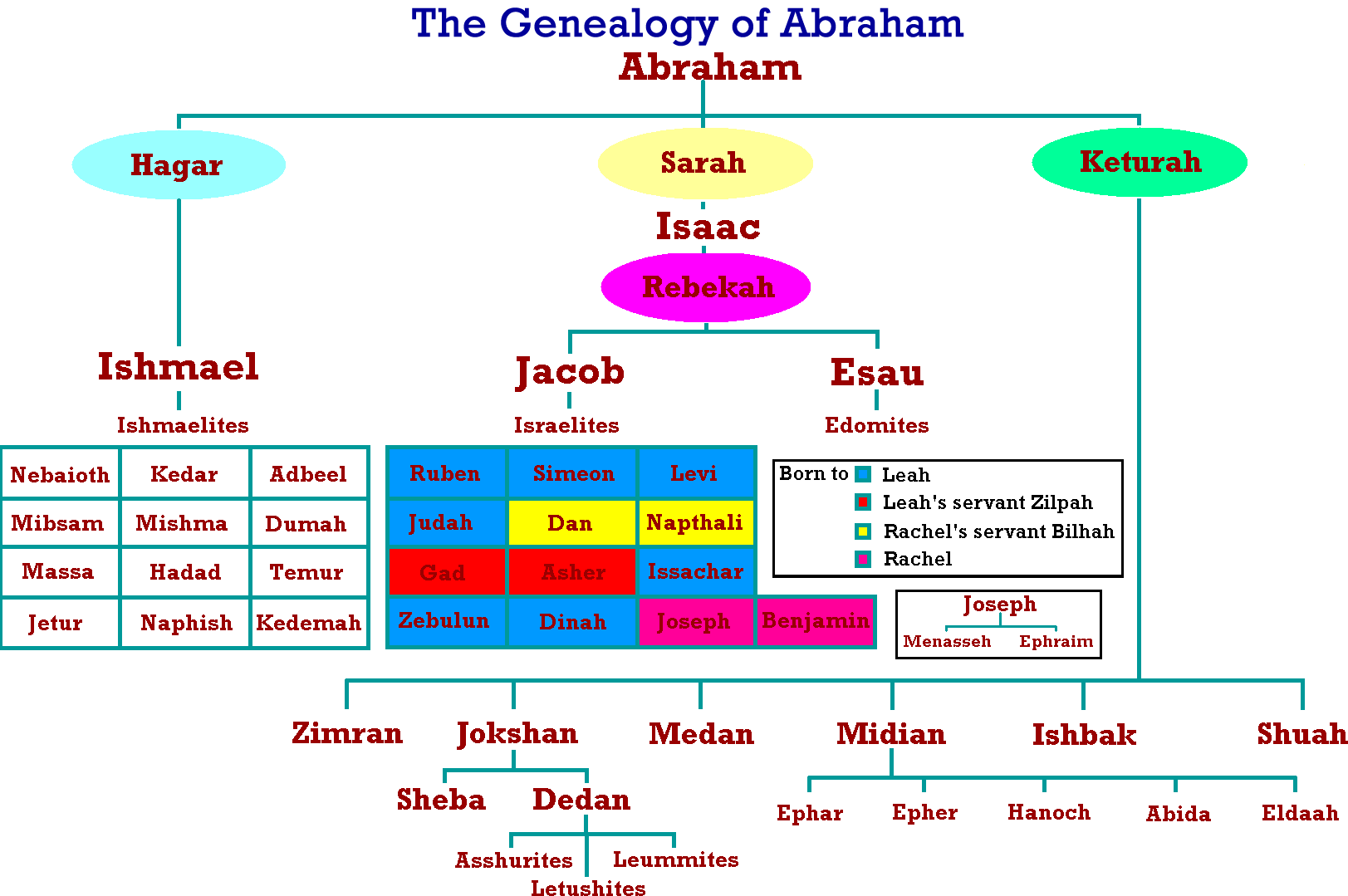
He had Ishmael (Ishmaelites) to Hagar, his wife’s maid servant. [29] Ishmael became the Patriach of the Islamic religion.
Then at the age of 100 Abraham had Issac to his wife Sarai. [30]
It was to be thru Issac that God would fulfill his promise to Abraham and so Ishmael was sent away. [31]
Issac married Rebeka who bore Esau (the Edomites) and Jacob (the Israelites). Abraham had a third wife Keturah who bore many children who were sent to the middle east and became fathers of nations there too. [32]
Jacob eventually bore 12 sons and a daughter. The eleventh son was Joseph. Joseph was the first son of Rachael (Jacob’s second wife). [33] Jacob had an encounter with God one night and was renamed Israel. [34] His descendants (the Jews) became the Nation of Israel (from which comes Judaism) out of which came Christ (Christianity) with whom God would fulfill his promise to Abraham. [35]
Genealogy of Noah (according to the Bible)
Genealogy of Noah (according to the Bible)

Genealogy of Abraham (according to the Bible)

Genealogy of Abraham (according to the Bible)


  • Biblical History

In the Biblical account, (Genesis 37-50) Joseph was the first born Son of Rachael (Jacob’s second wife). Jacob (Israel) favored Joseph over his other children. Joseph had a dream that one day he would rule over his brothers. His brothers became jealous of him and so sold him to slave traders who took him to Egypt. [36] He was subsequently sold to Potiphar in Egypt as a slave and was subsequently wrongfuly imprisoned.
It was in prison where he came to the attention of Pharaoh through his cupbearer who informed Pharaoh of Joseph’s ability to interpret dreams by the power of God. Pharaoh needed counsel about his own dreams and was not able to find anybody from his own kingdom to help.
Joseph was able to tell Pharaoh the meaning of his dreams which fortold of a coming famine lasting seven years but preceded by seven years of abundance. Pharaoh made Joseph second in charge over his all his kingdom. During the seven years of abundance, Joseph was able to build silos in every city and store enough grain to feed the Nation during the seven years of famine that followed. [37]

  • Joseph’s achievements in Egypt

When Joseph was 30 yrs old, Pharaoh put him in charge of the whole land of Egypt. Pharaoh gave Joseph his signet ring, dressed him in fine linen and put a gold chain around his neck. He was given a chariot to ride around Egypt as second in command. Joseph’s name was changed to Zapheneth Paneah and he was given a wife Asenath (Daughter of Potiphera, priest of On). [1]
During the seven years of abundance, Joseph stored up huge quantities of grain in each city from the fields surrounding them. [2]
He had two sons to Asenath, Mannaseh & Ephraim. [38]
Joseph saved Egypt and Caanan by selling the people grain during the 7 year famine. When the people had run out of money, Joseph brought their livestock. When they had run out of livestock he brought the land titles. [3]
Joseph brought up all the land in Egypt for Pharaoh. The priests did not have to sell their land as Pharaoh gave them a supply of food. [11]
Joseph’s family were saved. [39] Jacob (Israel) and his eleven other sons along with their wives and servants were invited by Pharaoh to come and live in Egypt. [40] They settled in Rameses and became numerous in number. [41]
Jacob died and was afforded an Egyptian burial [42] after blessing his children and those of Joseph. [43] [44] Joseph reassures his brothers after Jacobs death. [45] Eventually Joseph dies at the age of 110 and is given an Egyptian style burial aswell. [46]
After 430 years passed, the Israelites numbered over 2 million. They were eventually lead out of Egypt by Moses through the Red Sea (the exodus). [47]

Is Joseph likely to have figured in Egyptian records?

If Joseph was placed second in charge of Egypt by Pharaoh, there should be some note of this in Egyptian records. [1]
Joseph helped to save Egypt and the surrounding nations from a famine lasting seven years. [2]
Joseph would have had to construct massive grain silos for storing grain in many Egyptian cities and indeed, massive silos can be found in many historical significant Egyptian cities today (eg Saqqara).
Joseph married the daugher of one of the High Priests in Egypt. [1] He saved his country from a seven year famine and brought up all the land of Egypt except for that of the priests who did not need to sell their land because Pharaoh supplied them with food. The people became loyal subjects of Pharaoh because of what Joseph had done. [3]
Joseph was, therefore, responsible for making the Pharaoh’s wealthy and powerful. [11]
Joseph served the Pharaohs from the age of thirty. [1] He died at the age of 110 years of age and was given a Royal Egyptian burial. [46] It is quite possible that he may have been involved with the design of the first and maybe the second pyramid.
His family, the descendants of Jacob (Israel), produced mud bricks and became numerous in number in the 430 years that they lived in Egypt. There were over 600 thousand adult males (not counting women and children) who were lead out of Egypt by Moses during a time of great disaster in Egypt. [47]
With a list of accomplishments like this, it would be hard to conceive that Joseph would not be mentioned in Egyptian heiroglyphics or memorialized some other way.

Where does Joseph fit into Egyptian History?

Estimates of dates have long been the common denominator used by archaeologists and historians alike when trying to piece together ancient history.
Various teams of archaeologist have used a number of different dating methods to estimate how old a particular artifact is. For example, the type of pottery that is predominant in a layer can be used to date the layer.
Assumptions behind various dating techniques are not alway right. This can sometimes lead to artifacts being incorrectly dated by as much as 1000 to 2000 years.
If history is pieced together based only upon the estimated dates of particular dynasties, the results can be quite erroneous and it will be little wonder why Egyptian and Hebrew history does not fit together and why no Egyptian equivalent of Joseph has been found using the dates traditionally ascribed to various Egyptian dynasties.
An increasing number of historians are now calling into question the dates of Egyptian dynasties. In particular, Sweeney [15] [21] [19] [48] , Velikovski [49] [50] [51] , Fry [52] [12] [53] [16] [54] [55] [56] [57] [58] [59] [20] , Reilly [13] [17] [60] [22] Ashton & Down [18] .
Using their revised dating system, the historical records of Israel and Egypt fit together much better and it is possible to identify likely correlates and contemporaries of important Biblical Characters.
Conventional wisdom which has been very reliant on dating methods has been unable to find any evidence that the Patriarchs of Israel lived in Egypt and have not found any possible candidates for Joseph because they are looking for evidence of him in the Hyksos dynasty which is estimated to have been around 1700BC according to conventional chronology. As a result, conventional wisdom states that Joseph and other Biblical figures were minor figures in Egypt that were not note worthy enough to have been memorialized in the heiroglyphic records and other monuments that have been uncovered.
Modern thinking using the revised chronology results in much clearer picture with the history Israel and Egypt lining up and matching archaeological records. Abraham is considered to be a contemporary of Menes. Imhotep is considered to be the Joseph of the Bible and Djoser is considered to be the Pharaoh that he served [13] [17] [21] [15] [52] [54] .
This would fit with the theory that Amenemhet III was the Pharaoh of Moses who oppressed the Israelites making them make mud bricks [18] . Also of note is that the pyramid of Amenemhet III was made of mud bricks containing straw. [18] Amenemhet III was the 6th Pharaoh of the 12th dynasty and lived 450 to 500 years after Pharaoh Djoser in the 3rd dynasty. [18] He had only daughters who had a son (Amenemhet IV) who disappeared before he could become King. It has been suggested that Amenemhet IV was Moses. [18]
The Exodus took place during the Reign of Neferhotep I during the 13th dynasty in 1445BC. He was the only Pharaoh of that dynasty [18]
The Hyksos (15th & 16th dynasties) which were contemporary with Joshua and the Judges, came to an end when King Saul destroyed the Amalekites (Hyksos) [18] [61]
Dynasty 17 was contemporary with dynasty 16. [18]
Amenhotep I and Thutmosis I of the 18th dynasty were contemporaries of David. [18] Hatshepsut was the Queen of Sheba who visited Solomon. [62] [63] Thutmosis III came to power during the reign of Jereboam and became the greatest Pharaoh of Egypt. [18]
‘Modern’ Chronology (Ashton & Down 2006) [18]
DateDynastyEgyptContemporary_in_Israel
2080BC1stMenesAbraham
1900BC3rdDjoser_+_ImhotepJoseph
1531BC12thAmenemhet_III (6th_Pharaoh)Moses
1445BC13thNeferhotep IThe Exodus (Moses)
1405 -1021BC15th_&_16thHyksosJoshua to Saul
1018BC18thAmenhotep I & Thutmosis IKing David
950BC18thHatshepsut [Queen of Sheba]Solomon
929BC18thThutmosis IIIJereboam

Why is it so hard to piece together Egyptian records?

The Egyptians suffered great losses at the time of the Exodus and may not have wanted to remember what Joseph and his family had achieved during their 400 year stay in Egypt. This may be one reason why it is very difficult to find historical information about the exploits of the Israelites in Egypt.
This may also been the reason that the second pyramid designed by Imhotep was not completed.
Another reason why it is difficult to find historical information is because much of it was lost or destroyed by various seiges, conquests, natural distasters and even erosion over the centuries.
Egyptian records are written as qlyphs (pictures) in stone. They have a number of limitations – you need to know ‘the code’ ie what they mean. Pronunciation is not indicated as with Greek and English and there is no time stamp. The art of interpreting them (heiroglyphics)has been somewhat lost.

Similarities between Joseph and Imhotep

Imhotep – Egyptian records
Joseph – Bible
  • Imhotep is appointed Administrator by Pharaoh Djoser during the periods of seven years famine and seven years of bountiful harvests [8]
  • Joseph is appointed Administrator to Pharaoh for the seven years of plenty then of famine
  • Minister to the King of Lower Egypt [8]
  • Pharaoh .. made him ruler over all the land of Egypt
  • Administrator of the Great Palace [8]
  • Thou shalt be over my house
  • Not of royal blood; attained position by ability [8]
  • From another nation and religion, not of royal blood, attained position by ability
  • Not appointed by Pharaoh Djoser until he had reigned for some time [8]
  • Appointed well after Pharaoh ruled Egypt
  • Given the status of “son” to Pharaoh [8]
  • Granted the status of “son” to Pharaoh
  • High Priest in Heliopolis [8]
  • Married to Asenath, daughter of Poti-Pherah, High Priest in Heliopolis – by custom, would succeed father-in-law
  • Builder and architect [8]
  • Builder of grain storehouses such as at Sakkara step-pyramid
  • Exalted by Pharaoh Djoser as of godly character [8]
  • And Pharaoh said, ‘a man in whom the spirit of God is!’
  • “I need advice from God” [8]
  • Noted as saying, “It is not in me; God shall give Pharaoh an answer”
  • Had great medical skill – was compared to the Greek God of Healing [8]
  • Had doctors under his authority – worked by miracles, dreams and signs from God
  • Decided the tax rate during the seven years of famine; also not to apply to priests [8]
  • Decided the tax rate during the seven years of famine; also not to apply to priests
  • Realizes when he is dying – dies at age 110 [8]
  • Realizes when he is dying – dies at age 110

Who was Imhotep?

Imhotep was a most interesting figure in the Egyptian culture, his name means “the one who comes in peace”. He served Djoser, the third dynasty king, he was the vizier to the pharaoh and they say that he was the high priest to the sun god Ra. [64]
Imhotep is attributed with being the first person in history to be an acting physician, he was also the first architect, he was a poet and also a philosopher. After his death he was given the status of a deity, he was only one of a very few commoners to ever be given that kind of an honor.
[64]
He is thought to be the architect of the first Pyramid; the step pyramid at Saqqara. [64]
He is also credited with the use of columns in architecture. [64]
He is known as the founder of Egyptian medicine, and he is famous for not incorporating magic into his medical treatments, he diagnosed and treated over two hundred diseases, he extracted medicine from plants and he is also known to have performed operations and dentist work. He knew the circulation of the blood system and he knew where each vital organ was placed and what its uses were. [64]
He became the god of medicine and healing, when the Greeks invaded Egypt they worshiped him and built him temples because they saw in him their own god of healing named Asclepius. [64]
Imhotep was also the first person known to use the papyrus scroll. He may have actually invented it! [64]
Among other things Imhotep is also attributed to the prediction and prevention of a seven year famine that came upon the land, he predicted the famine from a dream the pharaoh Djoser had, in this dream the god of the Nile spoke to the pharaoh, and Imhotep was the only one that could interpret the dream. [64]

Could Joseph and Imhotep have been the same person?

The Roman-Jewish historian, Josephus, quotes the writings of Manetho, Egyptian historian: “During [the] reign of .. Pharaoh Djoser, 3rd Egyptian dynasty, lived Imhotep .. [with a] reputation among Egyptians like the Greek God of medicine – [Manetho even wondered] whether Imhotep could have been an actual person .. [because he had] “so many outstanding qualities and talents .. a very special person [who] appears in the history of Egypt.” On the foundations of the Step Pyramid in Sakkara was carved the name of Pharaoh Djoser and “.. Imhotep, Chancellor of the King of Lower Egypt, Chief under the King, Administrator of the Great Palace, Hereditary Lord, High Priest of Heliopolis, Imhotep the Builder..”. [8] [65]
Joseph arrived in Egypt as a young man and married Asenath, the daughter of Potipherah, the priest of On. [1]
This information precludes the theory that Joseph lived during Hyksos rule in Egypt. On or An was the ancient capital of Heliopolis (As-t Tem). Some claim that Egyptians also believed in One Great God who was never represented in their art work. Only his attributes, functions as Creator, Teacher and Healer were known as the neter or neteru. The symbolism surrounding Egyptian deities then is different from this One Great God, in whose image man was made, in that it scales our world and the universe to our dimensions so man can grasp it. The Egyptian name for this `One Great God’ is neter, probably an echo or more distant memory of the biblical Creator God of Abraham, Issac and Jacob. [66]
Both Imhotep and Joseph imposed a 20% (one fifth) tax on the people with the exemption of the priests. [54]
Moeller refers to an inscription on the island of Sihiel, near the first cataract of the Nile, which actually links Imhotep to the key biblical element of the Joseph story – telling of Pharaoh Djoser in the 18th year of his reign. The inscription states “seven meagre years and seven rich years”. Commenting on the inscription, Moeller writes, “Pharaoh Djoser asks Imhotep to help him with the coming seven years of famine. All the biblical components of the story are there, and there is a similar inscription on the island of Philae in the Nile.” (This is exactly as in the Bible with Joseph, except for listing the “meagre” years before the years of plenty. Note: The famine years were, of course, the event of significance, saving everyone from starvation and bringing in much wealth to Egypt – it is noted that the manuscript was written a thousand years after the occurrences.) [67] [8]
Pharaoh renamed Joseph ‘Zapeneth Peneah’ [1] which means “master of the school of learning” [66] or “Man to whom secrets are revealed” [54] .
It is also interesting to note that circumcision was widely practiced among Egyptians from the third dynasty onward. Although Abraham did visit Egypt, it seems more likely that this practice was introduced by Joseph-Imhotep in the third dynasty. [54]
Egyptian records show that before Imhotep, the bodies of Egyptian royalty were not embalmed. Instead, they were entombed in early Egyptian structures called mastabas, (or mastabahs), oblong structures with flat roofs and sloping sides built over the opening of a mummy chamber or burial pit . [54]
Djoser appears to be the first king to have be embalmed, [54] Jacob (Israel) was embalmed by Joseph and buried in a coffin and Joesph himself was embalmed and given a royal Egyptian burial. [46] [42] The Biblical account suggests that only Joseph’s bones were preserved as was the practice in the early dynasties of the Old Kingdom. Preservation of the whole body was not practiced until the Era of King Tut (New Kingdom). [54]
Extremely noteworthy regarding Imhotep-Joseph is that the mummified bodies of neither have ever been found. The known facts regarding the burials of Imhotep and Joseph also strongly support the thesis that they were the same person: [8]
Both died at age 110. [8] [46]
Imhotep’s coffin in Sakkara – with innumeral Ibis birds mummified in the adjoining galleries (Imhotep was called “Ibis” because of his reputation for healing – a large number of Ibis birds were sacrificed to him at his funeral in Sakkara); many clay vessels bearing the seal of Pharaoh Djoser were near the coffin; and the coffin is oriented to the North, not East, and is empty. [8]
Joseph would have been buried at Sakkara, his coffin orientated to the North – indicating he did not believe in the gods of the Egyptians (who were buried facing East, the rising sun); the coffin would also be empty as Joseph’s bones would have been taken by Moses with the Hebrews during the Exodus. [8] [46]

Could Pharaoh Djoser (King Netjerikhet) be the Pharaoh of Joseph?

The ‘correct alignment’ of Israel’s and Egypt’s history will allow contemporary fragments of information to be linked together to build up a clear picture of ancient history. Combining the records of Egypt, Israel and Mesopotamia will help to fill in the gaps in each nations’ record.
Evidence is now accumulating to suggest that Egyptian dynasties may overlap and may not date back as far as was once thought. [15] [16] [17] [18] [66]
Dynasty 2 is considered contemporary with dynasty 3. [18] There was no first intermediate period. The dark ages of the first intermediate period have been confused with the dark ages of the second intermediate period. [18]
Dynasties 7-10 have been identified with 15-16 and Dynasty 17 was contemporary with dynasty 16. [18]
Egyptian history, therefore, does not date back as far as was once thought (3000BC – 5000BC) as per the Conventional Chronology. [18] [50] [51] [49] [21] [13] [17] [52] [12] [53] [16] [54] [66]
The first Egyptian dynasty is now considered to have started around 2100BC and the Great Flood is considered to have been around 2300-2400BC. [18]
The Exodus occured just after the end of the 12th dynasty in 1445BC. [66] [18]
Any Egyptian dates before the 12th dynasty are considered quite speculative and are only approximations [18]
This ‘Modern Alignment’ of the Dynasties fits the Biblical account and also the records of Mesopotamia.
The ‘Modern Alignment’ of the Dynasties provides the answers to the major objection to Joseph and Imhotep being the same person (namely the mismatching dates) and by the same token makes it highly likely that Pharaoh Djoser was the Pharaoh of Joseph.
While Sweeney points out that Abraham was a contemporary of Menes who were patriarchs of their respective civilizations some time after a catestrophic destruction [21] , he has probably over corrected the dates which are far too short even for Biblical events.
If it is agreed that Joseph was Imhotep and he served Pharaoh Djoser (Zozer) of the Third dynasty, it does not follow that the identity of Moses and the Pharaoh’s he was contemporary with will be agreed as there is not universal agreement about which dynasties to identify and which dynasties ran in parallel. [58] [66] [19] [18] [17]
‘Conventional’ Chronology [21]
DateEgyptIsrael
3000BCMenes (First dynasty displays strong mesopotamian influence)Djoser and Imhotep (Famine crisis solved when Imhotep interprets Djoser’s dream)
2000BCFirst Intermediate period(Age of disturbance in nature and general lawlessness)Abraham (migrates from mesopotamia and introduces some of the basic civiliation to Egypt)Joseph (Famine crisis in Egypt solved when Joseph interprets Pharaoh’s dream)
1000BCMoses leads the Israelites to freedom amidst violent upheavals of nature
‘Revised’ Chronology (Sweeney 1997) [21]
DateEgyptIsraelMesopotamia
1300+BCEarly_Badarian‘Ubaid
1300BCCatestrophic_DestructionCatestrophic_DestructionCatestrophic_Destruction
1200BCLate_Bedarian_and_GerzeanKhirbet_KerakJamdat_Nasr(Early_Literacy)
1100-
1000BC
Destruction episodeDestruction episodeDestruction episode
1000BCMenes (Early Dynastic Age)Abraham(Early Dynastic Age)
900BCDjoser and ImhotepJoseph
800BCDestruction episodeDestruction episodeDestruction episode
800BCPyramid AgeAge of the JudgesAkkadian Age
700BCHyksos epochSaulSargon I
‘Modern’ Chronology (Ashton & Down 2006) [18]
Date Dynasty Egyptian_PharaohContemporary_in_Israel
2080BC1stMenesAbraham
1900BC3rdDjoser_+_ImhotepJoseph
1531BC12thAmenemhet_III (6th_Pharaoh)Moses
1445BC13thNeferhotep IThe Exodus (Moses)
1405 -1021BC15th_&_16thHyksosJoshua to Saul
1018BC18thAmenhotep I & Thutmosis IKing David
950BC18thHatshepsut [Queen of Sheba]Solomon
929BC18thThutmosis IIIJereboam

What implications does this have for Egyptian History?

If the ‘modern alignment’ of the Egyptian Dynasties is correct, Joseph can be identified with Imhotep and Egyptian history will be consistent with the Bible.
Pharaoh recognised Joseph’s divine inspiration and appointed him to be in charge of Egypt. Joseph built silos to store grain and so saved Egypt from a seven year famine. He acquired all the land of Egypt (other than the priest’s) for Pharaoh by selling grain. The Pharaohs became wealthy and powerful and the people of Egypt became his subjects. Joseph’s family was invited to live in Egypt (Rameses). [3] [11]
Joseph, therefore, saved his family and protected the Israelites as they grew to become a nation in Egypt. [45]
Djoser was the second Pharaoh of the 3rd dynasty of Egypt and came about three or four generations after Menes who was the Pharaoh of the 1st dynasty of Egypt and a contemporary of Abraham. [18] [21] [15]
Joseph came three generations after Abraham and was contemporary with Djoser (1900BC) . After his death he was deified because of his achievements. As King Netjeriket of the third Egyptian dynasty was also known by the name ‘Pharaoh Djoser’, it is possible that this name means ‘Pharaoh of Joseph’.
The Israelites stayed in Egypt 430 years. This takes us to the end of the 12th and beginning of the 13th dynasty which is when the Exodus occurred. (1445BC) [18]
It is unlikely that Joseph was some inconspicuous person in the 18th dynasty of Hyksos as is commonly held by people who adhere to the ‘conventional alignment’ of Egyptian dynasties.
What’s more, if the ‘modern alignment’ is correct, the Hebrew influence of Egyptian culture will be re-established. The first pyramid would have been designed by a Hebrew. The Hebrew God can be credited for saving Egypt from a seven year famine and giving the Pharaoh’s their power, wealth and the means to build the other pyramids. The designer of the first pyramid will, once again, be seen to be a servant of the God of Abraham, Issac and Jacob, even though the pyramids later became objects of pagan worship and Imhotep was deified long after his death by the Greeks.
When the Israelites left Egypt, Joseph’s association with the God of Abraham, Isaac and Jacob was forgotten and the pyramids became symbols of pagan gods.
With the aid of hind sight it can be seen how the designer of the first pyramid, the savior of the Egyptian people and the man responsible for the Pharaoh’s power, known as Imhotep, would be deified some 1400 years after his death once his connection with the God of Abraham, Issac and Jacob had been lost and forgotten.
The first pyramids, which were made of cut limestone, were built by the Egyptian people who had sold their land to Pharaoh and become his subjects.
After Joseph’s death, the Israelites were given the task of making mud bricks. [68] [69] Interestingly, the core of the Pyramid of Amenemhet III is made of mud bricks containing straw. [18] Amenemhet III was the 6th Pharaoh of the 12th Egyptian dynasty which preceeded the Exodus in 1445BC. [18]
Moses was forced to flee Egypt and go to Midian after killing an Israelite official. During that period, the Pharaoh died. [70] When he returned to Egypt, there was a new Pharaoh in power (possibly Neferhotep I of the 13th Dynasty). [18]
The Hyksos dynasties (14th & 15th dynasties) started after the Exodus, spanned the period of the Judges and was finally ended by Saul when he defeated the Amelekites. [18] [61]

What implications does this have for Israel and Christianity?

If Joseph was Imhotep, then Bible History is consistent with Egyptian history.
This will mean that there is archaeological evidence that the Patriarchs of Israel lived in Egypt.
Archaeological evidence for Israel in Arabia ⁄ Midian (Jabel el Lawz) in combination with the above would corroborate the Biblical account of the Exodus.
Joseph saved his family and protected the Israelites and allowed them to multiply in numbers so that they could fulfill what God had planned; namely to return to the land of Canaan and to take possession of it after spending 430 years in Egypt and 40 years in the Wilderness. [28]

What implications does this have for Literature, Medicine and Architecture?

If Joseph was Imhotep, this would make Joseph the father of medicine, the first architect to build with stone and use columns and the inventor of the papyrice and the first to use it (to write medical and non-medical literary works). [71] [72] [73] [74] [6] [75]
He probably served more than one pharaoh and appears to have designed at least two pyramids and several buildings that utilize columns. He was given the name Pathotep by a later pharaoh that he served. [54]
Imhotep may have invented the embalming techniques used to preserve the bodies of Egyptian Pharaohs. He became the first pathologist. He was known as the ‘Son of Ptah’ (or son of Path). [54] Hundreds of years after his death, he became deified and was known as the god Path. [54]
Not only was Pathotep’s name derived from that of the god Path, but our modern word, ‘Pathology’, was also derived from and bears his name. [54]

Summary: Joseph and Imhotep are the same person

There is such a strong match between the profile of Joseph and Imhotep that many historians, theologians and archaeologists have suggested that they are one in the same person.
There were only so many non royal, second in charge visiers who saved Egypt from a 7 year famine by interpreting Pharaohs dreams (with the power of God), imposed a 20% tax, brought up all the land of Egypt for Pharaoh (except for that of the priests), lived to the age of 110 and were embalmed when they died. – Imhotep & Joseph
Imhotep was also the High Priest of Heliopolis. Jospeh married the daughter of the high priest of On (the capital of Heliopolis) !
Until recently, the main case for not believing Joseph and Imhotep to be the same person, has been the considerable discrepancy between the estimated dates of their existance by as much as 1000 years!
Egyptian records are far from complete. They are not chronological and the exact way that fragments fit together is by no means certain.
In the Last 50 years, historians have realized that several Egyptian dynasties have been counted twice and some ran in parallel. The result is that Egyptian history can be substantially contracted, therefore eliminating the discrepancy in the estimated dates of Joseph and Imhotep.
This modern understanding of the Egyptian dynasties means that Joseph almost certainly was Imhotep and Egyptian History is consistent with the Bible.
If it can be generally accepted that Joseph and Imhotep were the same person, this would give historians an anchor in history in order to further correlate the history of Egypt, Israel and Mesopotamia.

Suggested Reading

1. J. Ashton & D. Down, Unwrapping the pharaohs. how Egyptian archaeology confirms the Biblical timeline, New Leaf Publishing Group (Master books), 2006. ISBN 978-0-89051-468-9 ISBN 0-89051-468-2 http://masterbooks.net
2. H. Bible, “Jacob bore 12 sons,” Genesis chapter 29-32,
3. H. Bible—”Keturah’s children sent away to Middle East,” Genesis 25:1-4,
4. H. Bible—”Abrahams children to be reckoned through Isaac,” Genesis 21:12,
5. H. Bible—”Ishmael sent away – Isaac the child of promise,” Genesis 21:8-13,
6. H. Bible—”Isaac born to Sarai,” Genesis Chapter 21,
7. H. Bible—”Ishmael born to Hagar,” Genesis Chapter 16,
8. H. Bible—”God’s covenant with Abraham,” Genesis Chapters 15 & 17,
9. H. Bible—”Call of Abraham,” Genesis Chapter 12,
10. H. Bible—”Terah sets out from Ur,” Genesis 11:27-32,
11. H. Bible—”The dispersion after Babel,” Genesis Chapter 11,
12. H. Bible—”The Flood,” Genesis Chapter 6,
13. H. Bible—”The Biblical account of Jospeh,” Genesis chapter 37-50,
14. H. Bible—”Jacob renamed Israel,” Genesis 32:22-32,
15. H. Bible—”Jacob favours Joseph,” Genesis chapter 37,
16. H. Bible—”Joseph sold into slavery and taken to Egypt,” Genesis 37:12-36,
17. H. Bible—”Joseph falsely accused and imprisoned in Egypt,” Genesis 39:1-23,
18. H. Bible—”Joseph able to interpret dreams,” Genesis 40:1-23,
19. H. Bible—”Joseph recognised by Pharaoh,” Genesis 41:1-40,
20. H. Bible—”The Exodus,” Exodus 12:31-42,
21. H. Bible—”Joseph reassures his brothers afer Jacob’s death,” Genesis 50:15-21,
22. H. Bible—”Jacob dies,” Genesis 49:29 -50:14,
23. H. Bible—”Jacob blesses his sons,” Genesis chapter 49,
24. H. Bible—”Jacob blesses Joseph’s children,” Genesis chapter 48,
25. H. Bible—”Pharaoh gives Jacob the land of Goshen,” Genesis Chapter 45,
26. H. Bible—”Joseph’s brothers go to Egypt to buy grain,” Genesis Chapters 42-44,
27. H. Bible—”Death of Joseph,” Genesis 50:22-26,
28. H. Bible—”Jacob moves to Egypt and settles in Rameses,” Genesis Chapter 46:1-47:12,
29. H. Bible—”Joseph buys up all the land of Egypt for Pharaoh,” Genesis 47:18-22,
30. H. Bible—”Joseph saves Egypt by selling grain,” Genesis 47:13-17,
31. H. Bible—”Joseph has two sons; Ephraim and Mannaseh,” Genesis 41:50-52,
32. H. Bible—”Joseph stores up huge quantities of grain in Egyptian cities,” Genesis 41:47-49,
33. H. Bible—”Pharaoh puts joseph in charge of all Egypt,” Genesis chapter 41:41-46,
34. H. Bible—”The Queen of Sheba visits Solomon,” 1Chron 9:1-12,
35. H. Bible—”The Queen of Sheba visits Solomon,” 1Kings 10:1-13,
36. H. Bible—”Saul destroys the Amalekites,” 1Samuel 15:2-9,
37. H. Bible__”Moses flees to Midian and Pharaoh eventually dies” Exodus 2:11-25,
38. H. Bible, “The Israelites oppressed,” Exodus 1:1-22,
39. H. Bible—”Pharaoh makes Israelites find own straw to make mud bricks,” Exodus 5:1-21,
40. “The Wall Chart of World History – From earliest times to the present” 1998 Bracken Books ISBN 1-86256-306-3

References:

1. H. Bible, “Pharaoh puts Joseph in charge of all Egypt,” Genesis chapter 41:41-46,
2. H. Bible—”Joseph stores up huge quantities of grain in Egyptian cities,” Genesis 41:47-49,
3. H. Bible—”Joseph saves Egypt by selling grain,” Genesis 47:13-17,
4. NationMaster.com, “Statemaster – Encyclopedia: Imhotep,” , statemaster.com, 2009.
6. M. Millmore, “The Step Pyramid at Saqqara,” , http://www.eyelid.co.uk, 2008.
9. E. Sweeney, “Were Joseph and Imhotep of Egypt The same man?,” THE GENESIS OF ISRAEL AND EGYPT, B. E. Sweeny (Editor), 2001.
10. B. Rhodes, “Joseph and Imhotep,” , http://the-red-thread.net/, 2009.
11. H. Bible, “Joseph buys up all the land of Egypt for Pharaoh,” Genesis 47:18-22,
12. D. Fry, “Hebrew sages of ancient Egypt – time calibrators,” Hebrew Sages of Ancient Egypt II, 2004.
13. J. Reilly, “Displaced dynasties,” Dysplaced Dynasties, 2009.
14. G. Byers, “Israel in Egypt,” , http://www.biblearchaeology.org, 2008.
17. J. Reilly, “The exodus and beyond chapter 3: Joseph & Moses,” The Exodus and Beyond, 2009.
19. E. Sweeney, The pyramid age, ages in alignment series, Algora Publishing, 2007.
21. E. Sweeney, The Genesis of Israel and Egypt, Janus Publishing Company Limited, 1997. ISBN 978-1857563504
23. R. Wyatt, “Joseph was Imhotep of Egypt,” , Wyatt Archaelogical Research, 1994.
24. H. Bible, “The Flood,” Genesis Chapter 6,
25. H. Bible—”The dispersion after Babel,” Genesis Chapter 11,
26. H. Bible—”Terah sets out from Ur,” Genesis 11:27-32,
27. H. Bible—”Call of Abraham,” Genesis Chapter 12,
28. H. Bible—”God’s covenant with Abraham,” Genesis Chapters 15 & 17,
29. H. Bible—”Ishmael born to Hagar,” Genesis Chapter 16,
30. H. Bible—”Isaac born to Sarai,” Genesis Chapter 21,
31. H. Bible—”Ishmael sent away – Isaac the child of promise,” Genesis 21:8-13,
32. H. Bible—”Keturah’s children sent away to Middle East,” Genesis 25:1-4,
33. H. Bible—”Jacob bore 12 sons,” Genesis chapter 29-32,
34. H. Bible—”Jacob renamed Israel,” Genesis 32:22-32,
35. H. Bible—”Abrahams children to be reckoned through Isaac,” Genesis 21:12,
36. H. Bible—”Jacob favours Joseph,” Genesis chapter 37,
37. H. Bible—”The Biblical account of Jospeh,” Genesis chapter 37-50,
38. H. Bible—”Joseph has two sons; Ephraim and Mannaseh,” Genesis 41:50-52,
39. H. Bible—”Joseph’s brothers go to Egypt to buy grain,” Genesis Chapters 42-44,
40. H. Bible—”Jacob moves to Egypt and settles in Rameses,” Genesis Chapter 46:1-47:12,
41. H. Bible—”Pharaoh gives Jacob the land of Goshen,” Genesis Chapter 45,
42. H. Bible—”Jacob dies,” Genesis 49:29 -50:14,
43. H. Bible—”Jacob blesses Joseph’s children,” Genesis chapter 48,
44. H. Bible—”Jacob blesses his sons,” Genesis chapter 49,
45. H. Bible—”Joseph reassures his brothers afer Jacob’s death,” Genesis 50:15-21,
46. H. Bible—”Death of Joseph,” Genesis 50:22-26,
47. H. Bible—”The Exodus,” Exodus 12:31-42, .
48. Empire of Thebes or Ages In chaos revisited (ages in alignment), Algora Publishing, 2006.
49. I. Velikovski, Worlds in collision, London and New York, 1950.
50. I. Velikovski—Ages in chaos, London and New York, 1953.
51. I. Velikovski—Earth in upheaval, 1956.
52. D. Fry, “Hebrew sages of ancient Egypt II,” 2009.
53. D. Fry—”Hebrew sages of ancient Egypt II The birth of Egypt,” Hebrew Sages of Ancient Egypt II, 2004.
57. D. Fry—”Hebrew sages of ancient Egypt – Egypts weather changes,” Hebrew Sages of Ancient Egypt, 2009.
60. J. Reilly—”The Exodus and beyond chapter 2: The Patriarchal Age,” The Exodus and Beyond, 2009.
61. H. Bible, “Saul destroys the Amalekites,” 1Samuel 15:2-9,
62. H. Bible, “The queen of Sheba visits Solomon,” 1Kings 10:1-13,
63. H. Bible—”The queen of Sheba visits Solomon,” 1Chron 9:1-12,
65. W. Whiston, The works of Josephus complete and unabridged, New Updated Edition, Hendrikson Publishers, 1987. ISBN 0-913573-86-8 ISBN 1-56563-167-6
67. L. Moeller, The case for the Exodus, .
68. H. Bible, “The Israelites oppressed,” Exodus 1:1-22,
70. H. Bible, “Moses flees to Midian and Pharaoh eventually dies,” Exodus 2:11-25,
72. Britannica, “Imhotep,” , http://www.britannica.com, 2009.
73. R. Strachan, “Imhotep,” , http://www.mnsu.edu/emuseum/, 2005.
74. K. Matthews, “Imhotep,” , http://www.greatbuildings.com, 2008.
75. Wikipedia, “Imhotep,” , http://en.wikipedia.org, 2009.

Wednesday, September 25, 2013

"... through this original sacrifice of Abraham a perspective opens up down the millennia"


The Eucharist: Heart of the Church


The Wellspring of Life from the Side of the Lord, Opened in Loving Sacrifice


by Cardinal Joseph Ratzinger/Pope Benedict XVI

....
In all ages, and among all peoples, the ultimate aim of men in their festivals has been to open the door of death. For as long as it does not touch on this question, a festival remains superficial, mere entertainment to anesthetize oneself. Death is the ultimate question, and wherever it is bracketed out there can be no real answer. Only when this question is answered can men truly celebrate and be free. The Christian feast, the Eucharist, plumbs the very depths of death. It is not just a matter of pious discourse and entertainment, of some kind of religious beautification, spreading a pious gloss on the world; it plumbs the very depths of existence, which it calls death, and strikes out an upward path to life, the life that overcomes death. And in this way the meaning of what we are trying to reflect on, in this meditation, becomes clear, what the tradition sums up in this sentence: The Eucharist is a sacrifice, the presentation of Jesus Christ’s sacrifice on the Cross.
 
Whenever we hear these words, inhibitions arise within us, and in all ages it has always been so. The question arises: When we talk about sacrifice, do we not do so on the basis of an unworthy picture of God, or at least a naive one? Does this not assume that we men should and could give something to God? Does this not show that we think of ourselves as equal partners with God, so to speak, who could barter one thing for another with Him: we give Him something so that He will give us something? Is this not to misapprehend the greatness of God, who has no need of our gifts, because He Himself is the giver of all gifts?
 
But, on the other hand, the question certainly does remain: Are we not all of us in debt to God, indeed, not merely debtors to Him but offenders against Him, since we are no longer simply in the position of owing Him our life and our existence but have now become guilty of offenses against Him? We cannot give Him anything, and in spite of that we cannot even simply assume that He will regard our guilt as being of no weight, that He will not take it seriously, that He will look on man as just a game, a toy.
 
It is to this very question that the Eucharist offers us an answer.
 
First of all, it says this to us: God Himself gives to us, that we may give in turn. The initiative in the sacrifice of Jesus Christ comes from God. In the first place it is He Himself who comes down to us: “God so loved the world that He gave His only-begotten Son” (Jn 3:16). Christ is not in the first instance a gift we men bring to an angry God; rather, the fact that He is there at all, living, suffering, loving, is the work of God’s love. He is the condescension of merciful love, who bows down to us; for us the Lord becomes a slave, as we saw in the previous meditation.
 
It is in this sense that, in the Second Letter to the Corinthians, we find the words in which grace calls out to us: “Be reconciled to God” (II Cor 5:20). Although we started the quarrel, although it is not God who owes us anything, but we Him, He comes to meet us, and in Christ He begs, as it were, for reconciliation. He brings to be in reality what the Lord is talking about in the story of the gifts in the Temple, where He says: “If you are offering your gift at the altar, and there remember that your brother has something against you, leave your gift there before the altar and go; first be reconciled to your brother, and then come and offer your gift” (Mt 5:23f). God, in Christ, has trodden this path before us; He has set out to meet us, His unreconciled children — He has left the temple of His glory and has gone out to reconcile us.
 
Yet we can already see the same thing if we look back to the beginning of the history of faith. Abraham, in the end, does not sacrifice anything he has prepared himself but offers the ram (the lamb) that has been offered to him by God. Thus, through this original sacrifice of Abraham a perspective opens up down the millennia; this lamb in the brambles that God gives him, so that he may offer it, is the first herald of that Lamb, Jesus Christ, who carries the crown of thorns of our guilt, who has come into the thorn bush of world history in order to give us something that we may give.
 
Anyone who correctly comprehends the story of Abraham cannot come to the same conclusion as Tilman Moser in his strange and dreadful book Poisoned by God; Moser reads here the evidence for a God who is as dreadful as poison, making our whole life bitter.3
 
Even when Abraham was still on his way, and as yet knew nothing of the mystery of the ram, he was able to say to Isaac, with trust in his heart: Deus providebit — God will take care of us. Because he knew this God, therefore, even in the dark night of his incomprehension he knew that He is a loving God; therefore, even then, when he found he could understand nothing, he could put his trust in Him and could know that the very one who seemed to be oppressing him truly loved him even then.
 
Only in thus going onward, so that his heart was opened up, so that he entered the abyss of trust and, in the dark night of the uncomprehended God, dared keep company with him, did he thereby become capable of accepting the ram, of understanding the God who gives to us that we may give. This Abraham, in any case, has something to say to all of us.
 
If we are only looking on from outside, if we only let God’s action wash over us from without and only insofar as it is directed toward us, then we will soon come to see God as a tyrant who plays about with the world. But the more we keep Him company, the more we trust in Him in the dark night of the uncomprehended God, the more we will become aware that that very God who seems to be tormenting us is the one who truly loves us, the one we can trust without reserve. The deeper we go down into the dark night of the uncomprehended God and trust in Him, the more we will discover Him and will find the love and the freedom that will carry us through any and every night.
....

Taken from: http://www.adoremus.org/0913Ratzinger.html

Sunday, September 15, 2013

Noah and Herakles (Nimrod)


Re our post:

Herakles (Nimrod) Threatens Nereus (Noah)
 

John R. Salverda has commented:


Dear Damien,

Here is a remark on the Noah and Nimrod as Nereus and Herakles post, it was too long for a regular comment:

OK, there may have been some "Nimrod" in Herakles. There was certainly some Gilgamesh in him. "The story of Heracles was an early variant of the Babylonian Gilgamesh epic which reached Greece by way of Phoenicia. Gilgamesh has Enkidu for his beloved comrade, Heracles has Iolaus. Gilgamesh is undone by his love for the goddess Ishtar, Heracles by his love for Deianeira. Both are of divine parentage. Both harrow Hell. Both kill lions and overcome divine bulls; and when sailing to the Western Isle Heracles, like Gilgamesh, uses his garment for a sail. Heracles finds the magic herb of immortality as Gilgamesh does, and is similarly connected with the progress of the sun around the Zodiac." (the quote is from Robert Graves "The Greek Myths"). And I'm certainly not opposed to connecting Nereus with Noah. Many ancient "sea gods" can probably be traced back to Noah. Including the Philistine god Dagon, a form of Enki. Which leads me back to the old standby identification with Herakles, Samson. The Philistine fish god was the famous nemesis of Samson, and this enmity is, in my view, also a very likely origin for the icon of Heracles confronting the Merman. Furthermore, many of the enemies of Heracles are characterized as the "son of Poseidon" another famous god of the sea and likely candidate for identification with Dagon.
The story of the death of Samson, seems to occur in the Greek myth of Heracles, in more than one place. Samson, of course, was led a captive to the temple of Dagon where he pushed apart the pillars, killing all who were present. Heracles has the story of Busiris, a son of Poseidon, who tries to offer him up in a temple Herakles summons up his strength and kills the thousands who were there as attendees. Herodotus tells us - which he himself did not believe possible; “The Greeks tell many tales without due investigation, and among them the following silly fable respecting Hercules:- Hercules, they say, went once to Egypt, and there the inhabitants took him, and putting a chaplet on his head, led him out in solemn procession, intending to offer him as a sacrifice to Zeus. For a while he submitted quietly; but when they led him up to the altar and began the ceremonies, he put forth his strength and slew them all. ... Besides this, how is it in nature possible that Heracles, being one person only and moreover a man (as they assert), should slay many myriads?" (“Histories” Book II, p. 45). In this story the land of "Egypt" is plausibly a corruption for the land of "Jacob" and Heracles is Samson.
The story of pushing upon the pillars was also known to the Greeks as a story of Hercules; "But since we have mentioned the pillars of Heracles, we deem it to be appropriate to set forth the facts concerning them. When Heracles arrived at the farthest points of the continents of Libya and Europe which lie upon the ocean, he decided to set up these pillars to commemorate his campaign. And since he wished to leave upon the ocean a monument which would be had in everlasting remembrance, he built out both the promontories, they say, to a great distance; consequently, whereas before that time a great space had stood between them, he now narrowed the passage, in order that by making it shallow and narrow he might prevent the great sea-monsters from passing out of the ocean into the inner sea, and that at the same time the fame of their builder might be held in everlasting remembrance by reason of the magnitude of the structures. Some authorities, however, say just the opposite, namely, that the two continents were originally joined and that he cult a passage between them, and that by opening the passage he brought it about that the ocean was mingled with our sea. On this question, however, it will be possible for every man to think as he may please." (Diodorus Siculus, "Library of History" 4. 18. 4,5). Notice how Diodorus gives Herakles the motivation of protecting us from sea-monsters (again Dagon?) in his manipulation of the pillars.
For all the images of Heracles vs. Nereus, there is very little story about it. But, of what story there is, I must admit that it is very reminiscent of the story of Gilgamesh; "Herakles took hold of him as he lay sleeping, and bound him fast as Nereus changed himself into all sorts of shapes; he did not let him loose until Nereus told him where the apples and the Hesperides were." (Apollodorus, The Library 2. 114). Take note that Herakles like Gilgamesh confronts Nereus as Ut-Napishtim in order to find a way to Hesperidies as Eden.
Now, I do realize that there is a large school of thought that identifies Gilgamesh with Nimrod. However, I am unaware of any legends in which Nimrod confronted Noah.
 
-John R. Salverda

Thursday, September 12, 2013

Herakles (Nimrod) Threatens Nereus (Noah)


Taken from: http://www.theparthenoncode.com/features/37NoahsPartIII.htm

....

HERAKLES/NIMROD THREATENS NEREUS/NOAH, BRINGS HIS RULE TO A HALT, AND PUSHES HIM OUT OF THE WAY
PLUS: WHAT THE REBEL HERAKLES—NIMROD—GILGAMESH IS AFTER, AND WHAT HE FEARS


Now we’re going to take a look at how Greek vase-painters pitted Herakles/Nimrod against Nereus/Noah in various scenes to depict the takeover of Zeus-religion—the Greeks’ contrary, man-centered religious outlook.

In the above scene, Herakles/Nimrod threatens Nereus/Noah with his club. It’s as if Herakles is saying, “Stay out of the way, Noah, or you’ll get some of this.” Note the serpent attached to Herakles’ belt in the back. The desire to get back to the serpent’s enlightenment is literally “behind” what is going on here.

In the above vase-scene, Nereus/Noah is headed somewhere, but Herakles/Nimrod, who leads the rebellion against his rule, surprises him from behind, making him turn his head. Herakles is literally “strong-arming” Nereus/Noah. Herakles grabs the wrist that holds the scepter, because that is what this is about: taking Noah’s authority and putting a stop to his rule.

In this larger view of the same vase-scene, it looks as if Herakles/Nimrod is saying to Noah as he grabs him from behind, “Hey, where do you think you’re going? It’s over for you. I’m in charge now.”

The scene on this black-figure cup expresses the same theme in a different way. Herakles/Nimrod comes from behind Nereus/Noah and brings his momentum to a halt. Notice how Herakles/Nimrod is leaning back and using his feet for brakes. He’s putting a stop to Noah’s rule. Poseidon, a “brother” of Zeus, advances. He will take over—as Nereus/Noah is stopped and pushed out of the picture. Note that Poseidon now has the trident, once an attribute of Nereus/Noah.

Here we see Nereus/Noah depicted as an old man carrying a trident, a symbol usurped by Poseidon, a “brother” of Zeus and son-in-law of Nereus (Poseidon married his daughter, Amphitrite) who replaced Nereus/Noah as Zeus-religion grew.

This polychrome relief from a small altar again carries the message that Herakles/Nimrod is bringing the momentum of Nereus/Noah to a stop. Herakles comes from behind and grabs Noah by his hair, figuratively bringing Noah and his rule to a halt.

In this scene, Herakles ushers an unresisting Nereus/Noah out of the way. Note again the serpent coiled into Herakles’ belt.

In this similar scene by a different artist, Herakles again pushes an unresisting Nereus/Noah out of the way.

In this scene, Herakles pushes Nereus/Noah out of the way, knocking loose the fish he held in his hand as a symbol of his authority as the one who brought humanity through the Flood. Herakles doesn’t care what Noah has done. His only concern is what he himself is going to do now. What does Herakles want? What is he after?

This ancient shield-band panel tells us what Herakles/Nimrod is after. On it, Noah is called “Halios Geron” meaning “The Salt-Sea Old Man.” He has a snake and a flame emanating from his head, telling us what Herakles is demanding to know—where he can find the enlightenment of the serpent.
Herakles could be saying to Noah, "You tell me where to find the enlightenment of the serpent or else!"

According to Greek “myth,” Nereus/Noah told Herakles where he could find the enlightenment of the serpent that the hero so desperately craved. That place, the serpent-entwined tree with its golden apples, symbolizing the serpent’s enlightenment, is depicted on the above vase. This is the ancient paradise called Eden in Genesis and the Garden of the Hesperides in Greek art (See Chapter 18 of TPC). The women represent the peace and pleasure of paradise. From left to right: Hygeia (Health), Chrysothemis (Golden Order), Asterope (Star Face), and Lipara (Shining Skin).

As we look further to the right in the scene, we see that Herakles has made it there. Of course, Herakles didn’t really get back to the ancient garden; it is a figurative artistic statement: the Greeks will not live under Noah and his God any longer, but will re-embrace the “enlightenment” of the ancient serpent, and live by the fruit of its tree. Zeus-religion celebrates the great change in the post-Flood religious paradigm. Noah and his God are out. The serpent and its enlightenment are back in. Humanity has decided this: man is now the measure of all things.

The eleventh and final tablet (pictured above) of the Epic of Gilgamesh, the Mespotamian hero (pictured above), tells the story of a Deluge very similar to the Genesis account of Noah’s Flood. In great fear of death and in search of the meaning of his life, Gilgamesh seeks after the one human believed to be immortal, Utnapishtim, survivor of the world-engulfing Flood. Utnapishtim is the Noah of Genesis and the Nereus of Greek religion. The hero Gilgamesh is the Nimrod of Genesis and the Herakles of Greek religion.
In Genesis 6:9, we read, "Noah is a just man." The ancient Greek poet Hesiod wrote in his Theogony, "And Sea begat Nereus, the eldest of his children, who is true and lies not: and men call him the Old Man because he is trusty and gentle and does not forget the laws of righteousness, but thinks just and kindly thoughts." Utnapishtim (ut nephis tam) in Shemitic/Hebrew means "a living beacon of righteousness."

Greek artists knew of the Epic of Gilgamesh, and they naturally expressed the hero’s fear of death and his demand for knowledge from Noah in terms of his Greek counterpart, Herakles. On the above vase, the hero clings to Nereus/Noah as he looks with dread over his shoulder at the monstrous figure, Kerberos, representing death and Herakles’s fear of it. Nereus/Noah gestures as if he is responding to the plea of Herakles/Nimrod. It appears that the vase-artist is depicting these very words of Gilgamesh from the epic: “Oh woe! What shall I do Utnapishtim? Where shall I go? The snatcher has taken hold of my flesh, in my bedroom, death dwells, and wherever I set my foot, there too is death.”

By the time Greek religion became systematized, Herakles/Nimrod/Gilgamesh had figuratively gotten back to the serpent’s enlightenment in the ancient garden, and overcome his great fear of death. On this reconstructed metope from the temple of Zeus at Olympia, we see that Herakles/Nimrod (pictured with his father, Hermes/Cush) now has Kerberos under control. There is no need for Herakles to fear death any longer: he has conquered the world on behalf of his ancestors in the way of Kain, and they have made him an immortal god as a reward for what he has done for them.
The 12 Labors of Herakles on the Temple of Zeus at Olympia chronicle and celebrate mankind's rebellion after the Flood.
CLICK HERE TO SEE THEM ALL RESTORED IN COLOR BY COMPUTER

Tuesday, August 13, 2013

Pythagoras as Joseph of Egypt


[For more on this, see Re-Orienting to Zion the History of Ancient Philosophy
http://westerncivilisationamaic.blogspot.com.au/2013/07/re-orienting-history-of-ancient.html]
 

Having proposed the connection between the patriarch Joseph as the wise Ptah-hotep, and as Thales 'the first philosopher', it is now a small step I believe to connect this sage also to the alleged 'first user of the word philosophy', Pythagoras, thought to have been born at Samos in c. 570 BC. As in the first part of the name Tha-les, so here again in the case of Pyth-agoras, has the Egyptian divine name Ptah been Grecised.

Also once again, as with Thales, do we have the problem of a lack of first-hand written evidence [W. Guthrie, "Pythagoras and Pythagoreanism", Ency. of Phil., Vol. 7, (Collier Macmillan, London, 1972), p. 39]: "The obstacles to an appraisal of classical Pythagoreanism are formidable. There exists no Pythagorean literature before Plato, and it was said that little had been written, owing to a rule of secrecy". These "obstacles" will be seen to be even more "formidable" when, in the Revelation section, I discuss 'Plato' and his era.

Consistently though, Pythagoras, like Thales, was much influenced by Egypt. I suggest in fact that the great Pythagorean contribution to mathematics (numbers, geometry, triangles) may also have been bound up with Egypt and with Imhotep's measuring and other activities as an architect.

Now consider the pattern of the life of Pythagoras and his descendants in relation to Joseph and the family of Israel (the Hebrews). Pythagoras, like Joseph,

(a)               left his home country and settled in a foreign land, founding a society with religious and political, as well as philosophical aims. Compare the Hebrews settling in the eastern Delta of Egypt (Genesis 46:33).

(b)               The society gained power there and considerably extended its influence. Compare this with the growth of Israel in Egypt, and its spreading all over the country (Exodus 1:9, 12). After Pythagoras' death,

(c)                a serious persecution took place. Likewise, about 65 years after Joseph's death, the "new king" of Exodus 1:8, became concerned about the amount of Hebrews in Egypt and resolved upon a cruel plan. Moses was born into this very era - the pyramid-building 4th dynasty era - at the approximate time that the founder-pharaoh Khufu (Greek Cheops)/Amenemes I had resolved to do something about the increase of Asiatics (including Hebrews) in Egypt. The Prophecies of Neferti, "All good things have passed away, the land being cast away through trouble by means of that food of the Asiatics who pervade the land" (www.touregypt.net/propheciesofneferti.htm). According to Josephus, Khufu was the oppressor of the Hebrews. Tyldesley, op. cit., p. 122.]. The pharaoh thus ordered for all the male Hebrew babies to be slain (Exodus 1:10, 15-16).

(d)               The (Pythagorean) survivors of the persecution scattered. This equates with the Exodus of Israel out of Egypt (Exodus 12)”.

Sunday, August 11, 2013

Making Travellers Fit the Bed: Sodom or Attica?


….
 
Rabbinic legends about Sodom describe an area of unusual natural resources, precious stones, silver and gold. Every path in Sodom, say the sages, was lined with seven rows of fruit trees. Eager to keep their great wealth for themselves, and suspicious of outsiders’ desires to share in it, the residents of Sodom agreed to overturn the ancient law of hospitality to wayfarers. The legislation later prohibited giving charity to anyone. One legend claims that when a beggar would wander into Sodom, the people would mark their names on their coins and give him a dinar. However, no one would sell him bread. When he perished of hunger, everyone would come and claim his coin. There was once a maiden who secretly carried bread out to a poor person in the street in her water pitcher. After three days passed and the man didn’t die, the maiden was discovered. They covered the girl with honey and put her atop the city walls, leaving her there until bees came and ate her. Hers was the cry that came up to God, the cry that inaugurated the angelic visit and its consequences.
Another famous rabbinic tale mirrors the Greek myth of Procrustes. Both the Jewish and Greek stories are about beds that invert the ethic of hospitality. In Sodom, they had a bed for weary guests upon which they might rest. However, when the wayfarer would lie down, they made sure that he fit the bed perfectly. A short man was stretched to fit it and a tall man was cut to size. The Midrash tells us that Eliezer, Abraham’s loyal servant, was once offered to lie upon it but he declined, claiming that since his mother died he pledged not to have a pleasant night’s sleep on a comfortable bed. In the Greek myth, Procrustes (meaning “he who stretches”) kept a house by the side of the road for passing strangers. He offered them a warm meal and a bed that always fit whomever lay upon it. Once laying upon it, he would likewise cut off the legs of those too long or stretch those too short. Theseus, the hero of the Greek tale, turns the tables on Procrustes and fatally adjusts him to his own bed.
The people of Sodom are not only protective of their wealth and punishing of acts of charity; they are also desperate to force everyone to fit a single measure. They have a well-to-do gated community that makes sure no beggars disturb their luxury and peace. They have zoned out poverty. But what makes Sodom the “right” kind of neighborhood is that no difference is tolerated. “Our kind” of folk are welcomed and protected, while all the rest are excluded or eliminated. It can hardly be incidental that the locus of this one-size-fits-all violence is a bed that serves as a guillotine and a rack. The place of sleep, comfort, and sexual pleasure in Sodom has been transformed into a place of threat and malice, a device of torture for strangers.
Eliezer saves himself from being amputated or stretched by the mourning of his mother. Mourning the dead is a particularly selfless expression of relationship and love. The people of Sodom treat all who are not inside the walls as being as good as dead; Eliezer treats the dead with an honor and presence that makes their memory a living reality. Sodom is a place where compassion is punished brutally, as the story of the young maiden suggests. Eliezer is saved from Sodom’s evil not by his sword or cunning, as is Theseus in the Greek myth, but by his own loving beyond all boundaries or benefit-by a loving which, like a mother’s love, has no reasons.


Procrustes, also called Polypemon, Damastes, or Procoptas, in Greek legend, a robber dwelling somewhere in Attica—in some versions, in the neighbourhood of Eleusis. His father was said to be Poseidon. Procrustes had an iron bed (or, according to some accounts, two beds) on which he compelled his victims to lie. Here, if a victim was shorter than the bed, he stretched him by hammering or racking the body to fit. Alternatively, if the victim was longer than the bed, he cut off the legs to make the body fit the bed’s length. In either event the victim died. Ultimately Procrustes was slain by his own method by the young Attic hero Theseus, who as a young man slayed robbers and monsters whom he encountered while traveling from Trozen to Athens.
The “bed of Procrustes,” or “Procrustean bed,” has become proverbial for arbitrarily—and perhaps ruthlessly—forcing someone or something to fit into an unnatural scheme or pattern.


Gavin Ardley has brilliantly applied the notion of the Procrustean bed to his philosophy of science in Aquinas and Kant. E.g.:

REVIEWS
Aquinas and Kant, Gavin Ardley, Longmans Green & Co., London, 1950.
Pp. x + 256. 18s,
THE author of this book is greatly perturbed about the ultimate basis of our
knowledge of the universe, and the conflicting character of modern thought
in philosophy and physics. And well he may be. The rise of Neo-
Thomism in one form or another is a feature of our generation. No
less marked, however, is the advance of theoretical physics associated
with the names of Poincari, Eddington, and one or two others of comparable
calibre. Again, as Mr Ardley remarks, St Thomas Aquinas and Kant seem
strange bedfellows indeed, as Aristotle and the Fathers were aforetime.
Observing that the latter pair were eventually ' reconciled,' he believes
that a corresponding state of bliss for the former couple is only a matter
of time. Kant's idea of a physicist was that of an extremely active person,
by no means content to receive laws from nature, but perpetually engaged
in the task of formulating laws of his own which he ' fastened ' upon
nature, and to which she was obliged to conform. All that is said about
the Procrustean bed and the chopper is most apt, and indeed on this view,
deserved. Nevertheless, according to Mr Ardley, it is a grave error to
imagine that this coercive technique is intrinsically necessary ; it is merely
a device to secure power for mankind.
Over against this stands metaphysics in serene detachment, ready
as always to admit the practical advantages o f saving appearances,' whether
in classical physics or in modern metrical technology, but claiming the
absolute title to the possession of philosophical truth. Seldom has the
precept' between us and you there is a great gulf fixed . . .' been restated
in starker form. Why, therefore, it is asked, are we in fact confronted
with physics heaping triumph upon triumph in almost every department
of twentieth-century life ? Mr Ardley replies in efiect that had a divergent
system of ' categorisation' been set up, things might have worked out
differently. This riposte is very disappointing, being nothing short of
wholly irrelevant, since what we want to know is why physics, as commonly
understood, should be any good at all.
No reasonable person has anything but reverence for the philosophia
paennis, yet this book cannot be said to have helped to bring the natural
sciences of to-day within its broad and generous frontiers. Unfortunately,
too, Mr Ardley's style lacks attractiveness ; it is rather that of a school-teacher
admonishing an unwilling class, and underlining for them, as he goes along,
what they are meant to learn by heart.
IAN RAWLINS
http://bjps.oxfordjournals.org/content/II/6/167.full.pdf

Wednesday, July 31, 2013

Dick Gagel asks "isn't the XII [Dynasty of Egypt] too early?" for Moses.


Dear Damien,

I must have had your paper on Moses ages ago, made my notes in the margin but never shared my understanding of the man's early life with you.
Used the following to gainsay those who called him and the Exodus "a myth".
It would appear we differ on both dynasties and chronology - isn't the XII too early?
MOSES was a general, as fully described by Josephus in Antiquities, Book II, ch X.
In ch XI, after he had virtually saved Egypt as its victorious general over the Ethiopians/Cushites, he had to flee for his life from an assassination plot. He was heir to a throne in Egypt as the ruler had a daughter but no grandchildren. Josephus: "if Moses had been slain, there was no one, either a kin or adopted, that had any oracle on his side for pretending to the crown of Egypt." Here are our clues - a dynasty in which Moses is General, and one which effectively ended at the point in history that Moses fled and did not regain authority in the land. There is such a dynasty which also exercised jurisdiction in the Northeastern Delta where Israel dwelt and Moses was found - Dynasty XIII.
The total length of this dynasty according to Africanus' and Eusebius' epitomes from Manetho was 453 years under 60 rulers. But the version of Barbarus provides a missing detail from Manetho. It reveals that for a time the court was not only at Thebes, but at Bubastis in the Delta for the first 153 years (Alfred Schoene's edition of Eusebius, p. 214).
In the Turin Canon catalogue of kings of the thirteenth dynasty, listed number 17, is "The General" with the throne name of Semenkhkare (Gardiner's Egypt of the Pharaohs, p. 440; and Weigall's History of the Pharaohs, pp 136, 151-152). The Egyptian word for "the General" was Mermeshoi - not in all dynastic history does this title appear again as the personal name of a ruler of Egypt.
When Moses was made General or Commander of the Troops, he automatically inherited royal authority, as only kings could have the supreme command of the army, explaining his appearance in the list. Before the rise to power of this famous General, the thirteenth dynasty was of Asiatic blood. Its kings at time bore the epithet "the Asiatic" - hence no basic prejudice in adopting the Hebrew child Moses into the family. (See volume II, ch II of the revised Cambridge Ancient History, ed.1962.)
The sixteenth king listed in the Turin Canon - just before "the General" - is Userkare Khendjer - the latter being an un-Egyptian personal name. He ruled over the Delta as well as Upper Egypt. A pyramid of his has been found at South Saqqara. No descendant of his is known to have succeeded to the throne. Though nothing more is known of this man's family, every evidence points to him as the Pharaoh whose daughter is mentioned in the book of Exodus. Within a few years the influence of this dynasty in the eastern Delta ceased.
The kings of this obscure period often have their names associated with king Neferkare (Turin Canon) on royal seals who is Phiops of Manetho, and commonly known as Pepi the Great. Here is the final proof that these minor rulers of Dynasty XIII were contemporaneous with the last great Pharaoh of the sixth dynasty of Memphis - the pharaoh of the Oppression. More than one name on a scarab has puzzled many historians, who view Egypt as generally ruled by one king at a time, but literally hundreds of such seals have been found. They are generally treated with discreet silence, for the implication of these seals would revolutionise the history of Egypt. (See The Sceptre of Egypt, by William C Hayes,, Vol.I, p.342)
Moses is finally able to return to Egypt "and it came to pass in the course of those many days that the king of Egypt died" (Ex. 2:23) confirms that it was a long wait as Pepi the Great ruled for 94 years and died at age 100, succeeded by his son Menthesuphis (Manetho) or Merenre II-Antyemzaef (Turin Canon) - the Pharaoh of the Exodus who ruled only one year 1487-1486, perishing in the Red Sea.
His widow Nitocris (Manetho) or Nitokerty (Turin Canon) ruled 12 years, followed by their son Neferka "the younger" - his first born elder brother and heir presumptive having died at the time of the Exodus.
Manetho ends his list here as the invading Hyksos having by then taken full control of the country with their Dynasty XV and ruled Egypt for the next 400 years.
I feel we are on safe ground to designate Pepi the Great as the oppressive pharaoh. Userkare Kendjer with an ethnic affinity with the Hebrews does not strictly apply the rules emanating from Memphis by elevating Moses who must later have gained huge popularity following his military success. Those factors may well have raised serious concerns at Memphis HO, prompting Pepi the Great to seek Moses' death by giving those assassination orders to the Bubastis court, and also maintaining his fatwa against Moses till the end of his life and reign.

Best regards
....


Damien Mackey replies:
 
Dear Dick

I just remembered that I, a few months ago, wrote a proposed synthesis of the biblical era, from Abraham to the Exodus, with the corresponding Egyptian history (and archaeology). See my:
 

Connecting the Biblical Patriarchs to Ancient Egypt


The article still has to be finished, but it already contains the basis of what my view is. Fundamental to my reconstruction are the following (after that I am tentative):
 
-The archaeological period from Abram at the time of the four Mesopotamian kings, to the Exodus, is bookended by Abram in Late Chalcolithic and Ghassul IV (Transjordan) and the Exodus Israelites as the Middle Bronze I (MBI) people.
-According to this archaeological evidence, Abram was contemporaneous with pharaoh Narmer, who may even have been the Pharaoh of Abram and Sarai. This latter, the biblical Abimelech pharaoh of Abraham and Isaac, was clearly a very long-reigning ruler, which would suit pharaoh Aha, the first dynastic king (who may have been Narmer, and Menes).
-Joseph is surely Imhotep, and Ptah-hotep.
-I fully accept the expert testimony of Dr R. Cohen (Israelites as MBI) and Professor Emmanuel Anati (Har Karkom is Mount Sinai).
-Anati notes (and I accept this) that the story of the Egyptian Sinuhe shares ‘a common matrix’ with that of Moses fleeing Egypt for Midian. (Obviously there are some vast differences as well between these two tales). That nails Moses to Late Amenemes I and early Sesostris I. Revisionists have found some striking 12th dynasty correlations with the Exodus account (e.g. those bricks mixed with straw).
-The MBI people do just what the Israelites did in their trek through the Paran desert,
Transjordania and into Palestine, where Early Bronze Jericho falls.
 
The 13thdynasty may possibly be partly contemporaneous with the life of Moses.
But be careful. The name, “Moses”, did not mean “General”. It was given to Moses with the meaning of being “drawn from the water” (Exodus 2:10): “She named him Moses, saying, "I drew him out of the water”." So that might shake your correspondence between Mermoshis and Userkare K.
(Perhaps Joseph, not Moses, was more likely to have left a dynasty of Asiatics).
You will see that I, too, have the 6th dynasty contemporaneous with the era of Moses, though I have not yet been able fully to integrate it all. Given my synthesis of dynasties (following Courville’s clue but not his model), then some 13th dynasty princes (or whatever they were) may well have been contemporaneous with the 6th dynasty’s Neferkare (Pepi the Great).
But Pepi the Great was not a founder, a “new king” (exodus 1:8), so you perhaps need to allow for two major pharaohs before the Pharaoh of the Oppression: namely, the founder Pharaoh and then, as according to the Artapanus tradition, the “Chenephres”(Neferkare?) who married Moses’ Egyptian ‘mother’, “Merris” (Meresankh, or Meres-ankh).
Artapanus’s“Chenephres” (Neferkare) and “Merris” pattern is fulfilled both with Chephren and Ankhesenmerire (i.e. Meresankh), in the 4th dynasty, and perhaps with Huni (Neferkare) and Meresankh, as explained in the above article, in relation to Sneferu (as Moses).
Merenre, followed by Nitocris, then the Hyksos, is a pattern that I, too, have previously proposed for the finale – but without properly having been able to blend the entire 6th dynasty with the biblical picture.
 
I hope that this is helpful
Damien.

Footprints of God: Over Holy Ground

Footprints of God: Peter Keeper of the Keys 1-DVD + Study Guide (Footprints of God)

by Steve Ray
The first film in a projected 10-video series, The Footprints of God: The Story of Salvation from Abraham to Augustine, join host Stephen Ray, best-selling author and dynamic speaker, on an amazing journey of adventure about Peter, the rugged fisherman Jesus chose to lead His Church. Filmed completely on location in Rome and the Holy Land, you will follow Peter from Galilee to Rome to discover answers about the major role of the Papacy in the saga of salvation.
View Book

  • Footprints of God: Mary the Mother of God 1-DVD + Study Guide (Footprints of God)

    This second film in the the Footprints of God series follows Mary on her extraordinary journey on location in Turkey, Israel and Greece with popular Catholic author and speaker Stephen Ray as guide. Down-to-earth teaching on subjects like Mary’s Immaculate Conception, Assumption into Heaven, and her role of intercessor, and more are offered in an energized, high-impact style that combines the best elements of a travel documentary, biography, Bible study, apologetics course, and church history review.
    View Book

  • Footprints of God: Paul Contending for the Faith 1-DVD + Study Guide (Footprints of God)

    Zealous for the God of Israel, Saul of Tarsus pursued murderous threats against the disciples of Jesus. But Saul’s zeal was turned upside down when he was knocked from his “high horse” and humbled by the hand of God. Join the adventure in this edition of the Footprints of God series as Stephen Ray, best-selling author and popular Bible teacher, takes you on the road with St. Paul through Israel, Syria, Turkey, Greece and Italy. Fall from a horse in the desert and dangle over the Damascus Wall in a basket.
    View Book

  • Footprints of God: Apostolic Fathers 1-DVD + Study Guide (Footprints of God)

    In this Footprints of God film, Apostolic Fathers Handing on the Faith, Steve Ray takes you on an exciting journey to the Roman Empire and the world of the first Christians. You’ll sit at the feet of the apostles, celebrate the Eucharist in hiding, and tremble at the suffering they endured for Jesus Christ. Retrace their steps through Israel, Turkey, France and Italy. All this in a fast-paced, entertaining biography, travel documentary, Bible study, apologetics course and Church history study rolled into one remarkable adventure!
    View Book

  • Footprints of God: Moses Sign Sacrament Salvation 1-DVD + Study Guide (Footprints of God)

    Born a slave, raised a prince, and humbled in exile, Moses returned to confront the mighty Pharaoh with only a staff and the promise of God. Join Steve Ray, best-selling author and popular Bible teacher, in this edition of the Footprints of God series as he takes you on an incredible journey of discovery through Egypt, Jordan, and Israel. Together you’ll discover how Moses, the Exodus, and the Hebrew experience in the wilderness point to the coming of Christ and our salvation. Gain a deeper appreciation for our Savior, and for the Church and her Sacraments.
    View Book

  • Footprints of God: David and Solomon Expanding the Kingdom 1-DVD + Study Guide (Footprints of God)

    Why is Jesus called the Son of David and why is that important to understanding Our Lord? How did the Kingdom of Israel prefigure and anticipate the Kingdom of God and the Catholic Church? Join Steve Ray in this edition from the Footprints of God series as he takes you on a fast-paced adventure through the mountains and deserts of Israel to discover not only where David and Solomon lived and reigned, but also the meaning of their lives and kingdoms.
    View Book

  • Footprints of God: Jesus The Word Became Flesh 1-DVD + Study Guide (Footprints of God)

    In this edition in the Footprints of God series, join Stephen Ray as he catches fish in the Sea of Galilee, camps along the Jordan, and explores the places Jesus lived and performed his miracles. Follow the incredible journey through the streets of Jerusalem to Calvary and the tomb, to the Resurrection and Pentecost. Gain a deeper appreciation for our Savior and the salvation he purchased for the world. All this in a fast-paced, entertaining biography, travel documentary, Bible study, apologetics course and Church history study rolled into one remarkable adventure!
    View Book

  • Footprints of God: Over Holy Ground- Exploring Sacred Sites 1-DVD (Footprints of God)

    Puts you in the skies above the Holy Land and beyond, giving you a bird’s-eye view of such significant sites as the Temple Mount in Jerusalem, the pyramids of Egypt, St. Peter’s Basilica in Rome and many, many more. All complemented by relevant passages of scripture, and backed by a moving musical score. Over Holy Ground takes inspirational filmmaking to new heights! Duration: 30 Mins
    View Book