Monday, July 11, 2016

Mount Olivet as Mount Moriah

 abraham isaac

by

 Damien F. Mackey


The Ark of Noah landed on “the mountains of Ararat (Urartu)”, a country, not just on a single Mount Ararat – and likewise in the biblical “land of Moriah” (Genesis 22:2) there were mountains (plural) of which Olivet was one, the “Upper Moriah”.  


In the case of Noah’s Ark and the ancient land of Urartu, I wrote:  


Mountain of Landing for the Ark of Noah


Now, Doug Jacoby, following the research of Dr. Ernest L. Martin (RIP), has drawn a parallel case between “Ararat” and “Moriah”, in his discussion of Moriah as, in part, Mount Olivet (http://www.greatcommission.com/TheRedHeiferandtheCrucifixion.html)


…. MORIAH: THE PLACE OF SACRIFICE


Sacrifice is found in nearly every book of the Bible, and this theme binds together all the other themes and plots in Scripture. The place of sacrifice par excellence is Moriah. Often we hear mention of "Mount Moriah." In a sense, there is more than one "Mount Moriah." Just as the Ark came to rest on "one of the mountains of Ararat," rather than on the Mount Ararat (Genesis 8:4), so Abraham was bidden by God to sacrifice his son on one of the mountains in the land of Moriah (Genesis 22:2):


Then God said, "Take your son, your only son, Isaac, whom you love, and go to the region of Moriah. Sacrifice him there as a burnt offering on one of the mountains I will tell you about."


There are conceivably a number of "Moriahs." Jesus too was sacrificed in the land of Moriah. Is there any need to remind the reader that there are at least ten amazing parallels, by way of foreshadowing, between the sacrifice of Isaac and the sacrifice of Jesus? It would come as no surprise if they were "sacrificed" and "received back" on the same mountain. The sacrifice of Christ takes on new meaning when we understand the Old Testament foreshadowing – in this case, with startling coincidence of detail. 5

The site of Jesus’ execution, like that of Isaac’s "sacrifice," is never identified with the Temple Mount, unlike the threshing floor of Araunah:


Then Solomon began to build the temple of the Lord in Jerusalem on Mount Moriah, where the Lord had appeared to his father David. It was on the threshing floor of Araunah the Jebusite, the place provided by David (2 Chronicles 3:1).


There are, in effect, two theologically significant places of sacrifice in the land of Moriah. The Mount of Olives is located on Moriah, and it is probable that here both Isaac and Jesus were offered. The threshing floor at which David stemmed the plague, indeed the very site at which Solomon erected his magnificent Temple, were not on the Mount of Olives, but on Moriah. The Mount of Olives we could call "Upper" Mt. Moriah, the Temple Mount, "Lower" Mt. Moriah.


The Four Sacrifices


1
2
Upper Moriah
Sacrifice of Isaac
Sacrifice of Jesus
Sacrifices with "resurrection"
One of the mountains in land of Moriah
Also on a mountain in Moriah6


Lower Moriah
Sacrifice to stem plague
Sacrifice of "bulls and goats"
Sacrifices without "resurrection"
Threshing floor of Araunah
Solomon’s Temple


You may be caught off guard by the thought that the Mount of Olives was a place of worship or sacrifice in the Bible. After all, wasn’t this a serene place of prayer? Was blood actually shed on this mountain?

According to 2 Samuel 15:32, there was already a significant place of worship on the Mount of Olives – some thousand years before Jesus was crucified:


But David continued up the Mount of Olives, weeping as he went; his head was covered and he was barefoot. All the people with him covered their heads too and were weeping as they went up. Now David had been told, "Ahithophel is among the conspirators with Absalom." So David prayed, "O Lord, turn Ahithophel's counsel into foolishness." When David arrived at the summit [place of the head], where people used to worship God, Hushai the Arkite was there to meet him, his robe torn and dust on his head (2 Samuel 15:30-32).


Yes, the elevated location was already a place of worship and sacrifice. At any rate, the threshing floor of Araunah (2 Samuel 24, 1 Chronicles 21), located on the other side of the Kidron on what would soon become the site of the First Temple, 7 was not the only place where reconciliation between man and God took place. The place of the Head, on the Mount of Olives, near the road into the city, was also a "holy place", as 2 Samuel 15 reveals to us. ….

[End of quote]


This article is worth reading in full.

Along very similar lines - but with interesting new information - we read this piece (albeit somewhat difficult to follow), reflecting on Luke 16. I do not necessarily agree with every identification being made here (http://www.sheshbazzardaq.com/olivet-zeytiym.html):


Olivet Zeytiym
The Father YHWH already stood over the holy Mount Olivet Zeytiym
The Clouds are the dust of His feet - Nachum 1:3 - Lukos 9:34-35


Lukos 16:19-31

….


In the above passage the Master Yeshua Messiah seems to reveal that he knows where the Ark of the Covenant of Elohim is located. Likewise the passage reveals that Lukos, and therefore Paulos, also may have known where the Ark of the Covenant was located. This is because the Ark was hidden by HaNavi Yirmeyahu in the "Bay of Abraham" beneath Mount Moriah just before the king of Babylon took the city. However Nagiyd Yeshua does not merely know this only because he himself is the Word but also because it is having been written in the Word. And for the same reason Yirmeyahu also knew where to hide the Ark according to the written Word. The place is called "Beth HaMerchaq" which translates into "The House Afar" which is clearly a reference to father Abraham "lifting up his eyes" in the "Third Day" and seeing the appointed place afar off. In Genesis 22:4 we find written "HaMaqowm Merachoq" which translates into "The Place Afar" or "The Station Afar" which is located upon the highest peak of Mount Moriah. However, the highest point on Mount Moriah is not where the Temple was later to be built, (for David numbered the people and provoked the Most High which led to the alternative location at the Threshing Floor of Araunah the Yebuciy-Jebusite). Therefore says David in the Psalm, "The Stone which the builders disallowed has become the Rosh-Head of the Pinnah-Corner, this is from YHWH". And the reason it is from the Most High is because he sent his Messenger when David had sinned in numbering the people; and not only were seventy thousand slain, (supernal in meaning) but "the builders had rejected the Chief Corner Stone" meaning that David himself had done so by his own actions and it would be Solomon his own son who would later build the Temple. The "builders" also becoming prophetic had now "disallowed" the highest peak location of Mount Moriah which is the same location wherein is found Ha-'Eben Ha-'Ezel, the Stone of Ezel or Departure which is the "Skull Face" Stone at Beth HaMerchaq, the House Afar. The lower peak of Moriah, at the Threshing Floor of Ornan the Yebuciy, was revealed by the Malak of YHWH as the direct result of the actions of melek David himself, (but all things work together for the good to them that love God). The highest peak on Mount Moriah is called Olivet and therein is likewise found the Gan-Garden, (of olive-shemen-oil) and in the midst of the Garden is also found the ancient winepress, (Gath or Geth). When we put the two words together, Gath-winepress and Shemen-oil, we perceive the true meaning of the Garden which is having been called Gath-shemeni or Gethsemane. Gan Gethsemane is about a "stone's throw", (Lukos 22:41) from Ha-'Eben Ha-'Ezel, the Stone of Ezel, (or Azal) which is to the side of the north just beyond the second northern wall of the old city of Yerushalaim between the Damascus and Herod Gates. The same place contains the stoning grounds where Stephen is traditionally said to have been stoned, and yet again when Saulos leaves the city by the Damascus Gate, in the Way to Damascus-Qumran, he sees the vision of Messiah and the Light blinds him for three days. This event likely occurred also at Golgotha where Saulos himself had just recently been employed, (unknowingly) to oversee the fiery immersion of the "whole house" of Stephanas. It may be perhaps Paulos was inspecting the site on his way toward the Qumran Essene Damascene Ekklesia, (where was Ananias the Zadokite and "the street having been called Straight") with papers from the chief priests to hunt down and bring back any talmidim of Yeshua to Yerushalaim for punishment. It may have been here at Golgotha, near the highest point of Moriah called Olivet, where Paulos had received the vision of Yeshua Moshiya, the bright and Morning Star, as he came upon the astonishing and overwhelming evidence that this man Yeshua, whom he was pursuing, was indeed the Messiah.


2 Samuel 15:13-32 ~ And there came the messenger to David, saying, The hearts of the men of Yisrael are after Absalom. And said David unto all his servants that were with him at Yerushalaim, Arise, and let us flee; for we shall not else escape from Absalom: make speed to depart, lest he overtake us suddenly, and bring evil upon us, and smite the city with the edge of the sword. And the king's servants said unto the king, Behold, thy servants are ready to do whatsoever Adoni the king shall appoint. And the king went forth, and all his household on foot. And the king left ten women, which were concubines, to keep the house. And so the king went forth, and all the people on foot, and they stationed at Beth HaMerchaq, (the House Afar). And all his servants crossed over by his side; and they stood by the Olivet in the wilderness, (LXX Septuagint) and all the people marched near him, and all his court, and all the men of might, and all the men of war, six hundred which were present by his side: and every Kretiy, and every Pletiy, and all the Gittim, six hundred men which came on foot from Gath, (winepress) crossed over in the presence of the king. Then said the king to Ittai the Gittite of the Gittim; For what reason should you also go with us? return to thy place, and abide with the king: for thou art a stranger, and also a goleh. As of late have you come; and should I this same day make thee go up and down with us, seeing I go wheresoever I go? Turn back, and take thy brethren: and mercy and truth be with thee. And Ittai answered the king, and said, As YHWH lives, and as Adoni the king lives, surely in whatsoever place Adoni the king shall be, whether in death or whether in life, even there also will thy servant be (same words as Petros and the Twelve Talmidim at Mount Olivet in Mattityahu 26:35). And David said to Ittai, Come then, and cross over with me. And Ittai the Gittite crossed over, and all his men, and all the little ones that were with him. And all the earth wept with a loud voice, and all the people crossed over: the king also himself crossed over in the brook Kidron, and all the people crossed over upon the face of the way to the wilderness. And, behold, Zadok also, and all the Levites were with him, bearing the Ark of the Covenant of Elohim: and they set down the Ark of Elohim; and Abiathar went up, until all the people completed crossing over out from the city. And the king said unto Zadok, Carry back the Ark of Elohim into the city: if I shall find favor in the eyes of YHWH, he will bring me again, and he will show me both it, and the navey-habitation of it: But if he thus say, I have no delight in thee; behold, here am I, let him do to me what seems good unto him. The king said also unto Zadok the priest, Art not thou a seer? return into the city in peace, and your two sons with you, Ahimaaz thy son, and Yonathan the son of Abiathar. See, I will tarry in the Arabah-fords of the wilderness, until there come word from you to certify me. Zadok therefore and Abiathar carried the Ark of Elohim again to Yerushalaim: and they tarried there. And David went up by the Ascent of Olivet-Zeytiym, and wept as he went up, and had his head covered, and he went barefoot: and all the people that was with him covered every man his head, and they went up, weeping as they went up. And it was reported to David, saying, Ahithophel is among the conspirators with Absalom. And said David, O YHWH, I pray thee, turn the counsel of Ahithophel into foolishness. And when it was that David was come unto ("Ros" LXX Septuagint) the Rosh-Head, (which was where he did humbly bow himself to Elohim) behold, Hushai the Archite came to meet him with his coat rent, and earth upon his head.

….


Saturday, June 18, 2016

Pharaoh of Abraham and Isaac

Sarah  The Pharaoh by LetMeBacktoSea

by
Damien F. Mackey
 
 
Upon close examination, the Book of Genesis appears to provide us with several vital clues
about the “Pharaoh” encountered by Abram and Sarai.
 
 
These may be such clues as can assist us in determining just who was, in the Egyptian records, this enigmatic ruler.
From a study of the structure of the relevant Genesis passages, from toledôt and chiasmus, as considered in my article:
 
Toledôt Explains Abram's Pharaoh
 
 
we learned that the biblical pharaoh:
 
Was the same as the Abimelech of Gerar, ruler of the Philistines, contemporaneous with both Abram (Abraham) and Isaac.
 
Which means that:
 
This particular pharaoh must have reigned for at least 60+ years (the span from Abram’s famine to the marriage of Isaac and Rebekah).
 
The era of Abram also closely approximated, we have found - as archaeologically determined by Dr. John Osgood - the time of Narmer.
Now, while some consider this Narmer to have been the father of Egypt’s first pharaoh, Menes, my preference is for Narmer as the invasive Akkadian king, Naram-Sin.
See my combined:


Thanks to the important revision of Dr. John Osgood, in “The Times of Abraham”, the Sothically mis-dated monarch, Narmer (c. 3100 BC, though conventional dates vary) can now be established archaeologically during the lifetime of Abraham (c. 1870 BC).
 
and


…. what makes most intriguing a possible collision of … Menes with a Shinarian potentate … is the emphatic view of Dr. W. F. Albright that Naram-Sin … had conquered Egypt, and that the “Manium” whom Naram-Sin boasts he had vanquished was in fact Menes himself (“Menes and Naram-Sin”, JEA, Vol. 6, No. 2, Apr., 1920, pp. 89-98).
 
a contemporary of Menes and the latter’s vanquisher.
I am also inclined to accept the view that the classical name “Menes” arose from the nomen, Min, of pharaoh Hor-Aha (“Horus the Fighter”).
Most importantly, according to Manetho, Hor (“Menes”) ruled for more than 60 years (http://www.phouka.com/pharaoh/pharaoh/dynasties/dyn01/01menes.html).
Moreover, Emmet Sweeney has provided a strong argument for a close convergence in time of Abraham and Menes (http://www.emmetsweeney.net/article-directory/item/70-abraham-and).
 
Conclusion
 
My tentative estimation would be that Abram came to Egypt at the approximate time of Narmer, and right near the beginning of the long reign of Hor-Aha (Menes), who in his youthfulness had fancied Sarai.
However, by the end of the pharaoh’s long reign, at the time when Isaac had married Rebekah, he (as Abimelech) no longer sought personal involvement with the young woman, but rather commented (Genesis 26:10): ‘What if one of the men had taken Rebekah for himself?’
 

Friday, June 17, 2016

Toledôt Explains Abram’s Pharaoh

Sarai

 
by
 Damien F. Mackey
 
  
Toledôt and chiasmus, the keys to the structure of the Book of Genesis,
may lead us to a real name for this “Pharaoh”.
  
 
1. The Toledoth Guide
Since it was common in ancient Egyptian documents for the ruler of Egypt to be referred to therein simply as “Pharaoh” (Egyptian per-aa: “The Great House”. “Palace”),

pr-aa
“Great house”
in
hieroglyphs
critics are not correct, therefore, in their claim that the lack of an Egyptian name (such as e.g. “Khety”, “Thutmose”, or “Ramesses”) for the ruler in the case of the Abram and Joseph narratives of Genesis (cf. 12:15 and 39:1) is a further testimony, as they think, to these texts being unhistorical.
Since these texts refer to the ruler of Egypt only as “Pharaoh”, it is argued that we ought not to take them as being serious histories.
It appears, however, from a consideration of the structures of the Book of Genesis, that the Holy Spirit may have a trick for us all, at least in the case of Abram’s history. From the now well-known theory of toledôt (a Hebrew feminine plural), we might be surprised to learn that so great a Patriarch as Abram (later Abraham), did not sign off the record of his own history (as did e.g. Adam, Noah, and Jacob).
No, Abram’s story was recorded instead by his two chief sons, Ishmael and Isaac.
“These are the generations of Ishmael …” (Genesis 25:12).
“These are the generations of Isaac …” (Genesis 25:19).
So, there were two hands at work in this particular narrative, and this fact explains the otherwise strange repetition of several famous incidents recorded in the narrative.
And it is in the second telling of the incident of the abduction of Abram’s wife, Sarai (later Sarah), that we get the name of the ruler who, in the first telling of it is called simply “Pharaoh”. He is “Abimelech” (20:2).
Admittedly, there are such seeming differences between the two accounts, as regards names, geography and chronology, as perhaps to discourage one from considering them to be referring to the very same incident; and that despite such obvious similarities as:
- the Patriarch claiming that his beautiful wife was his “sister”;
- the ruler of the land taking her for his own;
- he then discovering that she was already married (underlined by plagues);
- and asking the Patriarch why he had deceived him by saying that the woman was his sister;
- the return of the woman to her husband, whose possessions are now augmented.
The seeming contradictions between the two accounts are that, whereas the first narrated incident occurs in Egypt, and the covetous ruler is a “Pharaoh”, the second seems to be located in southern Palestine, with the ruler being “King Abimelech of Gerar”, and who (according to a somewhat similar incident again after Isaac had married) was “King Abimelech of the Philistines” (26:1).
Again, in the first narrated account, the Patriarch and his wife have their old names, Abram and Sarai, whereas in the second account they are referred to as Abraham and Sarah, presumably indicating a later time.
In the first narrated account, the “Pharaoh” is “afflicted with great plagues because of Sarai”, whereas, in the second, “God healed Abimelech, and also healed his wife and female slaves so that they bore children” (20:17).
The differences can be explained fairly easily.
Ishmael understandably wrote his father’s history from an Egyptian perspective, because his mother, Hagar, was “an Egyptian slave-girl” in Abram’s household, and she later “got a wife for [Ishmael] from the land of Egypt” (cf. 16:1 and 21:21). Ishmael names his father “Abram” because that is how he was known to Ishmael. Moreover, the incident with “Pharaoh” had occurred while the Patriarch was still called Abram.
Isaac was not even born until some 25 years after this incident. His parents were re-named as Abraham and Sarah just prior to his birth. So, naturally, Isaac refers to them as such in the abduction incident, even though they were then Abram and Sarai.
Again, there is no contradiction geographically between Egypt and Gerar because we are distinctly told in Ishmael’s account that it was just before the family went to Egypt (12:11) that Abram had told his wife that she was to be known as his sister.
Gerar is on the way to Egypt.
Finally, whether the one whom Isaac calls “Abimelech” was still, in Isaac’s day, “Pharaoh” of Egypt – as he had been in former times – he most definitely was, at least, ruler over the Philistines at Gerar. Perhaps he ruled both lands, Egypt and Philistia.
Be that as it may, the Holy Spirit has apparently provided the name of Abram’s “Pharaoh”. But one needs to respect His literary structures to discover that name. We now know his personal name: “Abimelech”. In Hebrew (אֲבִימֶלֶךְ) it means “Father is King”, or “Father of the King”.
Since Abimelech is not an Egyptian name, and since the other designation that we have for him is simply “Pharaoh”, that data, in itself, will not take us to the next step of being able to identify this ruler in the Egyptian historical (or dynastic) records. But that our Abimelech may have – according to the progression of Ishmael’s and Isaac’s toledôt histories – ruled Egypt and then gone on to rule Philistia, could well enable us to locate this ruler archaeologically.
Dr. John Osgood has already done much of the ‘spade work’ for us here, firstly by nailing the archaeology of En-geddi at the time of Abram (in the context of Genesis 14) to the Late Chalcolithic period, corresponding to Ghassul IV in Palestine’s southern Jordan Valley; Stratum V at Arad; and the Gerzean period in Egypt (“The Times of Abraham”, Ex Nihilo TJ, Vol. 2, 1986, pp. 77-87); and secondly by showing that, immediately following this period, there was a migration out of Egypt into Philistia, bringing an entirely new culture (= Early Bronze I, Stratum IV at Arad). P. 86: “In all likelihood Egypt used northern Sinai as a springboard for forcing her way into Canaan with the result that all of southern Canaan became an Egyptian domain”.
2. The Chiasmus Guide
A reader, Ken Griffith, in an e-mail, came up with the very interesting proposal of chiasmus that he thought might even verify my view, Abimelech = Pharaoh.
He wrote:
…. Though men can write chiastically, only God can write historical chiasmus by causing events to happen in a symmetrical manner.
I am quite open to the idea that Abimelech might have been the [Pharaoh]. However, you need to deal with the literary structure of the passage in question. I think chiasmus is a far better explanation in this case than having two authors. ….
Ken has thus further confirmed my merging of “Pharaoh” with “Abimelech” by kindly providing the following chiastic structure for this part of the Book of Genesis:
Genesis 12-
A – Promise, Test (leave father’s house), Worship
Promise of Blessing
Leave and go to another land.
Abraham and Lot Depart
Promise of Land
Builds Altar
B – Crisis, Attack, Conflict, Child
1 – Attack on Woman (Pharoah)
Famine
Goes down to Egypt
Call yourself my sister
Plagues
Abram leaves with wealth
2 – Crisis with Lot and Canaanites (Sodom plundered)
Abraham “comes up” from Egypt
Great Wealth
Parts the land with Lot
God promises all the Land he can see.
dwelt by Terebinth trees of Mamre
Amraphel 4 kings invade
Abram Rescues Lot
Melchizedek blesses Abram
Bread and Wine
Plunderestored
3 – Promise Hagar Sarah Conflict I
Vision “I am your shield and reward”
Abram – I have no children
Your descendants shall be as stars
Proof of giving land
Covenant with halved animals
Prophesy of Egyptian bondage
God goes between pieces
Promise of land from Nile to Euphrates
Sarai No children
Gives Hagar in 10th year
Child Conceived
Hagar offends Sarai
Hagar flees pregnant, prophecy of Ishmael
Hagar returns, bears Ishmael, Abram 86
C.
Abram 99, God makes new covenant
Abram – and Abraham, father many nations, very fruitful
Circumcision
Sarai – and Sarah, will have son
Abraham circumcised Ishmael, and household
B’ – Crisis, Attack, Conflict, Child (Sodom destroyed)
2′. Crisis with Lot and Canaanites
Lord appears by terebinth trees of Mamre, judgment on Sodom
Son will appear in a year
Sarah laughs, his name shall be laughter (Isaac)
Abraham intercedes for Sodom
If there were 50 I would save it.
If there are 10 I would save it.
God and Abraham depart
Angels enter Sodom
Lot gives lodging
Men of City demand men
Angels blind them
Angels say, collect your family
Son in laws don’t listen
Lot flees with family
Lot escapes to Zoar
God overthrows cities
Lot’s wife turned to vapor
Abraham goes to where he had met with God
Sodom and Gomorrah and plain smoking like furnace
God remembered Abraham and delivered Lot
Lot with his daughters
Birth of Moab and Ammon
1′ – Attack on Woman II leading to Child (Abimelech – and Isaac)
Abraham journeys South (goes down), dwelt between Kadesh and Shur
“she is my sister”
Abimelech King of Gerar sends for Sarah
God warns in dream
Abimelech judges Abraham sends him away with money.
Lord visits Sarah as promised,
Sarah conceived and bore Abraham a son, at set time.
Abraham calls his son Isaac.
Abraham circumcised Isaac.
Sarah rejoices.
3.’ [ Promise + Sarah – and Hagar conflict II ] (This time Hagar gets the promise.)
Child weaned and feasted.
Ishmael scoffed and sent away.
Hagar meets God again in desert.
God promises great nation to Ishmael
Hagar finds water and gets a wife for her son from Egypt.
Abraham makes a covenant with Abimelech
Abraham finds his own well of water at Beersheeba.
Abraham planted a tamarisk tree in Beersheba, in land of Philistines.
A’ Promise, Test, Worship
God calls Abraham, tells him to go to Land of Moriah
Abraham goes.
God tests him with Isaac.
Builds Altar
Abraham obeys.
God promises many descendants, stars of heaven and seashore, possess gates of enemies. Blessing.
Abraham returns to Beersheba and dwelt there.
[End of Ken’s chiasmus]
 
Admittedly, not well-formatted, but note how B. 1 and B’. 1’ merge beautifully with “Pharaoh” in B. 1 reflecting “Abimelech in B’. 1’.

Monday, May 23, 2016

Joseph a Millennium too early to be Amenhotep Son of Hapu


http://s4.e-monsite.com/2011/06/24/06/resize_550_550/fresque.jpg


by


Damien F. Mackey


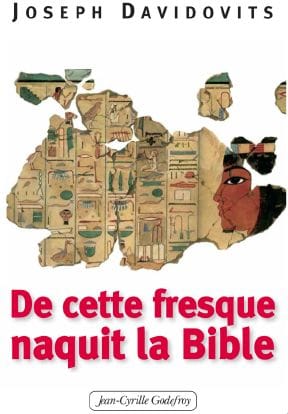
Professor Joseph Davidovits, French polymer scientist, has made some extraordinary claims about pharaoh Amenhotep III’s famed scribe-architect, Amenhotep son of Hapu, arguing that the latter was in fact the biblical patriarch Joseph in Egypt.


We may read at the professor’s site the following intriguing suggestions (http://www.davidovits.info/the-lost-fresco-and-the-bible-my-new-book-in-french/):


The Lost Fresco and the Bible (my new book in French)


I am presenting my 5th book on the Egyptian civilization, here in connection with the Bible, published by Éditions Jean-Cyrille Godefroy, Paris, ISBN 978-2-86553-216-2


Released on: 29 september 2009


http://www.davidovits.info/wp-content/uploads/couverture.jpg


In 1935 in Karnak, in Egypt, two French Egyptologists discover a fresco in the ruins of the memorial temple of Amenophis (Amenhotep) Son of Hapu, the most eminent scribe and scientist of ancient Egypt, Great chancellor of the Pharaon Amenhotep III, father of the monotheist Pharaon Akhenaton. Recently, 75 years later, I noted that the text of this fresco was reproduced word for word in the Bible, Genesis 41, when Pharaon installs the biblical Patriarch Joseph to rule over all Egypt. Royal scribe Amenophis Son of Hapu and the Patriarch Joseph are thus the same person.


I have found the following table at : http://kovtr.com/wordpress/?paged=5 apparently reproducing the professor’s comparisons between Joseph and Amenhotep (Amenophis) from sites of his: http://www.davidovits.info/wp-content/uploads/joseph-amenophis-english.pdf and: http://www.davidovits.info/filmtv-documentary-proposal-on-egypt/


Biblical Patriarch Joseph = Scribe and Genius Amenophis Son of Hapu
Joseph, Genesis 41, 40-46
Amenophis, Son of Hapu
And Pharaoh took off his ring from his
hand, and put it upon Joseph’s hand
He was bestowed with ornaments in gold
and all kind of precious minerals
and he arrayed him in vestures of fine linen
He was arrayed with clothes made of linen
of the finest quality
and put a gold chain about his neck
A necklace in pure gold and all kind of
minerals was placed around his neck
And Joseph was thirty years old when he
stood before Pharaoh king of Egypt
Year XXX… The great royal scribe,
Amenophis, bowed down before his Majesty


These are the sorts of eye-catching parallels that can delight those who seek verification of the historicity of the Bible.


But, since the patriarch Joseph belonged to an archaïc period of Egyptian history :


far removed in time and style from the age of pharaoh Amenhotep III and his genius official, Amenhotep son of Hapu - in the el-Amarna period revised - see e.g. my:


then perhaps the most that we can say about comparisons such as the above is that this may have been a conscious return to the formulary of the older Egyptian period.


Later pharaohs often hearkened back to much earlier periods of Egyptian history for their names (titulary) and architectural styles, etc.   


There is by now so much from Egyptian history to verify the biblical record that we do not need to insist upon such unrealistic identifications as professor Davidovits’s «Royal scribe Amenophis Son of Hapu and the Patriarch Joseph are thus the same person ».


In the light of the definite similarities here, though, it is most interesting to wonder who was this Amenhotep son of Hapu.


Professor Davidovits continues :


Moreover, the fresco contains a surprising detail which underlines its authenticity. Indeed, in Genesis 41, Pharaon names Joseph: çaphenat-paneah (sapnath-panéakh), a name which does not mean anything in Hebrew. Indeed, I discovered that çaphenat-paneah is the Egyptian name Amenophis Fils of Hapou, written reversely, from left to right, the hebrew language being written from right to left. The surprising detail in the fresco is that, precisely, the Egyptian name Amenophis is also written in hieroglyph reversely, from left to right, instead of from right to left like the rest of the text. There is thus absolute agreement between the fresco text and the Bible.


Even though I have not read the professor’s book, this bold claim strikes me as being highly unlikely to say the least. His « … absolute agreement between the fresco text and the Bible » is a very strong statement indeed.


The professor apparently follows the conventional dating system, which would locate the el-Amarna  era and Amenhotep son of Hapu more realistically closer (about half a millennium), [c. « 1350 B.C »] to the time of the patriarch Joseph. But even that date falls centuries short of the patriarch’s era according to the biblical reckoning.


Davidovits continues and concludes with further striking claims:


With this text going back to 1350 B.C., I prove that “the text in the Bible originated from this fresco ” and I describe the historical character of the Patriarch Joseph. I show how the Hebrew craftsmen were indeed Egyptians, yet, their leaders, the priests of Amenophis Son of Hapu’s Memorial Temple were of Semitic origin.


Why was this fresco then occulted by Egyptology? That remains a mystery. One does not find it mentioned in any works and books published by Egyptologists. This explains why biblical researchers and archeologists do not know of its existence and ignore its content. The historicity of the Bible goes back now to 3400 years and I claim that this fresco is the oldest text written word by word in the Bible. I have found many old and modern archaeological documents that fit in this new context. While following the written history of Amenophis Son of Hapu’s Memorial Temple from 1356 to 1060 B.C., one discovers the personality of Moses and the causes for Exodus around 1050 B.C., after heavy religious tensions, agitations and exemplified by the first strikes ever recorded in History, those of the craftmens working in the Valley of the Kings, Karnak, Egypt, called hepkher/hebbrer, the Hebrews.


I also explain in this book who were the Hebrews and their brothers (or cousins) from Madian who hosted Moses during 40 years, those who will be called later, the Arabs.


Part Two:


Ahmed Osman Prefers Yuya for Joseph


Ahmed Osman’s attempt to identify the biblical patriarch Joseph with el Amarna’s Yuya is to be rejected for the same chronological reasons as given in Part One, regarding professor Davidovits’s proposed identification of Joseph with Amenhotep son of Hapu.


In my rather un-sympathetic review of Ahmed Osman’s historical “mish-mash” as I called it, Out of Egypt. The Roots of Christianity Revealed (Century, 1998), which I entitled:


Osman's 'Osmosis' of Moses


I began as follows:


Perusing Osman’s book as a revisionist historian, I find it fascinating that he has located David and Solomon precisely where Immanuel Velikovsky did, to the early 18th dynasty of Egypt. No doubt Velikovsky’s 18th dynasty revision (Ages in Chaos I and II) was his main achievement, that will stand in pyramid-like strength after much else of his historical revision has collapsed under the weight of scientific criticism.


The 18th dynasty is also Osman’s entire showcase, encompassing all of his major characters. However, nowhere in his book do I find reference to Velikovsky or any other of the well-known revisionist historians. Osman either has not been influenced by Velikovsky at all, or perhaps does not bother to mention him because Osman retains the conventional dating of the early-mid 18th dynasty, instead of lowering it by the 500-600 years that Velikovsky had maintained was necessary.


More radical still – and even the most intrepid revisionists would baulk at this one – is Osman’s lumping together of Abraham, Joseph and Moses, into the same 18th dynasty scenario with, not only David and Solomon (his Part I: the Chosen People), but even with Jesus (his Part II: Christ the King); thereby totally ignoring customary chronological spacings. According to Osman, the 18th dynasty characters: Thutmose III, Amenhotep III, Yuya, Akhnaton and Tutankhamun, are to be identified as, respectively: David, Solomon, Joseph, Moses and Jesus Christ. Thus, once traditional heroes of Israel – even a great father-figure like King David – are now transmogrified into Egyptian (or, in Yuya’s case, a Syrian). Osman’s excuse for so radical a bouleversement seems to be that he is the one best suited to rediscover “the true Egyptian roots of Christianity and of Western civilization”.


Well, I believe that he has gone about it all in a most biased fashion. I cannot see how Osman – himself a followed of both Sothic dating and Higher Critical view – can possibly escape the label of anti-semitism (here meaning anti-Israel) as described in my earlier TGN article (“Velikovsky and Academic Anti-Semitism”). Osman is guilty of historical piracy, ‘hijacking’ famous Israelites into an Egyptian environment and ‘forcing’ Egyptianhood upon them. But that is an old trick – the Greeks had done it (in favour of Greece) long before him. Whilst admittedly the revision that has grown out of Velikovsky’s efforts can be at times radical, its protagonists are generally careful not to up-end established sequences. Much of the revision revolves around the more plausibly allowable, like deleting ‘Dark Ages’, or shortening artificially over-stretched eras (such as Egypt’s Third Intermediate Period). Velikovsky in fact lost many supporters when he, flying in the face of hard archaeological evidence, had indulged in such a radical up-ending by separating the 18th from the 19th dynasty (sequentially) and inserting in between foreign dynasties of 150 years duration (In Ramses II and His Time, and Peoples of the Sea).


Though Osman certainly becomes most interesting when he departs from the conventional norm, this is only the case when he does so with some sort of coherence. He correctly maintains that his country, Egypt, exerted an influence upon biblical and Christian thinking. However, as I intend to show, he does not appear to have properly understood what he has rightly sensed. He tries to force his examples; thereby missing Egyptian influences that really are there, whilst creating ones that are not. The Sothic chronology lets him down badly, exacerbating his mishmash. Osman proposes David as an Egyptian pharaoh of the C15th BC, who impregnates Sarai. And, taking his cue from the Babylonian Talmud (Osman, op. cit., p. 12), he recklessly makes David the father of Isaac. Despite his avowed aims, Osman lets himself down by his failure to appreciate the relevance of Egypt’s Old Kingdom; his lack of perspective regarding the 18th dynasty; but, most of all, by his anti-Israel bias. He locates the era of the Exodus to the 19th dynasty (New Kingdom), Late Bronze Age.


[End of quote]


It comes as no surprise, then, that Osman completely mis-dates and mis-identifies the patriarch Joseph and his most distinctive era of Egyptian history. Whereas professor Davidovits had, as we found, tried to identify Joseph with Amenhotep son of Hapu, Osman has chosen instead the latter’s contemporary, Yuya – both prevailed during the long reign of Amenhotep III.


I wrote of this in the following section of my review of Osman:


  1. Joseph = Yuya


Osman maintains that Joseph was the highly credentialled Yuya, Syrian relative of Akhnaton. …. Yuya, like Joseph, he states, was the only official in Egypt ever to be called “Father of Pharaoh”. And he optimistically claims that the details of Joseph’s life after his interpreting Pharaoh’s dreams “are matched by only one person in Egyptian history – Yuya, the minister of Amenhotep III (ibid., 39). But again Osman’s apparent ignorance of pre-18th dynasty Egyptian history lets him down. Professor A. Yahuda (op. cit., 23-24) had already found the equivalent title, “Father of Pharaoh” in Old Kingdom Egypt; the Genesis expression, ab, ‘father’, a title borne (centuries before Yuya) by the Vizier, Ptah-hotep, who was itf ntr mryy-ntr, ‘father of god, the beloved of god’; god here indicating Pharaoh. Now, since Ptah-hotep was also a wise sage, whose writings resemble the Hebrew Proverbs, and since he – like Joseph – lived for 110 years, then it is worthwhile considering that Ptah-hotep was Joseph in his guise as scribe and sage.


Osman’s identification of Joseph is a classic example, I think, of where revisionists would think that they could easily trump him. T. Chetwynd, for instance (in “A Seven Year Famine in the Reign of King Djoser with Other Parallels between Imhotep and Joseph”…” C and AH, 1987, 49-56), has found numerous parallels between Joseph and the celebrated Vizier, Imhotep, of the 3rd dynasty (Old Kingdom), who supposedly saved Egypt from a 7-year Famine. ….


Imhotep, who according to J. Hurry (Imhotep, 90) was “one of the few men of genius in the history of ancient Egypt … one of the fixed stars of the Egyptian firmament”, is portrayed as a kind of ‘Leonardo da Vinci’ of Egypt: mathematician, scientist, engineer, architect. He was more besides. Carved on the base of a statue of Zoser in the Cairo Museum is a short inscription describing Imhotep as: “The seal-bearer of the King of Lower Egypt … the high priest of Heliopolis … the chief of the sculptors, of the masons …”. Imhotep has also come down through history as a thaumaturgist, healer and Egyptian patron saint of medicine.


Joseph also, according to Yahuda (op. cit., 24), would have been of the high priestly caste” of Heliopolis – like Imhotep. ….