Thursday, August 28, 2014

"... the Bible tends to indicate that the river from the Garden of Eden originated in Judea and from there became four heads".

The Lost Rivers of the Garden of Eden

Where is Eden?
The quest for pinpointing the exact location of the Biblical Garden of Eden and the four rivers almost rivals the quest for the location of fabled Atlantis. And the theories that abound are almost as numerous as the interpretations of the seven days of Genesis. Before tackling this question let's review what is written in Genesis about the four rivers:
And a river went out of Eden to water the garden; and from thence it was parted, and became into four heads. The name of the first is Pison: that is it which compasseth the whole land of Havilah, where there is gold; And the gold of that land is good: there is bdellium and the onyx stone. And the name of the second river is Gihon: the same is it that compasseth the whole land of Ethiopia. And the name of the third river is Hiddekel: that is it which goeth toward the east of Assyria. And the fourth river is Euphrates.
(Genesis 2:10-14 KJV)

The Bible says that a single river flowed "out" of Eden and then does something that most rivers DO NOT do; specifically, split into four separate "heads" or rivers that flowed downstream, all fed from a common single river source. Almost all rivers start from a single source or are fed by multiple sources (tributaries). For example, the Ohio River actually begins where two rivers (the Monongahela and Allegheny) flow together at Pittsburg, Pennsylvania. The Ohio River terminates when it flows into the Mississippi river as one of that river's many tributaries. So the names of rivers are an arbitrary thing, usually denoting only a portion of a greater complex stream system, with one stream flowing into another, which in-turn, may flow into yet another. This pattern of rivers, as observed in nature, is just the opposite of what the Bible describes about the river of Eden.
For that reason, nobody has been able to look at modern maps of the regions mentioned in Genesis and figure out exactly where the Garden of Eden was, at least by the present topography of the lands of the Middle East. Only one river of the four, the Euphrates, is known by the same name in modern times. It presently originates in the mountains of Turkey and terminates when it merges with the Tigris River near the Iraq/Kuwait border region. Many have speculated that the Tigris is the river Hiddekel.
Tigre and Euphrates rivers
This has led to speculation that the Garden of Eden was located somewhere in Turkey. This is assumed because the present headwaters of the Euphrates River originate in Turkey, as do the headwaters of the Tigris.
Others have proposed that the other end of the Euphrates River, where it meets the Tigris, may be the true location. This requires interpreting the Tigris river as one of the other three (the Hiddekel), then interpreting a tributary confluence of rivers as a river head, and then locating at least two more rivers (or old river beds) as the other missing two. Having done so, they then claim that the Garden of Eden was near present day Kuwait. This is a convenient solution, but not one supported by the literal wording of the Bible or the geological and geographical realities of what river "head" means, i.e. headwaters or source of origin.
You will notice that the present day headwaters of both the Tigris and Euphrates rivers originate in Tuekey very close to each other in mountainous terrain. Logically, one would assume that if two of the rivers started there, the other two must have done so, as well, if Turkey was the location of Eden. Neither the Pison nor Gihon rivers are ever mentioned again in the Bible. However, the Hiddekel River is:
"And in the four and twentieth day of the first month, as I was by the side of the great river, which is Hiddekel;"
(Daniel 10:4 KJV)

This reference by the prophet Daniel comes from a vision he had while with the children of Israel during the Babylonian Captivity. This would put Daniel somewhere in the area of present-day Iraq and would make the present-day Tigris river a fairly good candidate for the "Hiddekel" river spoken of by the prophet, as it is the only other great river known in that region today. But the Bible says that this river "that is it which goeth toward the east of Assyria" and a historical map of the location of Assyria, shows that the Tigris actually goes southeastward.
Map of Assyria
Keep in mind that the geographical area known as "Assyria" is not so easy to pin down. Although the Assyrian Empire was centered near Nineveh, the actual empire also extended into what is also present-day Syria and Palestine. However, lacking a better candidate, and knowing that the prophet Daniel was in that geographical area at the time of his visions, the Tigris appears to be the best possible modern-day candidate for the Hiddekel River.
Region around Assryia
We now must search out the probable locations of the other two rivers. It is here that the theories that the Garden of Eden was either in Turkey or Kuwait starts to lose credibility.
First, let's identify the geographical region of the Pison river. The Bible says: "Pison: that is it which compasseth the whole land of Havilah, where there is gold" and gives us two good clues. There is a recently discovered "Fossil River" that runs from the western mountains of Saudi Arabia towards Kuwait. This old river course is now nothing more than a dry riverbed. It was detected by satellite imaging. Many have speculated that this may be the ancient Pison, as it has been dry since about 3,500 to 2,000 BC. Although Saudi Arabia could marginally qualify for the land of Havilah, the fossil riverbed that flows across it had its origins in the mountains bordering the eastern side of the present day Red Sea, south of Israel.
Kuwait River in proximity to Euphrates
It should be pointed out that those mountains are mirrored by another range of mountains on the western side of the Red Sea. The Red Sea is a tectonic spreading zone and part of the Great Rift system that runs from northward in Turkey, down through the Dead Sea, down through the Red Sea and southward deep into the African continent. Obviously, when that mountain range was split by the Rift the source waters of the proposed Pison river would have dried up.
But this proposed river path may be somewhat of a "red-herring" because it does not seem to naturally "fit" the overall pattern. An even better fit may be for the river to have flowed down what today is the Gulf of Aden south of present day Yemen (southern tip of Arabia). Yemen has both gold and onyx and the eastward trending fault branch from the Afar triangle would have been a natural riverbed in the days prior to Noah's flood (when sea levels were lower than today).
Red Sea and Gulf of Aden
If this was indeed the Pison River, one of four that flowed out of the main one rising in the Garden of Eden, it does not correspond with the present-day headwater source of the Euphrates or Tigris up in Turkey. What's more, the geography of the last remaining river, the Gihon, further complicates the problem.
The Gihon is spoken of as: "Gihon: the same is it that compasseth the whole land of Ethiopia" which is the African land area west of the Red Sea and southward. Of course, the political boundaries of what we call Ethiopia today were certainly different in Biblical times, but the general area is correct. And if a river formerly flowed down what is now the Red Sea basin and southward into Africa at the Afar Triangle, it would certainly fit the description of a river that "compasseth the whole land of Ethiopia." (Genesis 2:13)
If we have correctly identified all four rivers, we now have 2 rivers (Euphrates and Tigris) originating today out of Turkey and another running down what was is now the Red Sea south of Israel and deep into Africa, following the path of the present-day Great Rift system. For the moment, we will also include the previously discussed "fossil river" running through Saudi Arabia. Look at the same map again:
The Four rivers
The yellow lines show the paths of the four rivers as proposed from what we have discussed so far. You should note that we did not trace over the Euphrates and Tigris rivers to their present-day sources, but terminated them close to the Great Rift fault zone line. You will also note that we have not continued the proposed path of the "Gihon" beyond the top of the Red Sea, and have terminated the proposed "Pison" at the Great Rift fault zone line.
All 4 of these rivers have one thing in common: All are connected to the Great Rift system. And that is the key to the mystery. Two rivers presently originate out of Turkey to the north and two other fossil rivers flowed south of Israel. The geographical "center" of these four points of flow is neither Turkey nor Kuwait; the center is somewhere near the general region of present day Israel and Jordan.
The Bible itself lends further credence to Israel (or someplace nearby) as the location of the Garden of Eden. If you run the name "Eden" through a search of the Bible, among several references the following ones provide some insightful clues:
"Behold, the Assyrian was a cedar in Lebanon with fair branches, and with a shadowing shroud, and of an high stature; and his top was among the thick boughs. The waters made him great, the deep set him up on high with her rivers running round about his plants, and sent out her little rivers unto all the trees of the field. Therefore his height was exalted above all the trees of the field, and his boughs were multiplied, and his branches became long because of the multitude of waters, when he shot forth. All the fowls of heaven made their nests in his boughs, and under his branches did all the beasts of the field bring forth their young, and under his shadow dwelt all great nations. Thus was he fair in his greatness, in the length of his branches: for his root was by great waters. The cedars in the garden of God could not hide him: the fir trees were not like his boughs, and the chesnut trees were not like his branches; nor any tree in the garden of God was like unto him in his beauty. I have made him fair by the multitude of his branches: so that all the trees of Eden, that were in the garden of God, envied him."
(Ezekiel 31:3-9 KJV)

In this passage the Bible says that the Assyrian was in Lebanon. Spiritually speaking, the "trees" in this passage refer to men and leaders. Cedar trees are mentioned elsewhere in the Bible as references to Lebanon (Judges 9:15, Psalms 29:5 & 104:16, Song of Solomon 5:15, Isaiah 2:13, Jeremiah 22:23 and more).
Notice also in the last of the passage that the Spirit associates the trees with "Eden" that "were in the Garden of God." Lebanon, although not a part of modern political Israel, was a part of the Biblical lands ruled by the Kings of Israel in times past. From this we can infer that the Garden and the source of the rivers of the Garden was somewhere close to the land of Lebanon.
Assuming this postulation is correct, that the source of the four rivers was somewhere near Lebanon, the interconnection of the river systems would need to be somewhat like the map below:
Rivers tied to Great Rift Trace
What roughly emerges, when all four rivers are connected to trace of the Great Rift fault system, is a complex river network emerging from a common point of origin that flows both north and south, with each north and south extension splitting into two separate streams, for a total of four rivers. That adds up to four separate heads.
Of course, to propose such a reconstruction one would have to assume that the present day headwaters of the Tigris and Euphrates were not the main source headwaters in ancient times. It is possible that there could have been older main tributaries previously flowing from Lebanon which were, at that time, the main headwaters of those two rivers.
But the so-called Kuwait River, which has been proposed as the lost river Pison, does not seem to match with the common denominator of the others, that is the Great Rift and branching fault systems. Based on the description of its path in the Bible which says, "compasseth the whole land of Havilah" and knowing from the geology of present day Yemen that onyx can be found there, then this part of the verse, "where there is gold; And the gold of that land is good: there is bdellium and the onyx stone" suggests an alternate path for the River Pison, to the south of Yemen, and that would give us the path indicated by the blue and yellow markings on the next graphic.
When all factors are considered (Bible text and geology), I believe the paths indicated by the dotted lines on the large map below are probably where those rivers flowed. And a southern path around Yemen puts the fourth river squarely into the basin of the Great Rift system, flowing east from the upwelling Afar Triangle.
Four river of Eden paths
These paths meets the requirement of the Biblical text because the single river water source, originating from high ground somewhere in or near present day Israel, hits the Rift Valley, then would have flowed both north and south along the path of the Rift zone, with both the north and south forks each splitting a second time when intercepting other fault zones.
Fault map of middle east
Keep in mind that the course of rivers around and through the vicinity of the Great Rift fault system may have changed or dried up because of block faulting all along the Rift zone. Certainly Horst and Graben faulting along the Rift could, and would, change the surface topography. Horst and Graben faulting is defined as "elongate fault blocks of the Earth's crust that have been raised and lowered, respectively, relative to their surrounding areas as a direct effect of faulting. Horsts and Grabens may range in size from blocks a few centimeters wide to tens of kilometers wide; the vertical movement may be up to several thousand feet."
Horst and Graben faulting
Image courtesy of Dr. M. Mustoe www.tinynet.com/Graben.html
But when did this happen? The most likely time frame would be in the years immediately following Noah's Flood. Keep in mind that the Bible says there was a significant geologic event that happened 101 years after Noah's Flood - The "Earth was divided" (see: Genesis 10:25 & 1 Chronicles 1:19). The Bible also describes what was probably tectonic/volcanic activity in the Rift valley in Abraham's days (the destruction of Sodom and Gomorrah - See Genesis 19:28).
Imaging of the Dead Sea indicates that, at one time, the river bed of what is now the Jordan River once flowed across the land surface that is now at the bottom of the Dead Sea. This suggests that there was Horst and Graben faulting at the southern end of the present Dead Sea, which abruptly terminated the former flow of that river southward. And that stream was probably the feeder channel to the ancient Gihon River, which ran down the floor of what is now the Red Sea into Ethiopia and through the Rift basin south from the Afar Triangle. Supporting coincidental evidence for this is the fact that fish species down in the African Rift valley river and lake systems are very similar to those found in the Jordan River system:
Note: The aquatic life of the African lakes and rivers belongs to the so-called Ethiopian zoogeographical region. According to Annandale, the explanation of the Ethiopian affinity of the fish fauna of the Jordan is that the Jordan formed at one time merely part of a river system that ran down the Great Rift Valley. The Jordan was one branch of this huge river system, the chain of lakes in East Africa represents the other; and together they opened into the Indian Ocean. See R. Washbourn, The Percy Sladen Expedition to Lake Huleh, 1935, Palestine Exploration Fund, Quarterly Statements, (1936), p. 209. (Source website: The Great Rift and the Jordan)
Now, returning to the general area of Lebanon as the Biblical location of the Garden of Eden and the water source for the four rivers, let us take a look at the present-day geology and topography of that area. This map shows a great deal of block faulting in the area of Lebanon just north of modern day Israel.
Faulting in Lebanon and Iraq
Below is a satellite image of the entire area. You will note from the topographical relief that, had waters once flowed out of this area, they would naturally flow northward into the Euphrates Fault system river basin. At the time of the Garden of Eden the main headwaters of the Euphrates could have come from that direction. If the water flow at that time continued northward along the path of the Great Rift, it would also intersect the present-day Tigris river basin.
Satellite Photo of Dead Sea region
41G-120-0056 Dead Sea Rift Valley, Israel and Jordan October 1984 Seen from an altitude of 190 nautical miles (350 kilometers)
The prominent bodies of water along the Rift zone in this photo are the Dead Sea (bottom) and Sea of Galilee (top). They are connected by the Jordan River which flows south. Before the Earth was divided by the Rift, the mountainous land on both the Israeli and Jordanian sides were joined. You are looking at "ground zero" of what was once the Garden of Eden.
Here is another important point to remember. The Bible says that the river flowed out of Eden, but nowhere does the Bible give a geographical size for what constituted the actual area of Eden. Therefore, the actual source of the waters could have been south of Lebanon. More specifically, those waters could have originated in or near Jerusalem in present-day Israel, or even up welled from a massive spring under the sea of Tiberius.
The Israel/Lebanon region as the location of Eden and the lost river finds considerable support in the Bible. Support for this line of reasoning is found in the fact that God considers the land of Israel as His Holy land. It was upon one of the mountains in the "land of Moriah" (Genesis 22:2) where Abraham was told to sacrifice his son (a type of the Lord's sacrifice of Jesus). Solomon was told to build the Temple "at Jerusalem in mount Moriah" (2 Chronicles 3:1) and Jerusalem was where the Lord Jesus was actually crucified. By extension, we can assume that when God sacrificed an animal to cover Adam and Eve with its skin (Genesis 3:21), that animal was a Lamb (Revelation 13:8). Therefore, we can be certain from the typology that Adam and Eve, and the center of the Garden of God, were somewhere at or very near geographical Jerusalem.
Now, what exactly do those spiritual realities have to do with the location of the river of Eden? In the future, when the Lord Jesus Christ establishes His Kingdom and Righteous Temple in Jerusalem, the Bible speaks of a river flowing from below the Temple. The prophet Ezekiel spoke of seeing this in a vision:
Afterward he brought me again unto the door of the house; and, behold, waters issued out from under the threshold of the house eastward: for the forefront of the house stood toward the east, and the waters came down from under from the right side of the house, at the south side of the altar. Then brought he me out of the way of the gate northward, and led me about the way without unto the utter gate by the way that looketh eastward; and, behold, there ran out waters on the right side. And when the man that had the line in his hand went forth eastward, he measured a thousand cubits, and he brought me through the waters; the waters were to the ankles. Again he measured a thousand, and brought me through the waters; the waters were to the knees. Again he measured a thousand, and brought me through; the waters were to the loins. Afterward he measured a thousand; and it was a river that I could not pass over: for the waters were risen, waters to swim in, a river that could not be passed over. And he said unto me, Son of man, hast thou seen this? Then he brought me, and caused me to return to the brink of the river. Now when I had returned, behold, at the bank of the river were very many trees on the one side and on the other. Then said he unto me, These waters issue out toward the east country, and go down into the desert, and go into the sea: which being brought forth into the sea, the waters shall be healed. And it shall come to pass, that every thing that liveth, which moveth, whithersoever the rivers shall come, shall live: and there shall be a very great multitude of fish, because these waters shall come thither: for they shall be healed; and every thing shall live whither the river cometh. And it shall come to pass, that the fishers shall stand upon it from Engedi even unto Eneglaim; they shall be a place to spread forth nets; their fish shall be according to their kinds, as the fish of the great sea, exceeding many. But the miry places thereof and the marishes thereof shall not be healed; they shall be given to salt. And by the river upon the bank thereof, on this side and on that side, shall grow all trees for meat, whose leaf shall not fade, neither shall the fruit thereof be consumed: it shall bring forth new fruit according to his months, because their waters they issued out of the sanctuary: and the fruit thereof shall be for meat, and the leaf thereof for medicine.
(Ezekiel 47:1-12 KJV)

And this corresponds with what John said about the New Jerusalem:
And he shewed me a pure river of water of life, clear as crystal, proceeding out of the throne of God and of the Lamb. In the midst of the street of it, and on either side of the river, was there the tree of life, which bare twelve manner of fruits, and yielded her fruit every month: and the leaves of the tree were for the healing of the nations.
(Revelation 22:1-2 KJV)
Since the original "Tree of Life" was in the Garden of Eden, does it not make sense that when the Lord makes all things new again the future "Tree of Life" would be restored to its proper place? And that place is in Israel, the same place upon the mountains of Moriah (Jerusalem).
Yes, the Bible tends to indicate that the river from the Garden of Eden originated in Judea and from there became four heads. A forensic study of the region's geology tends to support the theory over the alternatively proposed locations of Turkey or Kuwait. What we have not shown is a geologic model for the source of these waters originating from the area of Jerusalem. Keep in Mind that Jerusalem sits just west of the Great Rift Valley. It is quite possible that the legendary river of Eden originated from a massive artesian aquifer, the source of which has long since been disrupted by block faulting along the Rift. We know for a scientific fact that there is a considerable amount of "fossil" water under the Middle East in the deep-rock sandstone aquifers of the region such as the Nubian sandstone aquifers and equivalent formations.
Also keep in mind that in the days of Adam and Eve a "mist" went up and watered the face of the Earth within the Garden (Genesis 2:6). Fountains of waters (underground waters under pressure gushing upwards) would certainly be a logical source for the generation of such a mist and would be a logical feed-source for such a river. Certainly, we cannot exclude this possibility.
In summary, although the modern-day geology and topography of the Middle-East does not readily reveal the exact location of the Garden of Eden and the four rivers source, guidance by faith from the Holy Bible and a forensic study of the region's geology reveals the matter. The available data appears to suggest that present-day Israel was the central location of the Garden of Eden.
....

Tower of Babel in a Revised History


1. Genesis 1 (c. 4050 BC) and the Flood (c. 2400 BC)

Two pillars of ‘Creationism’ or ‘Creation Science’, a very big industry, may actually be un-biblical. I refer to the notions that (i) God created the heavens and the earth in six days and that (ii) the Genesis Flood was global. Genesis I may instead be a revelation to man about a creation already effected. It seems to be strongly liturgical, not scientific (in a western sense). Paradise (the Garden) was for man what the Temple later became. The Sabbath rest has to do with God taking up his abode in the Garden on the seventh day just as He came to rest in the Temple that king Solomon had built for him (2 Chronicles 6:41). Happily, some ‘Creationists’ now seem to be cottoning on to the idea that the pre-Flood world is still scientifically identifiable, as opposed to the long-held fundamentalist view that the Flood completely erased all previous topography. The world of Adam’s and Noah’s day reached from the Tigris and Euphrates rivers (east) to the Pishon and Gihon rivers (west). Possibly, a sea then circumscribed that whole area. The archaeology of the line of Cain has been traced in pre-Flood cities such as Uruk or Unuk (called after Cain’s son, Enoch) and Eridu (called after Cain’s grandson, Irad), with legends associating the Babylonian Noah with Shuruppak. But Ann Habermehl has dropped a bombshell into this whole matter of the geography of early Genesis with her ground-breaking article, “Where in the World Is the Tower of Babel?” (https://answersingenesis.org/tower-of-babel/where-in-the-world-is-the-tower-of-babel/), according to which the biblical land of Shinar is the Sinjar region in NE Syria. This has huge ramifications for, not only the antediluvian geography, but also for the early post-Flood phase.
 
....
 

Thursday, August 14, 2014

Sargon of Akkad as Nimrod


Terrific article, a must read:

....

JETS 56/2 (2013) 273–305
IDENTIFYING NIMROD OF GENESIS 10 WITH SARGON OF AKKAD BY 
EXEGETICAL  
 AND
     ARCHAEOLOGICAL  
MEANS


DOUGLAS
PETROVICH
*

 I. INTRODUCTION Perhaps one of the more intriguing and enigmatic characters in the OT is Nimrod, though his name appears only four times throughout the entire Bible (Gen 10:8, 9; 1 Chr 1:10; and Mic 5:6). His biography is narrated in Genesis 10, and opinions about his identity and character have abounded since ancient times. In Philo’s Questiones in Genes in
2.82, which dates to the first half of the first century AD, he refers to Nimrod as a giant who opposes God, and the original and chief of sinners. In Ant . 1.113–114, Josephus considered not only that Nimrod was alive during the tower of Babel incident, but that he was the one who changed the government into a tyrannical one and incited those at Babel into building the infamous tower, in outright defiance of God. At present, opinions on the identity and character of Nimrod have continued to abound, and a discussion of some of the more noted options ventured will proceed shortly. For now, suffice it to say that Nimrod is thought by some to be heroic, while by others to be devious; he is considered by some to be a mere mortal, though by others to be divine. Thus the goal of this essay is to sift through the diversity of options for the identity of this enigmatic figure named Nimrod, and to determine—if at all possible—whether his biography can be matched precisely with any known figure from antiquity. In order to accomplish this endeavor, the task  will require a careful look at relevant exegetical data, and at the archaeological record that serves to inform the field of ancient Near Eastern (hereafter ANE) historical studies, a vital cognate to biblical studies. The task will be accomplished by proceeding through the following steps:(1) presenting a working translation that will act as a reference point for the reader;(2) investigating the various words, phrases, and constructions that act as exegetical clues to illuminate what can be known for certain about Nimrod biographically;(3) reviewing and critiquing some of the more popularly held opinions on the identification of Nimrod; and (4) presenting an alternative candidate for Nimrod with the help of archaeology and the support of the exegetical work that will have been done up to that point. Finally, a conclusion will be presented, and the reader will be able to judge whether the present writer has made a successful case.

....

Sunday, July 13, 2014

Gilgamesh tomb believed found

 
Archaeologists in Iraq believe they may have found the lost tomb of King Gilgamesh - the subject of the oldest "book" in history [sic].


King Gilgamesh, commemorated in stone, kills a lion
Gilgamesh was believed to be two-thirds god, one-third human
The Epic Of Gilgamesh - written by a Middle Eastern scholar 2,500 years before the birth of Christ - commemorated the life of the ruler of the city of Uruk, from which Iraq gets its name.
Now, a German-led expedition has discovered what is thought to be the entire city of Uruk - including, where the Euphrates once flowed, the last resting place of its famous King.
"I don't want to say definitely it was the grave of King Gilgamesh, but it looks very similar to that described in the epic," Jorg Fassbinder, of the Bavarian department of Historical Monuments in Munich, told the BBC World Service's Science in Action programme.


Magnetic
In the book - actually a set of inscribed clay tablets - Gilgamesh was described as having been buried under the Euphrates, in a tomb apparently constructed when the waters of the ancient river parted following his death.
"We found just outside the city an area in the middle of the former Euphrates river¿ the remains of such a building which could be interpreted as a burial," Mr Fassbinder said.
Who can compare with him in kingliness? Who can say, like Gilgamesh, I am king?
The Epic Of Gilgamesh
He said the amazing discovery of the ancient city under the Iraqi desert had been made possible by modern technology.
"By differences in magnetisation in the soil, you can look into the ground," Mr Fassbinder added.
"The difference between mudbricks and sediments in the Euphrates river gives a very detailed structure."
This creates a magnetogram, which is then digitally mapped, effectively giving a town plan of Uruk.


'Venice in the desert'
"The most surprising thing was that we found structures already described by Gilgamesh," Mr Fassbinder stated.
Archaeologists excavate the Euphrates
Iraq has long been the site of some of the most important historical finds

 
"We covered more than 100 hectares. We have found garden structures and field structures as described in the epic, and we found Babylonian houses."
But he said the most astonishing find was an incredibly sophisticated system of canals.
"Very clearly, we can see in the canals some structures showing that flooding destroyed some houses, which means it was a highly developed system.
"[It was] like Venice in the desert."


http://news.bbc.co.uk/2/hi/science/nature/2982891.stm


Friday, June 27, 2014

The Neutral Model of evolution and recent African origins


The Recent African Origins (RAO) theory is on tenuous ground. It relies deeply on the Standard Neutral Model of evolution (SNM), but every assumption behind SNM and, therefore, RAO has been openly questioned in the evolutionary literature. If real-world populations violate the central assumptions of SNM, the conclusions of studies that assume SNM are not the final word on the subject. The real situation is much more complicated than the simplifying assumptions allow, and several of these assumptions are either biased in favour of the conclusion or are contrary to the data: crossing over is not random, population structure exists at all scales, and population admixture and gene conversion overly complicate the models. The presence of natural selection among human mitochondria removes the ‘neutral’ part of SNM as far as RAO’s ‘Mitochondrial Eve’ is concerned. Finally, RAO and SNM are based on the belief that evolution can occur, but that it cannot affect the things that control the speed of evolution. There is no room for differences in mutation rates among populations caused by environmental stress, nutrition, demographics or mutations in the DNA copying, proofreading or correcting mechanisms. The most popular evolutionary model of recent human evolution is unsatisfactory, but the biblical model for human genetic history is still in its infancy. Outlined are several lines of thought that may be productive to creationist research.

‘The challenge of genetic studies of human history is to use the small amount of genetic differentiation among populations to infer the history of human migrations’ (Rosenberg et al. 20021).
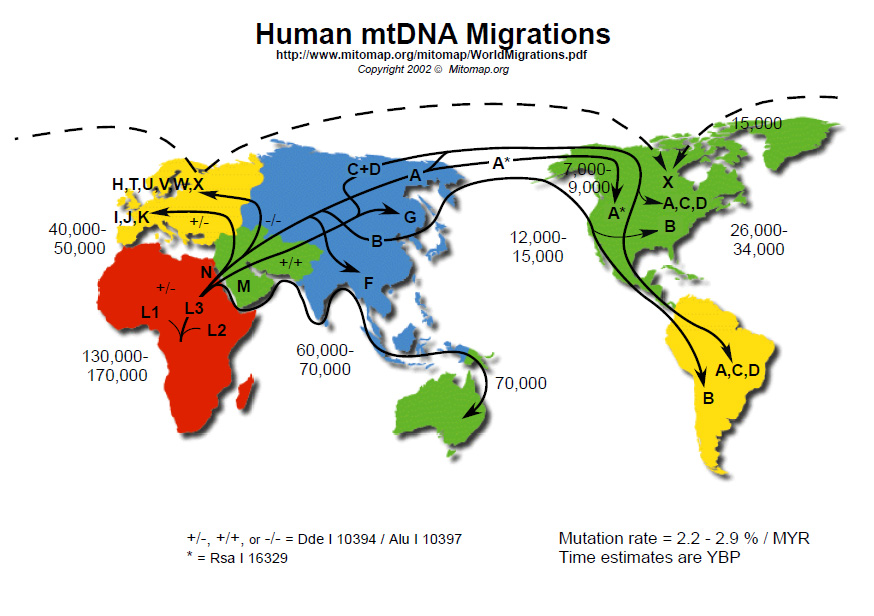
Human mtDNA Migrations
Figure 1. This map shows the Recent African Origins concept in detail. According to RAO theory, modern humans originated in Africa, diversified there, and then one lineage (with several major clades) migrated away to populate the rest of the world. This is very similar to the biblical concept, only with a different starting point (Middle East) and a different time frame. (From MITOMAP: A Human Mitochondrial Genome Database, , 2008).
This quote illustrates an important point. Modern geneticists are struggling to understand human genetic history. In the end, they are forced to make certain inferences based on limited data and a suite of simplifying assumptions. The purpose of this article is to look at the underpinnings of the Recent African Origins (RAO) model of human evolution, first popularized by claims of the discovery of ‘Mitochondrial Eve’ in Africa.2 Each of the fundamental assumptions behind the theory has been openly questioned in the evolutionary literature. If any one of the assumptions behind RAO falls, the entire theory may be made moot. By listing the assumptions and then systematically showing how each one is impractical, impossible, contradictory or biased in favour of evolutionary theory, I hope to bring RAO down a few notches.
The term ‘recent’ is used by RAO supporters in a deep-time sense and is not meant, by them, to be taken as support of a young Earth. According to RAO, humans evolved in Africa, existed as a small population for some hundreds of thousands of years, and then rapidly expanded into the rest of the world about 200,000 years ago. As an explanatory tool, it stands in direct opposition to the biblical model, where the most important genetic signals should be the Creation (which limits overall human diversity), the Flood (a bottleneck event), and the Tower of Babel event (which led to significant population subdivision and a world-wide migration). The last two are expected to yield similar results to the hypothetical RAO model, but with a different timescale.
I will caution the reader at this point. This article might seem to overthrow all arguments based on neutral evolution or bottleneck theories (both terms will be defined below). Creationists sometimes use those theories to their advantage, and it is not my intent to completely discount them. In fact, RAO uses much of the same mathematics many creationists would like to apply to the biblical model. My intent is to take a more ‘surgical’ approach, cutting out the ‘cancer’ of bad science, while leaving untouched any science that may yet be valid and useful. And in arguing against RAO, I am actually arguing for a more recent origin of humanity, though this is not my focus here and will not come through strongly in this article.
The goal of this paper is to highlight the places where they make unrealistic assumptions in their favour, and, by pointing out how unrealistic these assumptions are, I hope to dispel some of the RAO [Recent African Origins] mythology.
RAO makes a number of approximations, as do all theories by necessity. For this reason, almost any theory can be attacked for being ‘unrealistic’. The goal of this paper is to highlight the places where they make unrealistic assumptions in their favour, and, by pointing out how unrealistic these assumptions are, I hope to dispel some of the RAO mythology.
RAO does not support large-scale, deep-time evolution. There is nothing evolutionary about humans moving out of, or into, Africa at any time. Rather, the importance of the theory lies in the issue of dating and rooting the human genealogical tree. The following quote from the seminal RAO paper is going to be the focus of everything that follows: ‘We infer … that Africa is a likely source of the human mitochondrial gene pool. This inference comes from the observation that one of the two primary branches leads exclusively to African mtDNAs …, while the second primary branch also leads to African mtDNAs.’2 If we can dissect this, we will be far along the road to a better theory of human genetic history (figure 1).

The Standard Neutral Model of evolution

RAO is based on the Standard Neutral Model of evolution (SNM), itself being based on a long line of theoretical arguments, starting with J.B.S. Haldane’s writings in the 1950s. It is important to understand the development of this theory if we are to understand RAO.
Haldane (1957)3 was the first to discuss the concept known as the ‘cost of substitution’. According to Haldane, natural populations should not be able handle the number of deaths required by natural selection to drive positive evolution. Put simply, higher vertebrates do not have a high enough reproductive rate to support rapid rates of beneficial evolution. It takes too many deaths (the ‘cost’) to select for new mutations. Many creationists argue ‘Haldane’s Dilemma’ has not been sufficiently answered to date.4

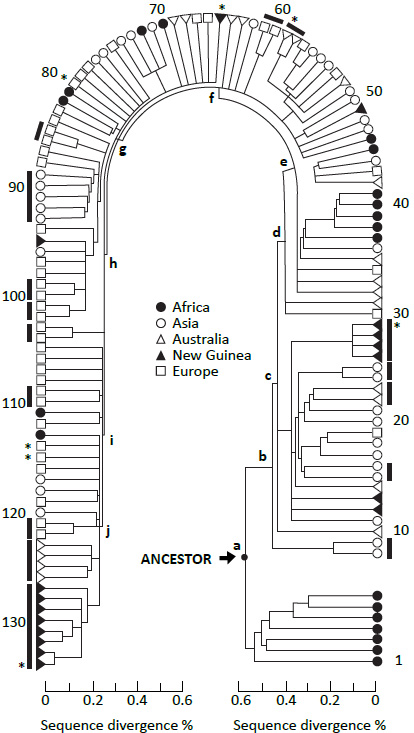
The tree that started it all. Cann et al.2 based their ‘Out of Africa’
conclusion on the fact that the first major branch in their tree leads to all African
sequences on one side and mixed African/world sequences on the other. This
conclusion is based on a suite of assumptions that are discussed at length in
the text.
Figure 2. The tree that started it all. Cann et al.2 based their ‘Out of Africa’ conclusion on the fact that the first major branch in their tree leads to all African sequences on one side and mixed African/world sequences on the other. This conclusion is based on a suite of assumptions that are discussed at length in the text. (From figure 3 of Cann et al.2).
Motoo Kimura took Haldane’s argument one step further by applying it to measured genetic differences between mammals. Following Haldane, he reasoned that if the genetic differences between two species were all due to positive selection, and if they evolved within the standard evolutionary timescale, then mammals would have needed an astronomically high reproductive rate to give natural selection enough fodder to drive evolutionary changes. For example, humans and chimpanzees have millions of genetic differences, but 3 million years would give us only about 100,000 human generations in which to fix these millions of differences. According to evolutionary calculations, natural selection would have had to remove many times more people than could possibly have been born during this time in order fix this many differences. To solve the dilemma, Kimura reasoned the majority of new mutations must be ‘neutral’ (this is the origin of the belief that most of the genome is composed of ‘junk DNA’, a term discussed elsewhere in this journal5). The rate of neutral evolution could be much faster than positive evolution, and would be limited only by the rate of DNA copying errors. Since natural selection will not act on neutral traits, which do not affect survival or reproduction, neutral evolution can proceed through random drift without any inherent cost of selection. Kimura saw Haldane’s Dilemma as a serious problem and listed it as his main reason for proposing the Neutral Theory of evolution.6 Haldane was right, Kimura asserted, but the preponderance of biological change must be neutral.
The Neutral Model has been expanded by many authors to become what we will call the Standard Neural Model (SNM). SNM was developed to cover complex historical patterns such as bottleneck events. It is the fundamental underpinning of RAO.
The following is a list of assumptions critical to the RAO model. Note how SNM is intrinsic to RAO theory (figure 2):
Constant population size. Although the Neutral Model is unaffected by population size, SNM was developed partly to model changes in population size (specifically one cycle of population bottleneck). RAO assumes a single human population with a single expansion event and no subsequent sub-population bottlenecks or other demographic differences.
Random mating (no population substructure, geographic or otherwise). Again, Neutral Theory is not contingent upon random mating, but RAO is. Population substructure prior to or after the Out of Africa Event might hide the true picture of human demographic history.
Neutral polymorphisms. There can be no selection acting on the alleles under question. RAO is based on the assumption that the entire mitochondrial genome is essentially neutral, or at least that negative mutations are efficiently eliminated. For detailed critique of this, see Sanford.7
An infinite-sites model of mutation. There cannot be multiple mutations at identical sites in different lineages and back mutations are not allowed. In some sense, this is a reasonable approximation, given the large size of the genome and the small number of generations involved (in the Creation model) or with the low rate of mutation (in evolutionary models). The approximation also simplifies the theoretical understanding and calculations. However, if this approximation turns out to be incorrect, RAO becomes harder to understand and the calculations behind it become less tenable.
Constant mutation/substitution rate among all subpopulations (the ‘molecular clock’). To illustrate how critical this is, I will quote Cann et al.:2 ‘A time scale can be affixed to the tree … by assuming that mtDNA sequence divergence accumulates at a constant rate’.

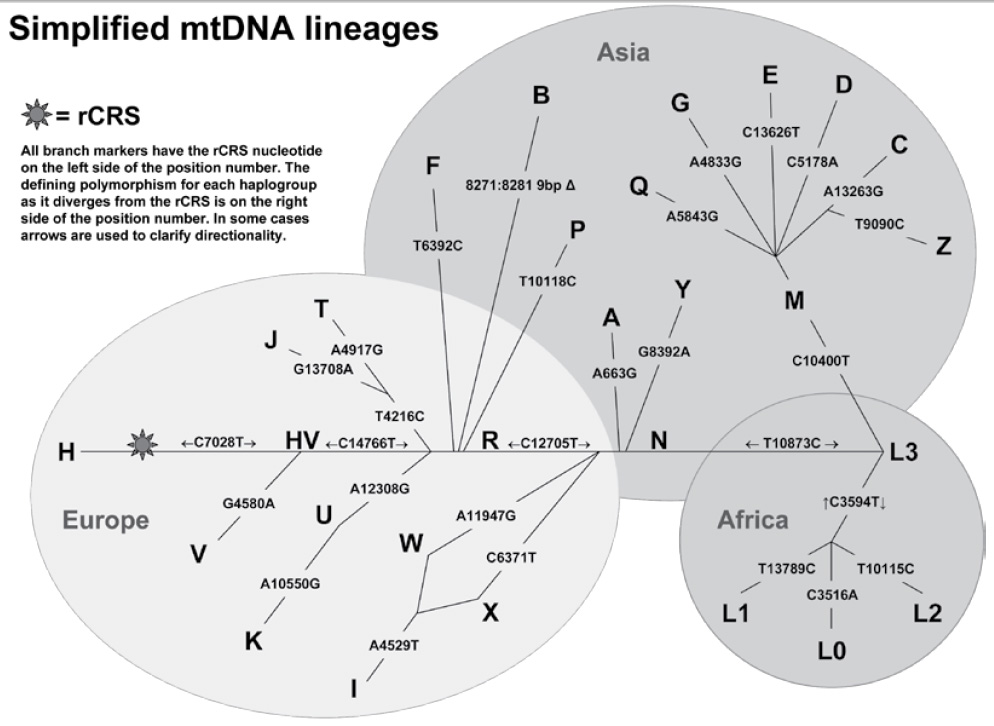
Simplified mtDNA tree from <www.mitomap.org>. This diagram shows the relationship among
the major mitochondrial lineages. Because it is not presented in a traditional tree format, it is easy to see
how difficult it is to determine where the ancestral sequence should be placed. Carter placed the root not
in Africa, but at the ’R’located close to the centre of the tree.
Figure 3. Simplified mtDNA tree from . This diagram shows the relationship among the major mitochondrial lineages. Because it is not presented in a traditional tree format, it is easy to see how difficult it is to determine where the ancestral sequence should be placed. Carter39 placed the root not in Africa, but at the ’R’located close to the centre of the tree. (From MITOMAP: A Human Mitochondrial Genome Database, , 2008).
Constant effective generation time among all subpopulations (typically assumed to be 20 years for humans, although values between 20 and 30 have been used by various authors).
A human-chimp common ancestor some 3–6 million years ago. This is not an assumption of SNM, but is needed for calibrating the SNM bottleneck event. Essentially, by counting the number of differences between chimp and human mitochondria, and by then dividing this number by 3 to 6 million, one can get an estimate of the number of mutations that supposedly accumulate in the populations per year.

Tajima’s D statistic


Tajima’s D statistic8 is used to test SNM along a given stretch of DNA. It is basically a summary of the allele frequency spectrum. D values not significantly different from zero indicate the population meets all the criteria for SNM. Positive and negative values are due to an overabundance or dearth in the expected number of rare polymorphisms, respectively. Significant positive or negative values of D may indicate the presence of natural selection or historic changes in population size or multi-population introgression. This is an important metric for both SNM and RAO theory.
Historic changes in population size are expected to influence Tajima’s D statistic in that population growth should lead to excess low-frequency polymorphisms (negative D-values). This occurs because new mutations are carried along with the expansion and do not exit the population as easily through random drift. Alternatively, population bottlenecks should lead to a deficiency in low-frequency polymorphisms (positive D-values) because most low frequency alleles are eliminated through random selection.

Linkage disequilibrium

SNM needs to be put in the context of sexual reproduction. During gamete production, crossing over occurs between chromosome copies. This mixing causes randomization of the alleles (variations) along a stretch of DNA. However, because there are only one or two crossing over events per chromosome arm per generation, not all alleles are randomized each generation. And, the closer two alleles are, the less likely they are to be separated. Alleles in close proximity are said to be ‘linked’. This is also true of alleles separated by regions of infrequent crossing over. Geneticists use the term ‘linkage disequilibrium’ (LD) to describe the unequal association of certain alleles with certain other alleles. A set of alleles inherited together are referred to as a ‘haplotype’.
Population growth not only leads to negative D values (excess low frequency alleles), it also leads to less LD because crossing over randomizes more and more alleles each generation. Alternatively, population bottlenecks should lead to higher LD because during a bottleneck event a small number of people pass their large linkage blocks on to the entire population. It takes time for the haplotypes to be scrambled.

Expectations of SNM

The population parameters used in SNM calculations must be estimated, and this is no easy task. For humans, the mutation rate is based on current levels of genetic diversity, the assumption that the vast majority of that genetic diversity is neutral, and an assumed chimp-human ancestor 3–6 Ma. In other words, the calculation assumes large-scale evolution (i.e. macroevolution) is true. The effective population size (Ne) is also estimated from observed levels of diversity. But Ne is also dependent upon the generation time and the time to a common ancestor, two parameters about which little is known.9 Given an equal number of males and females and random mating, the ratio of hypothetical Ne for the autosomes, X chromosome, non-recombining portion of the Y chromosome (NRY), and mtDNA is 4:3:1:1, respectively. The reduced Ne is expected to produce more rapid differentiation among populations for the haploid loci than for the others.10 This is one reason why RAO was initially based on mitochondrial sequences.
The bottleneck event associated with the Flood would have created a strong signal that should still be evident today. Any model of human history that does not take this into account will come to incorrect conclusions if the Flood story is accurate.
Since the calculation of the time to a most recent common ancestor (TMRCA) is directly proportional to Ne, TMRCAs for the autosomes and the X chromosome are expected to be 4 and 3 times greater, respectively, than for the two haploid loci.10 But this ignores the possibility that there was only one male lineage (Noah’s Y chromosome) and only three female lineages (the mitochondrial chromosomes of Noah’s three daughters-in-law) in the founding human population. The bottleneck event associated with the Flood would have created a strong signal that should still be evident today. Any model of human history that does not take this into account will come to incorrect conclusions if the Flood story is accurate.
SNM assumes that differences in LD among populations are due to differences in demographic history.11,12 This assumption depends, of course, on a constant rate of recombination, mutation and gene conversion in all subpopulations and a lack of ancient population structure (all of which affect LD). However, all it takes is one change in a DNA repair enzyme, one change in a gene that affects the rate of recombination, or one change in a gene that affects the process of gene conversion in one of the populations and the SNM results will diverge from reality. Thus, SNM assumes populations do not diverge in respect to certain genetic traits but are free to diverge in respect to others. This is perhaps the most critical point to understand.
According to SNM, low frequency alleles should be generally younger. As new alleles appear in the population, most of them will be lost through random drift. In fact, a new allele has a 1/Ne chance of eventually becoming fixed. In large stable populations, nearly all low frequency alleles are expected to be young. Younger alleles are also generally associated with longer haplotypes than high frequency alleles13 since it takes time to break down linkage blocks and shuffle new alleles in relation to older ones. Recombination is assumed to be neutral and random and to occur at a higher rate than mutation.10
By definition, the more linkage blocks a population has, the greater its expected ability to maintain polymorphism (linkage increases the variance of the numbers of polymorphic sites14). Higher levels of Ne also allow a population to maintain polymorphism (and a higher numbers of linkage blocks). The conclusion that African populations have maintained a larger long-term effective population size than non-African populations14 is based on the levels of polymorphism found in the populations, under the assumptions of SNM. But are the assumptions valid?

Violations of SNM

Violations of every assumption behind SNM have been detected and published in the evolutionary literature. Real-world populations do not conform to the constraints of SNM. Therefore, we must be careful when reading the conclusions of the many studies that have been based on this evolutionary theory.
Therefore, violations of SNM [Standard Neutral Model] should be expected to occur frequently. One may rightly question the utility of a model that cannot be fit to real-world data.
SNM is a necessary simplification that allows for the study of a highly complex system. However, violations of SNM are expected at all levels: population structure, subpopulation bottlenecks, small-scale variations in recombination rates and multi-population admixture all increase estimates of LD9 and interfere with SNM calculations. Also, haplotype patterns can be disrupted by recurrent mutation, gene conversion, genome assembly errors and errors in genotyping.12 When deviations from the SNM occur (e.g. the conclusions of the majority of studies performed on the European population), the meaning of the estimated population parameters is unclear.14 In the real world, it is understood that generations overlap, that Ne fluctuates over time, that gene flow between populations changes over time and that population structure occurs within populations worldwide. Therefore, violations of SNM should be expected to occur frequently. One may rightly question the utility of a model that cannot be fit to real-world data.

Ne

One needs a good estimate of Ne in order to perform most SNM calculations, but Ne estimates are affected by several parameters, the effects of which must often be discounted in order for the model to run. Calculations of long-term Ne are disproportionately affected by low values (population contractions):10 therefore, the reported values should tend to be underestimates. Generation time also heavily influences Ne . In general, greater generation times are expected to result in proportionally lower Ne (and visa versa). Most LD studies assume generation times are equal among populations, something that cannot be historically proven. Cultural as well as genetic differences may lead to differences in generation times. Also, estimates of generation time from modern genealogical data are greater than the 20-year generation time commonly assumed in these studies (for example, 10 generations in my family tree = 300 years, or 30 years/generation). And, according to the biblical data, there should not be a constant generation time, because generation time decreased significantly immediately after the Flood.
Higher levels of Ne are expected to result in less genetic drift, slowing the divergence of populations. Human Ne has often been estimated to be about 10,000 people. Interestingly, due to their calculated inbreeding coefficient, Reich et al.11 estimated a historic human Ne of ‘50 individuals for 20 generations; 1,000 individuals for 400 generations; or any other combination with the same ratio.’ I would like to point out that 5 individuals for 2 generations fits their ratio and corresponds roughly with with biblical expectations. Is this evidence of the Flood (six people for one generation), or are these calculations so entrenched in evolutionary theory that they are not useful? Frisse et al.14 found disagreement between estimates of Ne for non-African populations based on LD and polymorphism data. This is another example of real population data in conflict with SNM assumptions. Which Ne should one use?
For unexplained reasons, the estimate of a historic human Ne of 10,000 individuals is much less than Ne estimates for the great apes.10 There is a huge amount of diversity among living chimpanzees:15 perhaps as much as three to four times as much diversity as within the entire human population.16 Does this evidence support evolution under an SNM scenario, or is the diversity not so much evidence of ancient Ne as much as it is evidence of a chimpanzee genome in rapid decline?
The calculation of Ne assumes deep time. In the biblical model, calculations of Ne are not done for there is no assumption of long ages. Rather, we say that there was a population bottleneck some 4,500 years ago (the Flood) where the world population was reduced to 3 founding couples (Noah’s sons and daughters-in-law).

Non-random crossing over events

Because we do not know much about the mechanism controlling crossing over events, nor the frequency in which they occur, it is often assumed that crossing over is more or less random. This allows for easier calculations of LD. However, the phenomenon is not entirely random. Recombination ‘hot spots’ have been known for years. It is believed that there is extensive fine-scale variation of recombination frequency within the human genome, and models that incorporate recombination hot spots are often better than ones that assume random recombination.17 We need to get a better understanding of recombination in order to better understand human genetic history. There is much room for improvement and much hope for the biblical model of human origins in this subject. The very presence of long, unmixed linkage blocks suggests a young genome, but we need more data.

Population structure

Random mating, or lack of population structure (specifically for sub-Saharan African population prior to the Out of Africa dispersion), is another key assumption behind the SNM. The effective rate of recombination is expected to be reduced in structured populations because haplotypes constrained within the various subpopulations will not have a chance to recombine as often as they would under panmixia.18 Importantly, failure to recognize population structure can lead to false positives when testing for constant Ne.1 When discussing the possibility of population structure in the presumed ancestral African population, Garrigan and Hammer10 worried that ancestral population structure could have had the effect of increasing ancestral Ne, thus throwing off their calculations. Behar et al.19 claimed that the early evolutionary history of man in Africa involved small and isolated tribes existing independently for thousands of years. This is a critical issue, for small and isolated populations experience inbreeding, rapid drift and the rapid accumulation of new mutations. The situation violates the fundamental assumptions behind the SNM while providing potentially excellent material to support the biblical model: for if several of the sub-Saharan African populations existed in such a condition after the Flood, this might go a long way in explaining why there is more genetic diversity among people of African descent.
The random mating model ignores reality, for population structure is a fact of human existence.20 Individuals have a tendency to choose mates from the same social groups21 and subpopulations in close proximity may be completely isolated from one another. In a study by Bulayeva et al.,22 they showed through genealogical analysis that in a certain village of 2,700 people in Daghestan, only 10 marriages had been consummated by the villagers with outside people over nine generations! And most of these marriages were with neighbouring villages. Bamshad et al.23 showed that the Hindu caste system has preserved a significant event in history—a huge invasion of India from the northwest. Men and women from upper castes are genetically more similar to Eastern Europeans, while those from lower castes are more similar to SE Asians. The religious system among a significant proportion of the Indian population has prevented free mixing for thousands of years! All this says that a realistic model of human demographic history would be overly complex,18 especially if it uses the wrong model of human history. A highly complex model may not be needed however (e.g. Liu et al. 200624), but there are always dangers involved in oversimplification.

Population admixture

Not only is the assumption of no population structure invalid (both world-wide and within subpopulations), but the situation is made more complicated by the mixing of once-separated populations. When previously separated populations come back together, heterozygosity increases. The mixing of haplotypes that arose separately causes an increase of calculated LD, even at unlinked sites.14 Admixture causes substantial variation in genetic ancestry among individuals in a population.1 Interestingly, the block characteristics of a mixed population should be most similar to the populations with the lowest LD.25 In other words, mixing can mask significant amounts of LD. For example, the fascinating admixture of African Bantu females and Jewish males (the ancestors of the Lemba tribes in SE Africa) has created a population with an unusually large number of long linkage blocks (long-distance LD).26

Gene conversion

While LD is known to decrease due to the effects of crossing over, another, less well-known process called ‘gene conversion’ may be at work as well. Essentially, gene conversion is a process by which a section of DNA can copy itself onto a highly similar section of DNA in close proximity. It has been studied extensively in yeast but relatively little is known about the process in mammals.9,14,24 It is expected that gene conversion acts over short distances, breaking down LD between closely-linked markers where crossing over is less likely.9,14 If gene conversion is allowed in a model, calculations of Ne based on the crossing over parameter get much smaller.14 Even though little is known about gene conversion, one recent study concluded that models using crossing over plus gene conversion fit the data better than models with crossing over alone.18 However, the possibility of recurrent mutations complicates this picture by theoretically inflating the apparent level of recombination and biasing gene conversion rates upwards.14 Furthermore, high levels of recurrent mutation can make the phylogenetic signal completely invisible.27
Due to gene conversion, the term ‘NRY’ (the non-recombining portion of the human Y chromosome) is technically a misnomer, for extensive gene conversion (a form of recombination) has been detected in the male-specific regions of the Y chromosome.28,29 It is expected that high levels of gene conversion will slow divergence rates because they systematically eliminate mutational events.

Equivalent mutation rates and active selection

One of the central assumptions behind SNM is that equivalent genetic sequences in diverse populations evolve in a clock-like manner. This can only happen if selection is not acting upon the genetic sequences under question and if mutation rates are equal among all populations. However, there is evidence that a molecular clock is not operating within related clades of African mitochondrial haplogroup L2. Two of the four clades studied by Torroni et al.30 were ‘disproportionately derived’ and they concluded that their results were ‘not consistent with a simple model of neutral evolution with a uniform molecular clock.’ Howell et al.31 indicated that there may be clock violations for all African L mitochondrial haplogroups and that there were differences in clock rates between coding and control regions. Friedlaender et al.32 went so far as to say that the variable mutation rates among mtDNA clades bring the utility of coalescent statistics and associated age estimates into question.
These are key findings, for the deep-rooting branches of the sub-Saharan lineages are foundational to RAO theory. If no molecular clock is operating among them, there is no way to time the African diaspora. And the only basis for claiming these lineages are ancestral is that they are more divergent from the rest of the world population … but how they became so divergent would then be an open question.
Other studies have concluded that deviations from SNM in Europe and Asia may be due to natural selection. Also, natural selection may not be equal among all clades, especially since clades are not distributed equally across all environmental regions.33,34
Cultural factors may also mimic selection. Genghis Khan is ancestor to a surprising number of people in Central and Eastern Asia and is ancestor to perhaps 0.5% (1 out of 200!) of the world’s population.35 If we did not know about the existence of Genghis Khan from historical sources, how would this missing information affect our conclusions about the distribution of Asian Y chromosomes? And if non-random events like this can have such a profound effect on genetic diversity patterns, how could we trust molecular ‘clocks’ that depend so heavily on random mutation and random mating?

Conclusions

If the African sequences are not evolving in a clock-like manner, the Recent African Origins theory must be seriously reworked.
The studies referenced in this paper highlight the tenuous nature of the Recent African Origins theory. RAO relies deeply on the Standard Neutral Model of evolution, but every assumption behind SNM and, therefore, RAO has been openly questioned in the evolutionary literature. If the African sequences are not evolving in a clock-like manner, the Recent African Origins theory must be seriously reworked. The same would be true if selection is operating on the non-African sequences. If real-world populations violate the central assumptions of SNM, the conclusions of studies that assume SNM are not and cannot be the final word on the subject.
We can conclude that the assumptions behind SNM are not completely realistic. The real situation is much more complicated than the simplifying assumptions allow (figure 3) and several of these assumptions are either biased in favour of the conclusion or contrary to the data. Crossing over is not random. Population structure exists at all scales. Population admixture (especially if it occurred in the distant past) and gene conversion overly complicate the models. The presence of natural selection among human mitochondria removes the ‘neutral’ part of the SNM as far as RAO’s Mitochondrial Eve is concerned.
Finally, RAO and SNM are based on the belief that evolution can occur, but that it cannot affect the things that control the speed of evolution. There is no room for differences in mutation rates30,31 among populations caused by environmental stress,33,34 nutrition,36 demographics (life-history patterns caused by cultural factors), or mutations in DNA polymerase and the DNA copying, proofreading or correcting mechanisms.37,38
It has now been shown that the most popular evolutionary model of recent human evolution is unsatisfactory. But with what shall we replace it? The biblical model for human genetic history is still in its infancy. I hope this short article will spark creative thinking in other creation scientists, who will take up the torch by attacking evolutionary theory at its roots: but also, that they will succeed in introducing new ideas to the community at large. There is much work to be done. I have only sketched an outline and I have only hinted at several lines of thought that might be quite productive to creationist research.

Acknowledgments

The writing of this paper was heavily influenced and partially supported by J. Sanford. I would like to thank one of the reviewers in particular for an excellent critique; the manuscript was significantly improved as a result.

Related Articles

Further Reading

References

  1. Rosenberg, N.A. et al., Genetic Structure of Human Populations, Science 298:2381–2385, 2002. Return to text.
  2. Cann, R.L., Stoneking, M. and Wilson, A.C.. Mitochondrial DNA and human evolution, Nature 325:31–36, 1987. Return to text.
  3. Haldane, J.B.S., The cost of natural selection, Journal of Genetics 55:511–524, 1957. Return to text.
  4. ReMine, W.J., Cost theory and the cost of substitution—a clarification, Journal of Creation 19(1):113–125, 2005. Return to text.
  5. Woodmorappe, J., Junk DNA indicted, Journal of Creation 18(1):27–33, 2004. Return to text.
  6. Kimura, M., Evolution rate at the molecular level, Nature 217:624–626, 1968. Return to text.
  7. Sanford, J., Genetic Entropy and the Mystery of the Genome, FMS Publications, Waterloo, NY, 2008. Return to text.
  8. Tajima, F., Statistical-method for testing the neutral mutation hypothesis by DNA polymorphism, Genetics 123:585–595, 1989. Return to text.
  9. Ptak, S.E., Voelpel, K. and Przeworski, M., Insights into recombination from patterns of linkage disequilibrium in humans, Genetics 167:387–397, 2004. Return to text.
  10. Garrigan, D. and Hammer, M.F., Reconstructing human origins in the genomic era, Nature Reviews Genetics 7:669–680, 2006. Return to text.
  11. Reich, D.E. et al., Linkage disequilibrium in the human genome, Nature 411:199–204, 2001. Return to text.
  12. Gabriel, S.B. et al., The structure of haplotype blocks in the human genome, Science 296:2225–2229, 2002. Return to text.
  13. Voight, B.F. et al., A map of recent positive selection in the human genome, PLoS Biology 4(3):446–458, 2006. Return to text.
  14. Frisse, L. et al., Gene conversion and different population histories may explain the contrast between polymorphism and linkage disequilibrium levels, American Journal of Human Genetics 69:831–843, 2001. Return to text.
  15. Becquet, C. et al., Genetic structure of chimpanzee populations, PLoS Genetics 3(4):617–626, 2007. See also . Return to text.
  16. Kaessmann, H., Wiebe, V. and Pääbo, S., Extensive nuclear DNA sequence diversity among chimpanzees, Science 286:1159–1162, 1999. See also . Return to text.
  17. Wall, J.D. and Pritchard, J.K., Assessing the performance of the haplotype block model of linkage disequilibrium, American Journal of Human Genetics 73:502–515, 2003. Return to text.
  18. Przeworski, M. and Wall, J.D., Why is there so little intragenic linkage disequilibrium in humans? Genetic Research, Cambridge 77:143–151, 2001. Return to text.
  19. Behar, D.M. et al., and The Genographic Consortium, The dawn of human matrilineal diversity, American Journal of Human Genetics 82:1130–1140, 2008. Return to text.
  20. Cavalli-Sforza, L.L., Menozzi, P. and Piazza, A., The History and Geography of Human Genes, Princeton University Press, Princeton, NJ, 1994. Return to text.
  21. Rohde, D.L.T., Olson, S. and Chang, J.T., Modelling the recent common ancestry of all living humans, Nature 431:562–566, 2004. Return to text.
  22. Bulayeva, K.B. et al., Ethnogenomic diversity of Caucasus, Daghestan, American Journal of Human Biology 18:610–620, 2006. Return to text.
  23. Bamshad, M. et al., Genetic evidence on the origins of Indian caste populations, Genome Research 11:994–1004, 2001. Return to text.
  24. Liu, H. et al., A geographically explicit genetic model of worldwide human-settlement history, American Journal of Human Genetics 79:230–237, 2006. Return to text.
  25. Wall, J.D. and Pritchard, J.K., Haplotype blocks and linkage disequilibrium in the human genome, Nature Reviews Genetics 4:587–597, 2003. Return to text.
  26. Wilson, J.F. and Goldstein, D.B., Consistent long-range linkage disequilibrium generated by admixture in a Bantu-Semitic hybrid population, American Journal of Human Genetics 67:926–935, 2000. Return to text.
  27. Torroni, A. et al., Harvesting the fruit of the human mtDNA tree, TRENDS in Genetics 22(6):339–345, 2006. Return to text.
  28. Rozen, S. et al., Abundant gene conversion between arms of palindromes in human and ape Y chromosomes, Nature 423:873–876, 2003. Return to text.
  29. Skaletsky, H. et al., The male-specific region of the human Y chromosome is a mosaic of discrete sequence classes, Nature 423:825–838, 2003. Return to text.
  30. Torroni, A. et al., Do the four clades of the mtDNA haplogroup L2 evolve at different rates? American Journal of Human Genetics 69:1348–1356, 2001. Return to text.
  31. Howell, N. et al., African haplogroup L mtDNA sequences show violations of clock-like evolution, Molecular Biology and Evolution 21(10):1843–1854, 2004. Return to text.
  32. Friedlaender, J. et al., Expanding Southwest Pacific mitochondrial haplogroups P and Q, Molecular Biology and Evolution 22(6):1506–1517, 2005. Return to text.
  33. Mishmar, D. et al., Natural selection shaped regional mtDNA variation in humans, Proceedings of the National Academy of Sciences (USA) 100(1):171–176, 2003. Return to text.
  34. Moilanen, J.S., Finnilä, S. and Majamaa, K., Lineage-specificselection in human mtDNA: lack of polymorphisms in a segment of MTND5 gene in haplogroup J, Molecular Biology and Evolution 20(12):2132–2142, 2003. Return to text.
  35. Zerjal, T. et al., The genetic legacy of the Mongols, American Journal of Human Genetics 72:717–721, 2003. Return to text.
  36. Ames, B., Low micronutrient intake may accelerate the degenerative diseases of aging through allocation of scarce micronutrients by triage, Proceedings of the National Academy of Science (USA) 103(47):17589–17594, 2006. Return to text.
  37. Copeland, W.C. et al., Mutations in DNA polymerase gamma cause error prone DNA synthesis in human mitochondrial disorders, Acta Biochemica Polonica 50(1):155–167, 2003. Return to text.
  38. Lee, H.R. and Johnson, K.A., Fidelity of the Human Mitochondrial DNA Polymerase, The Journal of Biological Chemistry 281(47):36236–36240, 2006. Return to text.
  39. Carter, R. Mitochondrial diversity within modern human populations, Nucleic Acids Research 35(9):3039–3045, 2007. Return to text.
.... 


Taken from: http://creation.com/neutral-model-of-evolution-recent-african-origins