Joseph and Imhotep were the same person

Introduction
This article looks at the person of Joseph, son of Jacob, in the Bible, and whether or not there is any non-Biblical Egyptian historical or archeological evidence of his existence.
Joseph is responsible for saving Egypt from a seven year famine and may have built the massive underground silos that can be found in many cities of Egypt. [1] [2] [3] In particular, he may have built the silos associated with the first pyramid built in Egypt (The Step Pyramid which is part of the Djoser Pyramid complex at Saqqara, designed by Imhotep). [4] [5] [6] [7]
There are many similarities between the profile of Joseph and Imhotep. [8] [9] [10] [5] Imhotep is also credited with saving Egypt from a seven year famine after hearing of the Pharaoh’s dream. Imhotep, like Joseph, was a commoner with some divine connection and was placed second in charge of Egypt by the King (Netjerikhet). [8]
Joseph brought up all the land for Pharaoh by selling the grain he stored during the seven years that preceded the famine [11] ; a feat that could only have been performed once, early in Egypt’s history, and explains how the Pharaohs became so powerful and able to built the pyramids.
Given that Joseph was one of the Patriarchs of Israel, and figures very early in the Biblical record, less than 1000 years after the flood of Noah, it is quite possible that he may have figured in the early parts of Egyptian history, namely the Third Dynasty of Pharaoh Djoser. [9] [12] [13]
Until recently, the most compelling argument against Joseph and Imhotep being the same person, has been the discrepancy between the estimated times during which they lived. [4] [14]
In the last 50 years, evidence has accumulated to suggest that Egyptian dynasties may overlap and may not date back as far as was once thought. [15] [16] [17] [18] Egyptian records are not chronological. [12] Furthermore, the pyramids were probably constructed much later that many historians have estimated. [19]
If this “modern alignment” of the Egyptian dynasties is correct, it is highly likely that Joseph and Imhotep were the same person [20] [21] [22] [23] [18] and Egyptian History would be consistent with the Bible.
If it can be generally accepted that Joseph and Imhotep were the same person, this would give historians an anchor in history in order to further correlate the history of Egypt, Israel and Mesopotamia.
Biblical References to Joseph
References to Joseph can be found in the Book of Genesis in the Holy Bible, the Torah and The Koran.
These are the Holy scriptures of the Christian faith, Judaism and Islam respectively.
The story of Jospeh is told in Genesis Chapters 37-50.
Genesis is the first book of the Bible and no Biblical scholars would dispute the historical nature of this part of the Book.
Any suggestion that Joseph was a symbolic, mythical or a fictional character would be deeply offensive to these religions.
After the Flood [24] and the dispersion of Babel [25] , people spread out over all the Earth.
Terah set out from Ur of the Chaldeans with his Son Abraham to go to Canaan but stopped at Haran. [26]
This is where Abraham was called by God. God promised to make him into a great nation and to bless all nations through him. [27]
God made a covenant with Abraham and promised him the land of Canaan which his descendants would take possession of after serving as slaves in a foreign land (Egypt) for 400 years (4 generations). [28]
Abraham was to become the father of many nations centered around the middle east as we know it today.
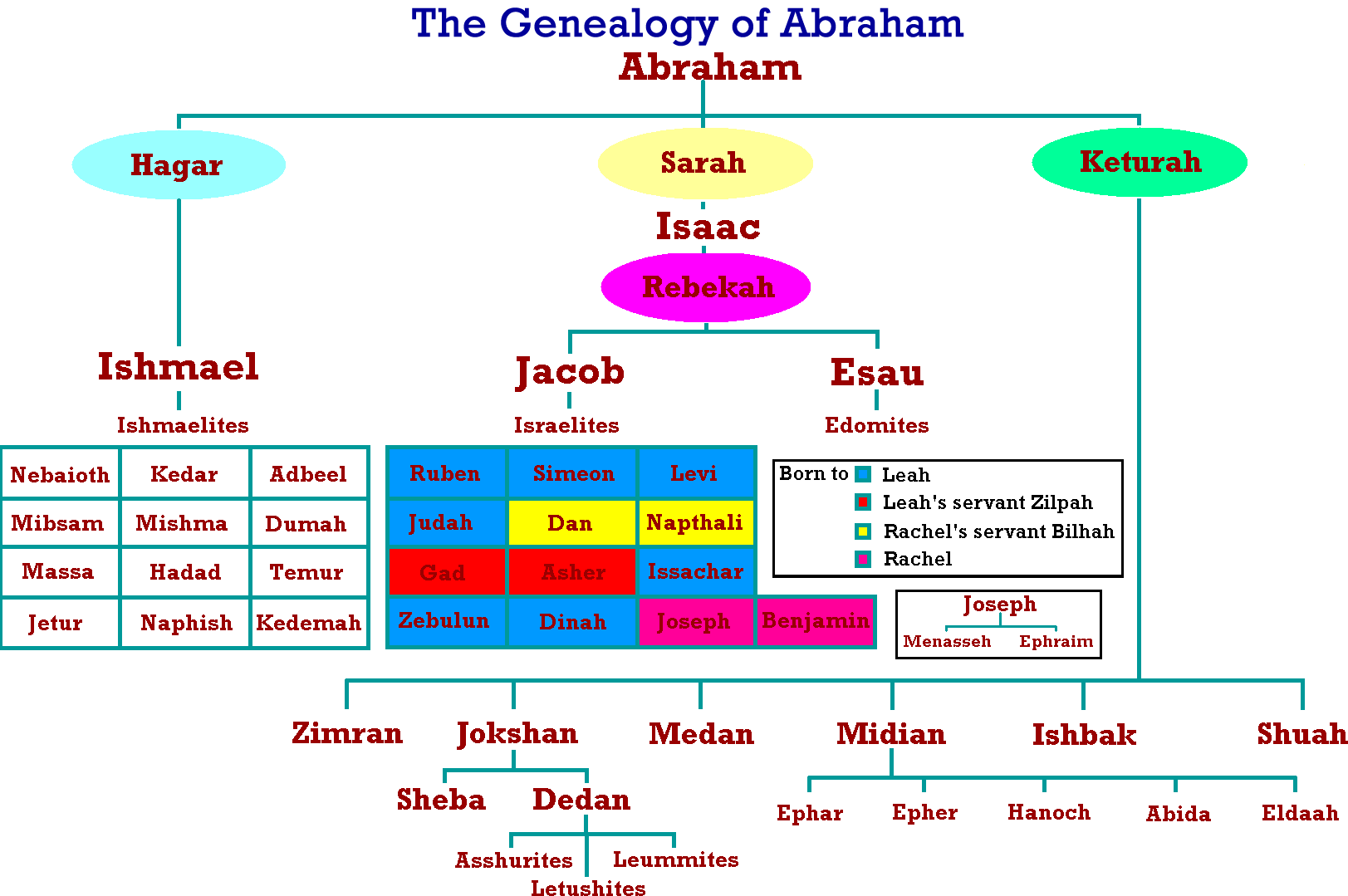
He had Ishmael (Ishmaelites) to Hagar, his wife’s maid servant. [29] Ishmael became the Patriach of the Islamic religion.
Then at the age of 100 Abraham had Issac to his wife Sarai. [30]
It was to be thru Issac that God would fulfill his promise to Abraham and so Ishmael was sent away. [31]
Issac married Rebeka who bore Esau (the Edomites) and Jacob (the Israelites). Abraham had a third wife Keturah who bore many children who were sent to the middle east and became fathers of nations there too. [32]
Jacob eventually bore 12 sons and a daughter. The eleventh son was Joseph. Joseph was the first son of Rachael (Jacob’s second wife). [33] Jacob had an encounter with God one night and was renamed Israel. [34] His descendants (the Jews) became the Nation of Israel (from which comes Judaism) out of which came Christ (Christianity) with whom God would fulfill his promise to Abraham. [35]
Genealogy of Noah (according to the Bible)
Genealogy of Abraham (according to the Bible)
In the Biblical account, (Genesis 37-50) Joseph was the first born Son of Rachael (Jacob’s second wife). Jacob (Israel) favored Joseph over his other children. Joseph had a dream that one day he would rule over his brothers. His brothers became jealous of him and so sold him to slave traders who took him to Egypt. [36] He was subsequently sold to Potiphar in Egypt as a slave and was subsequently wrongfuly imprisoned.
It was in prison where he came to the attention of Pharaoh through his cupbearer who informed Pharaoh of Joseph’s ability to interpret dreams by the power of God. Pharaoh needed counsel about his own dreams and was not able to find anybody from his own kingdom to help.
Joseph was able to tell Pharaoh the meaning of his dreams which fortold of a coming famine lasting seven years but preceded by seven years of abundance. Pharaoh made Joseph second in charge over his all his kingdom. During the seven years of abundance, Joseph was able to build silos in every city and store enough grain to feed the Nation during the seven years of famine that followed. [37]
Joseph’s achievements in Egypt
When Joseph was 30 yrs old, Pharaoh put him in charge of the whole land of Egypt. Pharaoh gave Joseph his signet ring, dressed him in fine linen and put a gold chain around his neck. He was given a chariot to ride around Egypt as second in command. Joseph’s name was changed to Zapheneth Paneah and he was given a wife Asenath (Daughter of Potiphera, priest of On). [1]
During the seven years of abundance, Joseph stored up huge quantities of grain in each city from the fields surrounding them. [2]
He had two sons to Asenath, Mannaseh & Ephraim. [38]
Joseph saved Egypt and Caanan by selling the people grain during the 7 year famine. When the people had run out of money, Joseph brought their livestock. When they had run out of livestock he brought the land titles. [3]
Joseph brought up all the land in Egypt for Pharaoh. The priests did not have to sell their land as Pharaoh gave them a supply of food. [11]
Joseph’s family were saved. [39] Jacob (Israel) and his eleven other sons along with their wives and servants were invited by Pharaoh to come and live in Egypt. [40] They settled in Rameses and became numerous in number. [41]
Jacob died and was afforded an Egyptian burial [42] after blessing his children and those of Joseph. [43] [44] Joseph reassures his brothers after Jacobs death. [45] Eventually Joseph dies at the age of 110 and is given an Egyptian style burial aswell. [46]
After 430 years passed, the Israelites numbered over 2 million. They were eventually lead out of Egypt by Moses through the Red Sea (the exodus). [47]
Is Joseph likely to have figured in Egyptian records?
If Joseph was placed second in charge of Egypt by Pharaoh, there should be some note of this in Egyptian records. [1]
Joseph helped to save Egypt and the surrounding nations from a famine lasting seven years. [2]
Joseph would have had to construct massive grain silos for storing grain in many Egyptian cities and indeed, massive silos can be found in many historical significant Egyptian cities today (eg Saqqara).
Joseph married the daugher of one of the High Priests in Egypt. [1] He saved his country from a seven year famine and brought up all the land of Egypt except for that of the priests who did not need to sell their land because Pharaoh supplied them with food. The people became loyal subjects of Pharaoh because of what Joseph had done. [3]
Joseph was, therefore, responsible for making the Pharaoh’s wealthy and powerful. [11]
Joseph served the Pharaohs from the age of thirty. [1] He died at the age of 110 years of age and was given a Royal Egyptian burial. [46] It is quite possible that he may have been involved with the design of the first and maybe the second pyramid.
His family, the descendants of Jacob (Israel), produced mud bricks and became numerous in number in the 430 years that they lived in Egypt. There were over 600 thousand adult males (not counting women and children) who were lead out of Egypt by Moses during a time of great disaster in Egypt. [47]
With a list of accomplishments like this, it would be hard to conceive that Joseph would not be mentioned in Egyptian heiroglyphics or memorialized some other way.
Where does Joseph fit into Egyptian History?
Estimates of dates have long been the common denominator used by archaeologists and historians alike when trying to piece together ancient history.
Various teams of archaeologist have used a number of different dating methods to estimate how old a particular artifact is. For example, the type of pottery that is predominant in a layer can be used to date the layer.
Assumptions behind various dating techniques are not alway right. This can sometimes lead to artifacts being incorrectly dated by as much as 1000 to 2000 years.
If history is pieced together based only upon the estimated dates of particular dynasties, the results can be quite erroneous and it will be little wonder why Egyptian and Hebrew history does not fit together and why no Egyptian equivalent of Joseph has been found using the dates traditionally ascribed to various Egyptian dynasties.
An increasing number of historians are now calling into question the dates of Egyptian dynasties. In particular, Sweeney [15] [21] [19] [48] , Velikovski [49] [50] [51] , Fry [52] [12] [53] [16] [54] [55] [56] [57] [58] [59] [20] , Reilly [13] [17] [60] [22] Ashton & Down [18] .
Using their revised dating system, the historical records of Israel and Egypt fit together much better and it is possible to identify likely correlates and contemporaries of important Biblical Characters.
Conventional wisdom which has been very reliant on dating methods has been unable to find any evidence that the Patriarchs of Israel lived in Egypt and have not found any possible candidates for Joseph because they are looking for evidence of him in the Hyksos dynasty which is estimated to have been around 1700BC according to conventional chronology. As a result, conventional wisdom states that Joseph and other Biblical figures were minor figures in Egypt that were not note worthy enough to have been memorialized in the heiroglyphic records and other monuments that have been uncovered.
Modern thinking using the revised chronology results in much clearer picture with the history Israel and Egypt lining up and matching archaeological records. Abraham is considered to be a contemporary of Menes. Imhotep is considered to be the Joseph of the Bible and Djoser is considered to be the Pharaoh that he served [13] [17] [21] [15] [52] [54] .
This would fit with the theory that Amenemhet III was the Pharaoh of Moses who oppressed the Israelites making them make mud bricks [18] . Also of note is that the pyramid of Amenemhet III was made of mud bricks containing straw. [18] Amenemhet III was the 6th Pharaoh of the 12th dynasty and lived 450 to 500 years after Pharaoh Djoser in the 3rd dynasty. [18] He had only daughters who had a son (Amenemhet IV) who disappeared before he could become King. It has been suggested that Amenemhet IV was Moses. [18]
The Exodus took place during the Reign of Neferhotep I during the 13th dynasty in 1445BC. He was the only Pharaoh of that dynasty [18]
The Hyksos (15th & 16th dynasties) which were contemporary with Joshua and the Judges, came to an end when King Saul destroyed the Amalekites (Hyksos) [18] [61]
Dynasty 17 was contemporary with dynasty 16. [18]
Amenhotep I and Thutmosis I of the 18th dynasty were contemporaries of David. [18] Hatshepsut was the Queen of Sheba who visited Solomon. [62] [63] Thutmosis III came to power during the reign of Jereboam and became the greatest Pharaoh of Egypt. [18]
‘
Modern’ Chronology (Ashton & Down 2006) [18]
| Date | Dynasty | Egypt | Contemporary_in_Israel |
| 2080BC | 1st | Menes | Abraham |
| 1900BC | 3rd | Djoser_+_Imhotep | Joseph |
| 1531BC | 12th | Amenemhet_III (6th_Pharaoh) | Moses |
| 1445BC | 13th | Neferhotep I | The Exodus (Moses) |
| 1405 -1021BC | 15th_&_16th | Hyksos | Joshua to Saul |
| 1018BC | 18th | Amenhotep I & Thutmosis I | King David |
| 950BC | 18th | Hatshepsut [Queen of Sheba] | Solomon |
| 929BC | 18th | Thutmosis III | Jereboam |
Why is it so hard to piece together Egyptian records?
The Egyptians suffered great losses at the time of the Exodus and may not have wanted to remember what Joseph and his family had achieved during their 400 year stay in Egypt. This may be one reason why it is very difficult to find historical information about the exploits of the Israelites in Egypt.
This may also been the reason that the second pyramid designed by Imhotep was not completed.
Another reason why it is difficult to find historical information is because much of it was lost or destroyed by various seiges, conquests, natural distasters and even erosion over the centuries.
Egyptian records are written as qlyphs (pictures) in stone. They have a number of limitations – you need to know ‘the code’ ie what they mean. Pronunciation is not indicated as with Greek and English and there is no time stamp. The art of interpreting them (heiroglyphics)has been somewhat lost.
Similarities between Joseph and Imhotep
Imhotep – Egyptian records
| Joseph – Bible |
- Imhotep is appointed Administrator by Pharaoh Djoser during the periods of seven years famine and seven years of bountiful harvests [8]
|
- Joseph is appointed Administrator to Pharaoh for the seven years of plenty then of famine
|
- Minister to the King of Lower Egypt [8]
|
- Pharaoh .. made him ruler over all the land of Egypt
|
- Administrator of the Great Palace [8]
|
- Thou shalt be over my house
|
- Not of royal blood; attained position by ability [8]
|
- From another nation and religion, not of royal blood, attained position by ability
|
- Not appointed by Pharaoh Djoser until he had reigned for some time [8]
|
- Appointed well after Pharaoh ruled Egypt
|
- Given the status of “son” to Pharaoh [8]
|
- Granted the status of “son” to Pharaoh
|
- High Priest in Heliopolis [8]
|
- Married to Asenath, daughter of Poti-Pherah, High Priest in Heliopolis – by custom, would succeed father-in-law
|
- Builder and architect [8]
|
- Builder of grain storehouses such as at Sakkara step-pyramid
|
- Exalted by Pharaoh Djoser as of godly character [8]
|
- And Pharaoh said, ‘a man in whom the spirit of God is!’
|
- “I need advice from God” [8]
|
- Noted as saying, “It is not in me; God shall give Pharaoh an answer”
|
- Had great medical skill – was compared to the Greek God of Healing [8]
|
- Had doctors under his authority – worked by miracles, dreams and signs from God
|
- Decided the tax rate during the seven years of famine; also not to apply to priests [8]
|
- Decided the tax rate during the seven years of famine; also not to apply to priests
|
- Realizes when he is dying – dies at age 110 [8]
|
- Realizes when he is dying – dies at age 110
|
Who was Imhotep?
Imhotep was a most interesting figure in the Egyptian culture, his name means “the one who comes in peace”. He served Djoser, the third dynasty king, he was the vizier to the pharaoh and they say that he was the high priest to the sun god Ra. [64]
Imhotep is attributed with being the first person in history to be an acting physician, he was also the first architect, he was a poet and also a philosopher. After his death he was given the status of a deity, he was only one of a very few commoners to ever be given that kind of an honor.
[64]
He is thought to be the architect of the first Pyramid; the step pyramid at Saqqara. [64]
He is also credited with the use of columns in architecture. [64]
He is known as the founder of Egyptian medicine, and he is famous for not incorporating magic into his medical treatments, he diagnosed and treated over two hundred diseases, he extracted medicine from plants and he is also known to have performed operations and dentist work. He knew the circulation of the blood system and he knew where each vital organ was placed and what its uses were. [64]
He became the god of medicine and healing, when the Greeks invaded Egypt they worshiped him and built him temples because they saw in him their own god of healing named Asclepius. [64]
Imhotep was also the first person known to use the papyrus scroll. He may have actually invented it! [64]
Among other things Imhotep is also attributed to the prediction and prevention of a seven year famine that came upon the land, he predicted the famine from a dream the pharaoh Djoser had, in this dream the god of the Nile spoke to the pharaoh, and Imhotep was the only one that could interpret the dream. [64]
Could Joseph and Imhotep have been the same person?
The Roman-Jewish historian, Josephus, quotes the writings of Manetho, Egyptian historian: “During [the] reign of .. Pharaoh Djoser, 3rd Egyptian dynasty, lived Imhotep .. [with a] reputation among Egyptians like the Greek God of medicine – [Manetho even wondered] whether Imhotep could have been an actual person .. [because he had] “so many outstanding qualities and talents .. a very special person [who] appears in the history of Egypt.” On the foundations of the Step Pyramid in Sakkara was carved the name of Pharaoh Djoser and “.. Imhotep, Chancellor of the King of Lower Egypt, Chief under the King, Administrator of the Great Palace, Hereditary Lord, High Priest of Heliopolis, Imhotep the Builder..”. [8] [65]
Joseph arrived in Egypt as a young man and married Asenath, the daughter of Potipherah, the priest of On. [1]
This information precludes the theory that Joseph lived during Hyksos rule in Egypt. On or An was the ancient capital of Heliopolis (As-t Tem). Some claim that Egyptians also believed in One Great God who was never represented in their art work. Only his attributes, functions as Creator, Teacher and Healer were known as the neter or neteru. The symbolism surrounding Egyptian deities then is different from this One Great God, in whose image man was made, in that it scales our world and the universe to our dimensions so man can grasp it. The Egyptian name for this `One Great God’ is neter, probably an echo or more distant memory of the biblical Creator God of Abraham, Issac and Jacob. [66]
Both Imhotep and Joseph imposed a 20% (one fifth) tax on the people with the exemption of the priests. [54]
Moeller refers to an inscription on the island of Sihiel, near the first cataract of the Nile, which actually links Imhotep to the key biblical element of the Joseph story – telling of Pharaoh Djoser in the 18th year of his reign. The inscription states “seven meagre years and seven rich years”. Commenting on the inscription, Moeller writes, “Pharaoh Djoser asks Imhotep to help him with the coming seven years of famine. All the biblical components of the story are there, and there is a similar inscription on the island of Philae in the Nile.” (This is exactly as in the Bible with Joseph, except for listing the “meagre” years before the years of plenty. Note: The famine years were, of course, the event of significance, saving everyone from starvation and bringing in much wealth to Egypt – it is noted that the manuscript was written a thousand years after the occurrences.) [67] [8]
Pharaoh renamed Joseph ‘Zapeneth Peneah’ [1] which means “master of the school of learning” [66] or “Man to whom secrets are revealed” [54] .
It is also interesting to note that circumcision was widely practiced among Egyptians from the third dynasty onward. Although Abraham did visit Egypt, it seems more likely that this practice was introduced by Joseph-Imhotep in the third dynasty. [54]
Egyptian records show that before Imhotep, the bodies of Egyptian royalty were not embalmed. Instead, they were entombed in early Egyptian structures called mastabas, (or mastabahs), oblong structures with flat roofs and sloping sides built over the opening of a mummy chamber or burial pit . [54]
Djoser appears to be the first king to have be embalmed, [54] Jacob (Israel) was embalmed by Joseph and buried in a coffin and Joesph himself was embalmed and given a royal Egyptian burial. [46] [42] The Biblical account suggests that only Joseph’s bones were preserved as was the practice in the early dynasties of the Old Kingdom. Preservation of the whole body was not practiced until the Era of King Tut (New Kingdom). [54]
Extremely noteworthy regarding Imhotep-Joseph is that the mummified bodies of neither have ever been found. The known facts regarding the burials of Imhotep and Joseph also strongly support the thesis that they were the same person: [8]
Both died at age 110. [8] [46]
Imhotep’s coffin in Sakkara – with innumeral Ibis birds mummified in the adjoining galleries (Imhotep was called “Ibis” because of his reputation for healing – a large number of Ibis birds were sacrificed to him at his funeral in Sakkara); many clay vessels bearing the seal of Pharaoh Djoser were near the coffin; and the coffin is oriented to the North, not East, and is empty. [8]
Joseph would have been buried at Sakkara, his coffin orientated to the North – indicating he did not believe in the gods of the Egyptians (who were buried facing East, the rising sun); the coffin would also be empty as Joseph’s bones would have been taken by Moses with the Hebrews during the Exodus. [8] [46]
Could Pharaoh Djoser (King Netjerikhet) be the Pharaoh of Joseph?
The ‘correct alignment’ of Israel’s and Egypt’s history will allow contemporary fragments of information to be linked together to build up a clear picture of ancient history. Combining the records of Egypt, Israel and Mesopotamia will help to fill in the gaps in each nations’ record.
Evidence is now accumulating to suggest that Egyptian dynasties may overlap and may not date back as far as was once thought. [15] [16] [17] [18] [66]
Dynasty 2 is considered contemporary with dynasty 3. [18] There was no first intermediate period. The dark ages of the first intermediate period have been confused with the dark ages of the second intermediate period. [18]
Dynasties 7-10 have been identified with 15-16 and Dynasty 17 was contemporary with dynasty 16. [18]
Egyptian history, therefore, does not date back as far as was once thought (3000BC – 5000BC) as per the Conventional Chronology. [18] [50] [51] [49] [21] [13] [17] [52] [12] [53] [16] [54] [66]
The first Egyptian dynasty is now considered to have started around 2100BC and the Great Flood is considered to have been around 2300-2400BC. [18]
The Exodus occured just after the end of the 12th dynasty in 1445BC. [66] [18]
Any Egyptian dates before the 12th dynasty are considered quite speculative and are only approximations [18]
This ‘Modern Alignment’ of the Dynasties fits the Biblical account and also the records of Mesopotamia.
The ‘Modern Alignment’ of the Dynasties provides the answers to the major objection to Joseph and Imhotep being the same person (namely the mismatching dates) and by the same token makes it highly likely that Pharaoh Djoser was the Pharaoh of Joseph.
While Sweeney points out that Abraham was a contemporary of Menes who were patriarchs of their respective civilizations some time after a catestrophic destruction [21] , he has probably over corrected the dates which are far too short even for Biblical events.
If it is agreed that Joseph was Imhotep and he served Pharaoh Djoser (Zozer) of the Third dynasty, it does not follow that the identity of Moses and the Pharaoh’s he was contemporary with will be agreed as there is not universal agreement about which dynasties to identify and which dynasties ran in parallel. [58] [66] [19] [18] [17]
‘
Conventional’ Chronology [21]
| Date | Egypt | Israel |
| 3000BC | Menes (First dynasty displays strong mesopotamian influence)Djoser and Imhotep (Famine crisis solved when Imhotep interprets Djoser’s dream) | |
| 2000BC | First Intermediate period(Age of disturbance in nature and general lawlessness) | Abraham (migrates from mesopotamia and introduces some of the basic civiliation to Egypt)Joseph (Famine crisis in Egypt solved when Joseph interprets Pharaoh’s dream) |
| 1000BC | | Moses leads the Israelites to freedom amidst violent upheavals of nature |
‘
Revised’ Chronology (Sweeney 1997) [21]
| Date | Egypt | Israel | Mesopotamia |
| 1300+BC | Early_Badarian | | ‘Ubaid |
| 1300BC | Catestrophic_Destruction | Catestrophic_Destruction | Catestrophic_Destruction |
| 1200BC | Late_Bedarian_and_Gerzean | Khirbet_Kerak | Jamdat_Nasr(Early_Literacy) |
1100-
1000BC
| Destruction episode | Destruction episode | Destruction episode |
| 1000BC | Menes (Early Dynastic Age) | Abraham | (Early Dynastic Age) |
| 900BC | Djoser and Imhotep | Joseph | |
| 800BC | Destruction episode | Destruction episode | Destruction episode |
| 800BC | Pyramid Age | Age of the Judges | Akkadian Age |
| 700BC | Hyksos epoch | Saul | Sargon I |
‘Modern’ Chronology (Ashton & Down 2006) [18]
| Date | Dynasty | Egyptian_Pharaoh | Contemporary_in_Israel |
| 2080BC | 1st | Menes | Abraham |
| 1900BC | 3rd | Djoser_+_Imhotep | Joseph |
| 1531BC | 12th | Amenemhet_III (6th_Pharaoh) | Moses |
| 1445BC | 13th | Neferhotep I | The Exodus (Moses) |
| 1405 -1021BC | 15th_&_16th | Hyksos | Joshua to Saul |
| 1018BC | 18th | Amenhotep I & Thutmosis I | King David |
| 950BC | 18th | Hatshepsut [Queen of Sheba] | Solomon |
| 929BC | 18th | Thutmosis III | Jereboam |
What implications does this have for Egyptian History?
If the ‘modern alignment’ of the Egyptian Dynasties is correct, Joseph can be identified with Imhotep and Egyptian history will be consistent with the Bible.
Pharaoh recognised Joseph’s divine inspiration and appointed him to be in charge of Egypt. Joseph built silos to store grain and so saved Egypt from a seven year famine. He acquired all the land of Egypt (other than the priest’s) for Pharaoh by selling grain. The Pharaohs became wealthy and powerful and the people of Egypt became his subjects. Joseph’s family was invited to live in Egypt (Rameses). [3] [11]
Joseph, therefore, saved his family and protected the Israelites as they grew to become a nation in Egypt. [45]
Djoser was the second Pharaoh of the 3rd dynasty of Egypt and came about three or four generations after Menes who was the Pharaoh of the 1st dynasty of Egypt and a contemporary of Abraham. [18] [21] [15]
Joseph came three generations after Abraham and was contemporary with Djoser (1900BC) . After his death he was deified because of his achievements. As King Netjeriket of the third Egyptian dynasty was also known by the name ‘Pharaoh Djoser’, it is possible that this name means ‘Pharaoh of Joseph’.
The Israelites stayed in Egypt 430 years. This takes us to the end of the 12th and beginning of the 13th dynasty which is when the Exodus occurred. (1445BC) [18]
It is unlikely that Joseph was some inconspicuous person in the 18th dynasty of Hyksos as is commonly held by people who adhere to the ‘conventional alignment’ of Egyptian dynasties.
What’s more, if the ‘modern alignment’ is correct, the Hebrew influence of Egyptian culture will be re-established. The first pyramid would have been designed by a Hebrew. The Hebrew God can be credited for saving Egypt from a seven year famine and giving the Pharaoh’s their power, wealth and the means to build the other pyramids. The designer of the first pyramid will, once again, be seen to be a servant of the God of Abraham, Issac and Jacob, even though the pyramids later became objects of pagan worship and Imhotep was deified long after his death by the Greeks.
When the Israelites left Egypt, Joseph’s association with the God of Abraham, Isaac and Jacob was forgotten and the pyramids became symbols of pagan gods.
With the aid of hind sight it can be seen how the designer of the first pyramid, the savior of the Egyptian people and the man responsible for the Pharaoh’s power, known as Imhotep, would be deified some 1400 years after his death once his connection with the God of Abraham, Issac and Jacob had been lost and forgotten.
The first pyramids, which were made of cut limestone, were built by the Egyptian people who had sold their land to Pharaoh and become his subjects.
After Joseph’s death, the Israelites were given the task of making mud bricks. [68] [69] Interestingly, the core of the Pyramid of Amenemhet III is made of mud bricks containing straw. [18] Amenemhet III was the 6th Pharaoh of the 12th Egyptian dynasty which preceeded the Exodus in 1445BC. [18]
Moses was forced to flee Egypt and go to Midian after killing an Israelite official. During that period, the Pharaoh died. [70] When he returned to Egypt, there was a new Pharaoh in power (possibly Neferhotep I of the 13th Dynasty). [18]
The Hyksos dynasties (14th & 15th dynasties) started after the Exodus, spanned the period of the Judges and was finally ended by Saul when he defeated the Amelekites. [18] [61]
What implications does this have for Israel and Christianity?
If Joseph was Imhotep, then Bible History is consistent with Egyptian history.
This will mean that there is archaeological evidence that the Patriarchs of Israel lived in Egypt.
Archaeological evidence for Israel in Arabia ⁄ Midian (Jabel el Lawz) in combination with the above would corroborate the Biblical account of the Exodus.
Joseph saved his family and protected the Israelites and allowed them to multiply in numbers so that they could fulfill what God had planned; namely to return to the land of Canaan and to take possession of it after spending 430 years in Egypt and 40 years in the Wilderness. [28]
What implications does this have for Literature, Medicine and Architecture?
If Joseph was Imhotep, this would make Joseph the father of medicine, the first architect to build with stone and use columns and the inventor of the papyrice and the first to use it (to write medical and non-medical literary works). [71] [72] [73] [74] [6] [75]
He probably served more than one pharaoh and appears to have designed at least two pyramids and several buildings that utilize columns. He was given the name Pathotep by a later pharaoh that he served. [54]
Imhotep may have invented the embalming techniques used to preserve the bodies of Egyptian Pharaohs. He became the first pathologist. He was known as the ‘Son of Ptah’ (or son of Path). [54] Hundreds of years after his death, he became deified and was known as the god Path. [54]
Not only was Pathotep’s name derived from that of the god Path, but our modern word, ‘Pathology’, was also derived from and bears his name. [54]
Summary: Joseph and Imhotep are the same person
There is such a strong match between the profile of Joseph and Imhotep that many historians, theologians and archaeologists have suggested that they are one in the same person.
There were only so many non royal, second in charge visiers who saved Egypt from a 7 year famine by interpreting Pharaohs dreams (with the power of God), imposed a 20% tax, brought up all the land of Egypt for Pharaoh (except for that of the priests), lived to the age of 110 and were embalmed when they died. – Imhotep & Joseph
Imhotep was also the High Priest of Heliopolis. Jospeh married the daughter of the high priest of On (the capital of Heliopolis) !
Until recently, the main case for not believing Joseph and Imhotep to be the same person, has been the considerable discrepancy between the estimated dates of their existance by as much as 1000 years!
Egyptian records are far from complete. They are not chronological and the exact way that fragments fit together is by no means certain.
In the Last 50 years, historians have realized that several Egyptian dynasties have been counted twice and some ran in parallel. The result is that Egyptian history can be substantially contracted, therefore eliminating the discrepancy in the estimated dates of Joseph and Imhotep.
This modern understanding of the Egyptian dynasties means that Joseph almost certainly was Imhotep and Egyptian History is consistent with the Bible.
If it can be generally accepted that Joseph and Imhotep were the same person, this would give historians an anchor in history in order to further correlate the history of Egypt, Israel and Mesopotamia.
Suggested Reading
1. J. Ashton & D. Down, Unwrapping the pharaohs. how Egyptian archaeology confirms the Biblical timeline, New Leaf Publishing Group (Master books), 2006.
ISBN 978-0-89051-468-9 ISBN 0-89051-468-2 http://masterbooks.net
2. H. Bible, “Jacob bore 12 sons,”
Genesis chapter 29-32,
3. H. Bible—”Keturah’s children sent away to Middle East,”
Genesis 25:1-4,
4. H. Bible—”Abrahams children to be reckoned through Isaac,”
Genesis 21:12,
5. H. Bible—”Ishmael sent away – Isaac the child of promise,”
Genesis 21:8-13,
14. H. Bible—”Jacob renamed Israel,”
Genesis 32:22-32,
17. H. Bible—”Joseph falsely accused and imprisoned in Egypt,”
Genesis 39:1-23,
21. H. Bible—”Joseph reassures his brothers afer Jacob’s death,”
Genesis 50:15-21,
29. H. Bible—”Joseph buys up all the land of Egypt for Pharaoh,”
Genesis 47:18-22,
32. H. Bible—”Joseph stores up huge quantities of grain in Egyptian cities,”
Genesis 41:47-49,
37. H. Bible__”Moses flees to Midian and Pharaoh eventually dies”
Exodus 2:11-25,
38. H. Bible, “The Israelites oppressed,”
Exodus 1:1-22,
39. H. Bible—”Pharaoh makes Israelites find own straw to make mud bricks,”
Exodus 5:1-21,
40. “The Wall Chart of World History – From earliest times to the present” 1998 Bracken Books
ISBN 1-86256-306-3
References:
19. E. Sweeney, The pyramid age, ages in alignment series, Algora Publishing, 2007.
21. E. Sweeney, The Genesis of Israel and Egypt, Janus Publishing Company Limited, 1997.
ISBN 978-1857563504
24. H. Bible, “
The Flood,” Genesis Chapter 6,
48. Empire of Thebes or Ages In chaos revisited (ages in alignment), Algora Publishing, 2006.
49. I. Velikovski, Worlds in collision, London and New York, 1950.
50. I. Velikovski—Ages in chaos, London and New York, 1953.
51. I. Velikovski—Earth in upheaval, 1956.
67. L. Moeller, The case for the Exodus, .