Sunday, September 26, 2010

Abraham and His Contemporaries


Chapter Thirteen
ABRAHAM: THE FATEFUL YEARS


And it came to pass
in the days of Amraphel king of Shin’ar,
Ariokh king of Ellasar,
Khedorla’omer king of Elam,
and Tidhal king of Go’im -
That these made war
with Bera King of Sodom,
and with Birsha king of Gomorrah,
Shinab king of Admah,
and Shem-eber king of Zebi’im,
and with the king of Bela, which is Zoar.

"Thus begins the biblical tale, in chapter 14 of Genesis, of an ancient war that pitted an alliance of four kingdoms of the East against five kings in Canaan. It is a tale that has evolved some of the most intense debate among scholars, for it connects the story of Abraham, the first Hebrew Patriarch, with a specific non-Hebrew event, and thus affords objective substantiation of the biblical record of the birth of a nation.

"....For many decades the critics of the Old Testament seemed to prevail; then, as the nineteenth century was drawing to a close, the scholarly and religious worlds were astounded by the discovery of Babylonian tablets naming Khedorla’omer, Ariokh, and Tidhal in a tale not unlike the biblical one.

"The discovery was announced in a lecture by Theophilus Pinches to the Victoria Institute, London, in 1897. Having examined several tablets belonging to the Spartoli Collection in the British Museum, he found that they describe a war of wide-ranging magnitude, in which a king of Elam, Kudur-laghamar, led an alliance of rulers that included one named Eri-aku and another named Tud-ghula - names that easily could have been transformed into Hebrew as Khedor-la’omer, Ariokh, and Tidhal. Accompanying his published lecture with a painstaking transcript of the cuneiform writing and a translation thereof, Pinches could confidently claim that the biblical tale had indeed been supported by an independent Mesopotamian source.

"With justified excitement the Assyriologists of that time agreed with Pinches reading of the cuneiform names. The tablets indeed spoke of "Kudur-Laghamar, king of the land of Elam"; all scholars agreed that it was a perfect Elamite royal name, the prefix Kudur ("Servant") having been a component in the names of several Elamite kings, and Laghamar being the Elamite epithet-name for a certain deity. It was agreed that the second name, spelled Eri-e-a-ku in the Babylonian cuneiform script, stood for the original Sumerian ERI.AKU, meaning "Servant of the god Aku," Aku being a variant of the name of Nannar/Sin. It is known from a number of inscriptions that Elamite rulers of Larsa bore the name "Servant of Sin," and there was therefore little difficulty in agreeing that the biblical Eliasar, the royal city of the king Ariokh, was in fact Larsa. There was also unanimous agreement among the scholars for accepting that the Babylonian text’s Tud-ghula was the equivalent of the biblical "Tidhal, king of Go’im"; and they agreed that by Go’im the Book of Genesis referred to the "nation-hordes" whom the cuneiform tablets listed as allies of Khedorla’omer.

"Here, then, was the missing proof - not only of the veracity of the Bible and of the existence of Abraham, but also of an international event in which he had been involved!

"....The second discovery was announced by Vincent Scheil, who reported that he had found among the tablets in the Imperial Ottoman Museum in Constantinople a letter from the well-known Babylonian King Hammurabi, which mentions the very same Kudur-laghamar! Because the letter was addressed to a king of Larsa, Father Scheil concluded that the three were contemporaries and thus matched three of the four biblical kings of the East - Hammurabi being none other than "Amraphael king of Shin’ar."

"....However, when subsequent research convinced most scholars that Hammurabi reigned much later (from 1792 to 1750 B.C., according to The Cambridge Ancient History), the synchronization seemingly achieved by Scheil fell apart, and the whole bearing of the discovered inscriptions - even those reported by Pinches - came into doubt. Ignored were the pleas of Pinches that no matter with whom the three named kings were to be identified - that even if Khedorla’omer, Ariokh, and Tidhal of the cuneiform texts were not contemporaries of Hammurabi - the text’s tale with its three names was still "a remarkable historical coincidence, and deserves recognition as such." In 1917, Alfred Jeremias (Die sogenanten Kedorlaomer-Texte) attempted to revive interest in the subject; but the scholarly community preferred to treat the Spartoli tablets with benign neglect.

"....Yet the scholarly consensus that the biblical tale and the Babylonian texts drew on a much earlier, common source impels us to revive the plea of Pinches and his central argument: How can cuneiform texts, affirming the biblical background of a major war and naming three of the biblical kings, be ignored? Should the evidence - crucial, as we shall show, to the understanding of fateful years - be discarded simply because Amraphel was not Hammurabi?

"The answer is that the Hammurabi letter found by Scheil should not have sidetracked the discovery reported by Pinches, because Scheil misread the letter. According to his rendition, Hammurabi promised a reward to Sin-Idinna, the king of Larsa, for his "heroism on the day of Khedorla’omer." This implied that the two were allies in a war against Khedorla’omer and thus contemporaries of that king of Elam.

It was on this point that Scheil’s find was discredited, for it contradicted both the biblical assertion that the three kings were allies and known historical facts: Hammurabi treated Larsa not as an ally but as an adversary, boasting that he "overthrew Larsa in battle," and attacked its sacred precinct "with the mighty weapon which the gods had given him."

"A close examination of the actual text of Hammurabi’s letter reveals that in his eagerness to prove the Hammurabi-Amraphel identification, Father Scheil reversed the letter’s meaning: Hammurabi was not offering as a reward to return certain goddesses to the sacred precinct (the Emutbal) of Larsa; rather, he was demanding their return to Babylon from Larsa.

"....The incident of the abduction of the goddesses had thus occurred in earlier times; they were held captive in the Emutbal "from the days of Khedorla’omer"; and Hammurabi was now demanding their return to Babylon, from where Khedorla’omer had taken them captive. This can only mean that Khedorla’omer’s days were long before Hammurabi’s time.

"Supporting our reading of the Hammurabi letter found by Father Scheil in the Constantinople Museum is the fact that Hammurabi repeated the demand for the return of the goddesses to Babylon in yet another stiff message to Sin-Idinna, this time sending it by the hand of high military officers. This second letter is in the British Museum (No. 23,131) and its text was published by L.W. King in The Letters and Inscriptions of Hammurabi.

"....That the goddesses were to be returned from Larsa to Babylon is made clear in the letter’s further instructions.

"....It is thus clear from these letters that Hammurabi - a foe, not an ally, of Larsa - was seeking restitution for events that had happened long before his time, in the days of Kudur-Laghamar, the Elamite regent of Larsa. The texts of the Hammurabi letters thus affirm the existence of Khedorla-omer and of Elamite reign in Larsa ("Ellasar") and thus of key elements in the biblical tale.

Abram's Mesopotamian Contemporaries


Taken from "The Wars of Gods and Men": http://www.bibliotecapleyades.net/sitchin/sitchinbooks03_05.htm

....
Chapter Thirteen
ABRAHAM: THE FATEFUL YEARS


And it came to pass
in the days of Amraphel king of Shin’ar,
Ariokh king of Ellasar,
Khedorla’omer king of Elam,
and Tidhal king of Go’im -
That these made war
with Bera King of Sodom,
and with Birsha king of Gomorrah,
Shinab king of Admah,
and Shem-eber king of Zebi’im,
and with the king of Bela, which is Zoar.

"Thus begins the biblical tale, in chapter 14 of Genesis, of an ancient war that pitted an alliance of four kingdoms of the East against five kings in Canaan. It is a tale that has evolved some of the most intense debate among scholars, for it connects the story of Abraham, the first Hebrew Patriarch, with a specific non-Hebrew event, and thus affords objective substantiation of the biblical record of the birth of a nation.

"....For many decades the critics of the Old Testament seemed to prevail; then, as the nineteenth century was drawing to a close, the scholarly and religious worlds were astounded by the discovery of Babylonian tablets naming Khedorla’omer, Ariokh, and Tidhal in a tale not unlike the biblical one.

"The discovery was announced in a lecture by Theophilus Pinches to the Victoria Institute, London, in 1897. Having examined several tablets belonging to the Spartoli Collection in the British Museum, he found that they describe a war of wide-ranging magnitude, in which a king of Elam, Kudur-laghamar, led an alliance of rulers that included one named Eri-aku and another named Tud-ghula - names that easily could have been transformed into Hebrew as Khedor-la’omer, Ariokh, and Tidhal. Accompanying his published lecture with a painstaking transcript of the cuneiform writing and a translation thereof, Pinches could confidently claim that the biblical tale had indeed been supported by an independent Mesopotamian source.

"With justified excitement the Assyriologists of that time agreed with Pinches reading of the cuneiform names. The tablets indeed spoke of "Kudur-Laghamar, king of the land of Elam"; all scholars agreed that it was a perfect Elamite royal name, the prefix Kudur ("Servant") having been a component in the names of several Elamite kings, and Laghamar being the Elamite epithet-name for a certain deity. It was agreed that the second name, spelled Eri-e-a-ku in the Babylonian cuneiform script, stood for the original Sumerian ERI.AKU, meaning "Servant of the god Aku," Aku being a variant of the name of Nannar/Sin. It is known from a number of inscriptions that Elamite rulers of Larsa bore the name "Servant of Sin," and there was therefore little difficulty in agreeing that the biblical Eliasar, the royal city of the king Ariokh, was in fact Larsa. There was also unanimous agreement among the scholars for accepting that the Babylonian text’s Tud-ghula was the equivalent of the biblical "Tidhal, king of Go’im"; and they agreed that by Go’im the Book of Genesis referred to the "nation-hordes" whom the cuneiform tablets listed as allies of Khedorla’omer.

"Here, then, was the missing proof - not only of the veracity of the Bible and of the existence of Abraham, but also of an international event in which he had been involved!

"....The second discovery was announced by Vincent Scheil, who reported that he had found among the tablets in the Imperial Ottoman Museum in Constantinople a letter from the well-known Babylonian King Hammurabi, which mentions the very same Kudur-laghamar! Because the letter was addressed to a king of Larsa, Father Scheil concluded that the three were contemporaries and thus matched three of the four biblical kings of the East - Hammurabi being none other than "Amraphael king of Shin’ar."

"....However, when subsequent research convinced most scholars that Hammurabi reigned much later (from 1792 to 1750 B.C., according to The Cambridge Ancient History), the synchronization seemingly achieved by Scheil fell apart, and the whole bearing of the discovered inscriptions - even those reported by Pinches - came into doubt. Ignored were the pleas of Pinches that no matter with whom the three named kings were to be identified - that even if Khedorla’omer, Ariokh, and Tidhal of the cuneiform texts were not contemporaries of Hammurabi - the text’s tale with its three names was still "a remarkable historical coincidence, and deserves recognition as such." In 1917, Alfred Jeremias (Die sogenanten Kedorlaomer-Texte) attempted to revive interest in the subject; but the scholarly community preferred to treat the Spartoli tablets with benign neglect.

"....Yet the scholarly consensus that the biblical tale and the Babylonian texts drew on a much earlier, common source impels us to revive the plea of Pinches and his central argument: How can cuneiform texts, affirming the biblical background of a major war and naming three of the biblical kings, be ignored? Should the evidence - crucial, as we shall show, to the understanding of fateful years - be discarded simply because Amraphel was not Hammurabi?

"The answer is that the Hammurabi letter found by Scheil should not have sidetracked the discovery reported by Pinches, because Scheil misread the letter. According to his rendition, Hammurabi promised a reward to Sin-Idinna, the king of Larsa, for his "heroism on the day of Khedorla’omer." This implied that the two were allies in a war against Khedorla’omer and thus contemporaries of that king of Elam.

It was on this point that Scheil’s find was discredited, for it contradicted both the biblical assertion that the three kings were allies and known historical facts: Hammurabi treated Larsa not as an ally but as an adversary, boasting that he "overthrew Larsa in battle," and attacked its sacred precinct "with the mighty weapon which the gods had given him."

"A close examination of the actual text of Hammurabi’s letter reveals that in his eagerness to prove the Hammurabi-Amraphel identification, Father Scheil reversed the letter’s meaning: Hammurabi was not offering as a reward to return certain goddesses to the sacred precinct (the Emutbal) of Larsa; rather, he was demanding their return to Babylon from Larsa.

"....The incident of the abduction of the goddesses had thus occurred in earlier times; they were held captive in the Emutbal "from the days of Khedorla’omer"; and Hammurabi was now demanding their return to Babylon, from where Khedorla’omer had taken them captive. This can only mean that Khedorla’omer’s days were long before Hammurabi’s time.

"Supporting our reading of the Hammurabi letter found by Father Scheil in the Constantinople Museum is the fact that Hammurabi repeated the demand for the return of the goddesses to Babylon in yet another stiff message to Sin-Idinna, this time sending it by the hand of high military officers. This second letter is in the British Museum (No. 23,131) and its text was published by L.W. King in The Letters and Inscriptions of Hammurabi.

"....That the goddesses were to be returned from Larsa to Babylon is made clear in the letter’s further instructions.

"....It is thus clear from these letters that Hammurabi - a foe, not an ally, of Larsa - was seeking restitution for events that had happened long before his time, in the days of Kudur-Laghamar, the Elamite regent of Larsa. The texts of the Hammurabi letters thus affirm the existence of Khedorla-omer and of Elamite reign in Larsa ("Ellasar") and thus of key elements in the biblical tale.

....

Friday, June 4, 2010

Dr John Osgood Establishes Archaeology of Abraham

The Times of Abraham

By Dr A.J.M. Osgood

Introduction

This article, 'The times of Abraham', attempts to show that the present accepted archaeological period placement of Abraham in the Palestinian Middle Bronze I period (MB I A nomenclature) has no basis in substance, and attempts to show that only the late Chalcolithic culture of Palestine satisfies the biblical criteria, so forcing a radical revision of the accepted chronology of the ancient world, in terms of biblical statements.

Many a reader of the Bible is impressed with the narrative of the life of Abraham as though it was written about a real person who lived in a real time and a real world. He has the strengths and the weaknesses of real men.

However, particularly since the documentary hypothesis (J.E.D.P. theory), the theological world has increasingly expressed doubts about the reality of the existence of a man called Abraham. The question has ebbed backwards and forwards. Increasingly however, archaeological finds confirm a correctness of the traditions associated with the Abrahamic story.

However, the documentary hypothesis has seriously impaired the willingness of many to see the Biblical narratives as straightforward stories based on historical reality. As John Bright puts it (after discussing the JEDP theory):

‘As for the patriarchal stories, though they were valued for the light they cast on the beliefs and practices of the respective periods in which the various documents were written, their worth as sources of information concerning Israel's prehistory was regarded as minimal if not nil. Abraham Isaac and Jacob were commonly explained as eponymous ancestors of clans, or even as figures of myth, and their real existence was not infrequently denied. The patriarchal religion as depicted in Genesis was held to be a back-projection of later beliefs. In line with evolutionary theories abroad at the time, the actual religion of Israel nomadic ancestors was described as an animism or polydaemonism.’1

The problem concerning Abraham historically is compounded by the combined problems discussed in 'The Times of the Judges - the Archaeology', namely:

  1. The theory of evolution,
  2. The documentary hypothesis,
  3. The accepted yardstick of the Egyptian chronology of Monetho, and
  4. Acceptance of dating methods as being truly objective.

The resultant confusion leaves us today with a conviction that Abraham was an historical figure, yet with no really convincing time slot archaeologically in which to place him, which can bear up to solid scrutiny, and certainly no positive identification of events in Abraham's life occurring at any particular time slot archaeologically.

Present time placement of Abraham

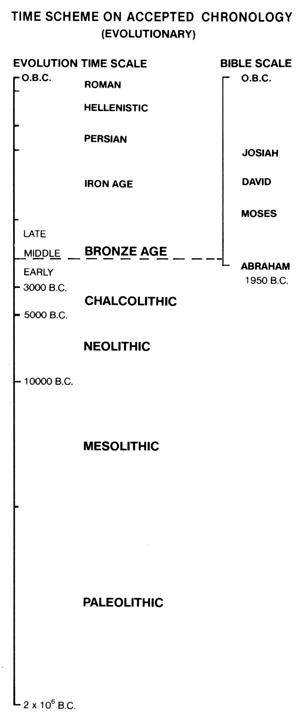
The accepted or evolutionary time scale for the Paleolithic to Iron Age sequence, when placed side by side with the known time relationships in the Scripture concerning Abraham, allows a placement of Abraham of somewhere around the Middle Bronze I period (abbreviated MB I variously referred to as Early Bronze IV (EB IV) in Palestine, or Intermediate Early Bronze-Middle Bronze (see Figure 1). The placement originally of Abraham in this time slot can be largely traced to Nelson Glueck, with support from William Albright. Nelson Glueck was one who asserted the correctness historically of Scripture, yet held an evolutionary chronology and so placed Abraham in Middle Bronze I.

Figure 1.
Figure 1. Time scheme of the accepted evolutionary chronology.
‘If one believes, as we do, in the validity of the historical memories of the Bible, and if one accepts as real flesh and blood human beings the personages reflected in the portrayals of the Biblical Patriachs. then the Age of Abraham must be assigned to the MiddIe Bronze I period. Ending in the nineteenth century B.C... The only archaeological framework in which the person and period of Abraham in the Negeb can be placed is Middle Bronze I.’2

In that same discussion, Nelson Glueck insists that the destructions of MB I settlements corresponded to the biblical account of the destruction inflicted by Chedorlaomer and his confederates (Genesis 14). However, apart from the statement of such, he offered no positive evidence to confirm that such an historical link-up can be made more secure than the simple statement of belief.

William Albright was quick to ally himself with Nelson Glueck and established a belief that Abraham was one who plied a trade as a donkey caravaneer between Mesopotamia and Egypt. This is a belief that was Albright's, but certainly does not conform to the Scriptures, in the literal sense.

‘Nelson Glueck was prompt to associate the biblical traditions of Abraham with the MB I remains in the Negeb; he also recognised the fact that the settlements from this age were connected with old caravan routes.’3

So the MB I period of Palestine has since been indelibly associated with the time of Abraham in the minds of many. The characteristics of this age have been argued over time and time again, and they are still the subject of lively debate.

Essentially then, the time of Abraham has been fixed in MB I for the following reasons:

  1. It fits the presently accepted chronology as far as DATING is concerned if one accepts the time relationships the Bible claims. (It is then keyed in on an evolutionary time scale.)
  2. The MB I period does have characteristics that suggest a nomadic people, and as Abraham had certain nomadic characteristics, the belief is made to stick.

However, placement of Abraham in the Middle Bronze I Age has nothing more positive than that to offer. There are no positive identifying features that can make it certain that Abraham is to be placed in this age. It still remains a 'correct' fit as far as the accepted chronology is concerned and that is where the matter rests.

A need for a re-evaluation

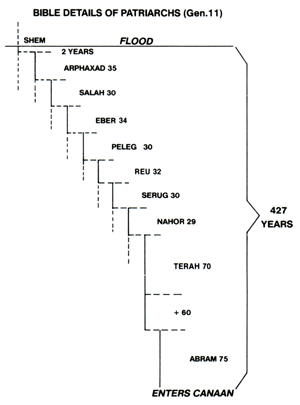
In no way can it be said that the times of Abraham have been established. Moreover, there is much about the presently accepted archaeological time slot which makes one feel quite uneasy. Abraham was the product of a generation that can be traced in the Bible ten generations from the Flood, the Bible narrative giving the impression that only about 430 years elapsed from the time of the world wide catastrophic Flood until the times of Abraham in Canaan (see Figure 2). Yet on the accepted time scale we are to admit huge amounts of time for the development of civilizations prior to the times of Abraham.

Figure 2.
Figure 2. Biblical details of the patriarchs.

This leaves us with three possible options:

  1. To accept the present chronology and minimize the historicity of the biblical genealogies, a point that those who hold its message dear for faith find extremely difficult;
  2. Disbelieve the historicity of Abraham altogether and claim that the biblical record is simply an allegory for some pious religious purpose. This is the position adopted by many documentary hypothesists; or
  3. Re-evaluate the whole archaeological record in terms of the Bible's time framework alone. This is the task of the present author.

    There is much at stake in this discussion, for the whole historical validity of the Scriptural message of hope is at stake. The reality of the promises and covenants (legal agreements) of the spiritual message of hope rest on the historical validity of those promises and covenants. The world's hope stands or falls on this issue. It cannot just be left to be dealt with in the cold halls of the intellectual who otherwise has no interest in the biblical message, for it is of dynamic concern to all people.

    The genealogy of Genesis 11 has been put under the microscope by many, often without due regard to the Hebrew text. Some would claim that there are gaps in this genealogy. This of course would solve part of the problem, if such gaps exist. However, the formula of the genealogy leaves this impossible if one is to accept the Hebrew text as correct, for it has the following formula:

    X at age Z begat Y

    That is, a named person at a named age begat a named person. Such a formula absolutely resists the input of gaps, unlike the genealogy of Matthew's gospel (Matthew 1), which allows a gap without denying the historical reality of missed generations in that genealogy.

    Matthew's formula of 'A begat B' allows gaps. Genesis does not. We must insist that if the Hebrew words mean anything they must be taken at face value and resist the insertion of gaps. The issue is one of correctness historically or otherwise of this whole record.

    A new placement of Abraham's time against the archaeological record

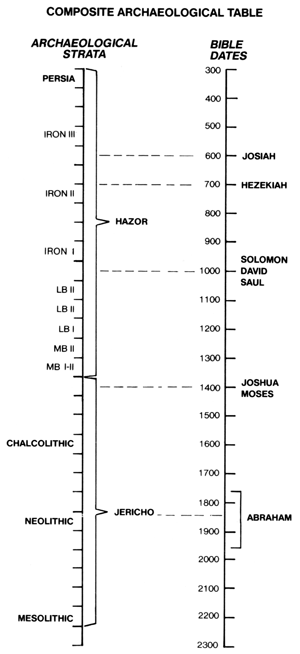
    In order to arrive at an approximate guide as to where we should look for the times of Abraham we start with the biblical dates from the Flood to Christ, as years B.C., and attempt to reinterpret all the archaeological data against that time scale. This has been done before in 'The Times of the Judges - the Archaeology' (see Osgood, EN Tech. J., this volume). The resultant chronological table is reproduced here in Figure 3 with the area of Abraham pin-pointed.

    Figure 3.
    Figure 3. Composite archaeological table.

    It can be seen against this archaeological table that Abraham fits somewhere towards the end of the Neolithic of Jericho passing into the Chalcolithic of Jericho. It is around that approximate area we will now look in the archaeological record to see if we can make positive identification of the times of Abraham. The reader will no doubt appreciate the huge difference in time on the accepted scale between the Chalcolithic of Palestine and the MB I of Palestine. What I am insisting here is that the whole archaeological chronology must be re-evaluated against the biblical record. Let us begin that reevaluation.

    In order to make positive identification of the period of Abraham we will begin with a narrative in the life of Abraham as taken from Genesis 14.

    Genesis 14 is a narrative which begins with a confederation of four Mesopotamian kings:-

    1. Amraphel, king of Shinar
    2. Arioch, king of Ellasar
    3. Chedorlaomer, king of Elam
    4. Tidal, king of Goiim (Genesis 14:1)

    These extended their empire to include Palestine, or at least the Jordan valley, and in particular they brought under their suzerainity the kings of Sodom, Gomorrah, Admah and Zeboiim and Bela - the five cities of the plain. For twelve years (verse 4) this continued, but in the thirteenth year the kings of the plain rebelled, so in the fourteenth year the four kings of Mesopotamia, apparently with Chedorlaomer as chief, came and attacked the whole region.

    Now many have been the attempts to identify these kings, for most have realised that if they can be identified in the archaeological record, then the times of Abraham can be found for certain. As R.K. Harrison has put it:

    ‘The chronology of the patriarchal period would be stabilized if a reliable identification of the four invading Mesopotamian Icings could be made. This may emerge as the result of future excavations in the area, but in the meantime the chronology of the period under consideration must be placed between the twentieth and the late seventeenth centuries B.C.’4

    The problem is not so much one of identification of the kings, for they are named in the narrative and their nations are given. Rather it is a problem of identifying the period from which these kings came in an archaeological context. So far this has defied success. However, it is my hope that the discussion here will lay to rest that search as we identify the only period when such a confederation could conceivably have existed.

    In order to achieve this we will continue the narrative and the search for the details of this narrative in the life of Abraham.

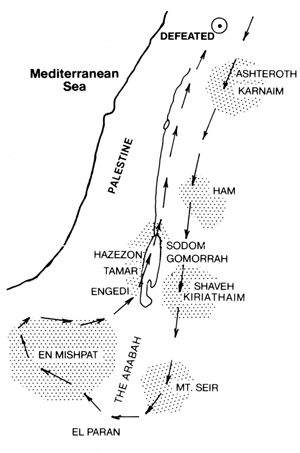
    Figure 4.
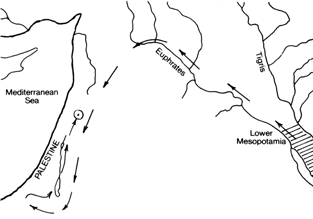
    Figure 4. Route of Chedorlaomer.

    When the four kings of Mesopotamia attacked, they followed a particular course which can be seen on the maps in Figures 4 and 5. They came down through Syria into the Bashan area where they attacked the Rephaim in Ashteroth Karnaim (Genesis 14:5). Then they proceeded southwards into Trans Jordan to the later Ammonite area and attacked the Zuzim in Ham. (These are later mentioned in Deuteronomy 2:20.) Moving further south into the region later identified as Moab, they attacked the Emim (Deuteronomy. 2:10), and then on they went down into the region which later became Edom, where they attacked the Horites in Mt Seir (see Deuteronomy 2:22). Having completed their conquest of Trans Jordan, they crossed the Arabah into the Negev of later Israel and attacked both En Mishpat (Genesis 14:7) (most likely Kadesh Barnea), and the area later inhabited by the Amalekites which was westward of Kadesh Barnea. Having completed that, they then headed northwards again along the Jordan valley and attacked the Amorites in Hazezon-tamar. Continuing further north, they met in battle the kings of the five cities of the plain, defeated them, took captives and headed north. They were then pursued by Abram with his own private army allied with Aner, Eshcol and Mamre, the Amorite chieftains (Genesis 14;24). They overtook the Mesopotamian kings in Syria defeated them, and returned with the spoils to Canaan.

    Figure 5.
    Figure 5. Course of Chedorlaomer (as proposed).

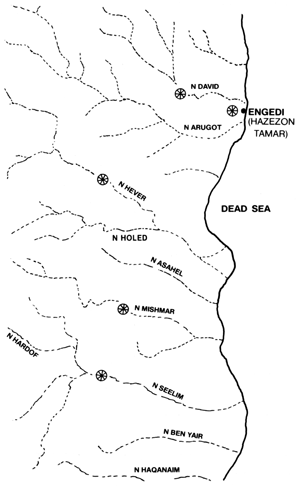
    As is often the case, the positive clue comes from the most insignificant portion of this passage. In Genesis 14:7 we are told that the kings of Mesapotamia attacked 'the Amorites who dwelt in Hazezon-tamar'. Now 2 Chronicles 20:2 tells us that Hazezon-tamar is En-gedi, the oasis mentioned in Scripture a number of times on the western shore of the Dead Sea.

    The passage in Genesis chapter 14, therefore, allows us to conclude that in the days of Abraham there was a civilization in En-gedi on the western shore of the Dead Sea, a civilization of Amorites, and that these were defeated by Chedorlaomer in his passage northward.

    Focus on En-gedi

    Happily for us. En-gedi has been excavated.5,6 The excavations found only three major periods of settlement at En-gedi:-.

    1. The Roman period - not relevant here
    2. During the Kingdom of Israel - not relevant here
    3. During the Chalcolithic of Palestine - the largest and most prolific settlement period.

    In fact, a building complex was discovered situated on a hill terrace above the spring of En-gedi approximately 150 metres north. This appeared to be a sacred enclosure, similar to the Chalcolithic sanctuary discovered in Stratum XIX at Megiddo. Notably, the enclosure at En-gedi was not destroyed, but was abandoned with the people apparently taking their cult furniture with them.

    I believe it is more than coincidental that corresponding to our new match on the archaeological table we find that there was in fact a civilization in En-gedi during this archaeological period. The picture becomes even more illuminated when we are led into the various caves around the En-gedi region, and particularly to one called the Cave of the Treasure.

    In 1960 an expedition of urgency into the Judean desert was conducted by the Hebrew University, the Department of Antiquities, and the Israel Exploration Society with help from the armed forces of Israel. The precipitating motive was to rescue antiquities, such as finds like the Dead Sea Scrolls, from destruction, and to do a complete search of the caves of the Judean desert to look for antiquities for preservation (see Figure 6).

    Figure 6.
    Figure 6. Significant Chalcolithic finds.

    Many caves were found and finds were such that it was clear that the greatest time of occupation was the Chalcolithic period. Although the caves themselves were apparently occupied for only a brief period, they testified to prolific civilization and a significant population density in this area greater than for any later one. The conclusion can almost certainly be drawn that the sanctuary at En-gedi was the focal point for their worship.

    One of the most remarkable caves was the cave of the treasure in Nahal Mishmar. Details have been fully published in 'The Cave of the Treasure' by Pessah Bar-Adon.7 A significant treasure of cult artifacts and weapons was found, testifying to a wealth of culture at this period.

    Bar-Adon comments:

    ‘It took us three hours to remove the articles, which were wrapped in a straw mat, from their hiding place - four hundred and twenty nine in all. Apart from six of haematite, six of ivory and one of stone, all the rest are of metal. They were all of a surprisingly high technical standard of workmanship.’8

    And he goes on:-

    ‘The hoard comprised the following: axes and chisels; hammers; 'mace heads'; hollow stands decorated with knobs, branches, birds, and animals such as deer, ibex, buffalo, wild goats, and eagle; 'horns' (in one of which there was still a piece of thread running through the perforations at the edge); smooth and elaborately ornamented 'crowns', small baskets; a pot; a statuette with a human face; sceptres; flag poles; an ivory box; perforated utensils made - as subsequently determined by Prof. Haas - from hippopotamus tusks; and more.’8

    They dated it to the Chalcolithic period.

    Bar-Adon queried the reasons for the articles in this context as if somebody had left them there and intended to return but was not able to. He continues on:-

    ‘What induced the owners of this treasure to hide it hurriedly away in the cave? And what was the event that prevented them from taking the treasure out of its concealment and restoring it to its proper place? And what caused the sudden destruction of the Chalcolithic settlements in the Judean Desert and in other regions of Palestine.’8:226

    The remarkable thing about this culture also was that it was very similar, if not the same culture, to that found at a place in the southern Jordan Valley called Taleilat Ghassul (which is the type site of this culture), and also resembles the culture of Beersheba. The culture can in fact be called 'Ghassul culture' and specifically Ghassul IV.

    The Ghassul IV culture disappeared from Trans Jordan, Taleilat Ghassul and Beersheba and the rest of the Negev as well as from Hazezon-tamar or En-gedi apparently at the same time. It is remarkable when looked at on the map that this disappearance of the Ghassul IV culture corresponds exactly to the areas which were attacked by the Mesopotamian confederate of kings. The fact that En-gedi specifically terminates its culture at this point allows a very positive identification of this civilization, Ghassul IV, with the Amorites of Hazezon-tamar.

    If that be the case, then we can answer Bar Adon's question very positively. The reason the people did not return to get their goods was that they had been destroyed by the confederate kings of Mesopotamia, in approximately 1,870 B.C. in the days of Abraham.

    Now as far as Palestine is concerned, in an isolated context, this may be possible to accept, but many might ask: What about the Mesopotamian kings themselves? Others may ask: What does this do to Egyptian chronology? And still further questions need to be asked concerning the origin of the Philistines in the days of Abraham, for the Philistines were closely in touch with Abraham during this same period (Genesis 20). So we must search for evidence of Philistine origins or habitation at approximately the end of the Chalcolithic (Ghassul IV) in Palestine. All these questions will be faced.

    The Mesopotamian complex of Chedor Laomer

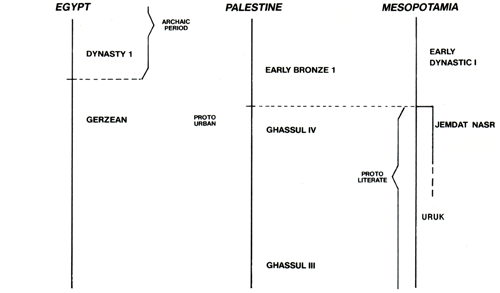
    Ghassul IV corresponds in Mesopotamia to the period known as the Jemdat-Nasr/ Uruk period, otherwise called Protoliterate (because it was during this period that the archaeologists found the first evidence of early writing). Ghassul IV also corresponds to the last Chalcolithic period of Egypt, the Gerzean or pre-Dynastic period (see Figure 7). Let us look, therefore, at both of these geographically and archaeologically, and see what we find.

    Figure 7.
    Figure 7. Correlation of national archaeological periods.

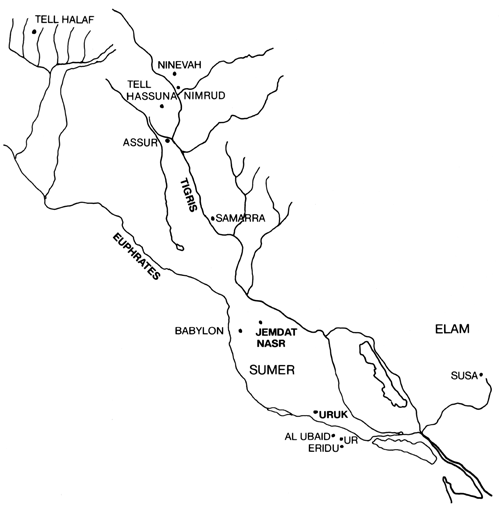
    Uruk is so called because it refers to a culture associated with the archaeological site called Warka (Uruk of Mesopotamian history or biblical Erech - Genesis 10:10) in the land of Sumer or biblical Shinar (see Figure 8), and we note that one of the kings of the Mesopotamian confederacy came from Shinar, namely Amraphel.

    Jemdat Nasr is a site in northern Sumer, northeast of Babylon (see Figure 8). It is a site that was found to have a pottery with similarities to the culture of Elam and corresponding in time to the later phases of the Uruk culture.

    We have in Mesopotamia, therefore, archaeological evidence that there was a period in which the Uruk culture, and an Elamite culture typified by Jemdat Nasr, were in some sort of combination, and this corresponds to the period in Palestine when the Ghassul culture disappeared. The writing of this period does not allow us to recognise at this point any particular kings from contemporary records for it is undeciphered, but all that is known archaeologically is in agreement with the possibility of a combine of nations of the description of Genesis 14 existing. Considering the war-like attitudes of Sumer and Elam in later years this is all the more remarkable, for no other period of Sumer/Elamite relationship accepts the possibility of such a semi-benevolent relationship.

    Figure 8.
    Figure 8. Location of Uruk, Jemdat Nasr and other important sities in Mesopotamian history.

    Archaeology in Iran. in the plain of Susiana, has demonstrated a resurgent Elamite culture contemporary with Jemdat Nasr in Mesopotamia,9 and this fits the biblical suggestion of a dominant Chedorlaomer (Genesis 14).

    Considering the fact that the Bible allows the interpretation of Chedorlaomer being the chief of the combine of kings, one could even theorise that Jemdat Nasr may have been a site deliberately built by the Elamite king to assist control of the region of Sumer, but that remains highly speculative.

    We have then so far, in summary, the following evidence as a witness that the end of the Chalcolithic in Palestine was during the days of Abraham:-

    1. A fit on the archaeological table previously presented that corresponds.
    2. Positive identification of a culture, corresponding exactly geographically to the biblical story, which disappeared from the scene at that period of time in Palestine and Trans Jordan.
    3. Archaeological evidence in Mesopotamia which is consistent with a combination of Sumerian and Elamite kings, and which definitely allows the possibility of other confederates.

    But Egypt!

    At this stage there will be many objections to the hypothesis here presented, for it is totally contradictory to the presently held Egyptian chronology of the ancient world. However, I would remind my reader that the Egyptian chronology is not established, despite claims to the contrary. It has many speculative points within it. Let us continue to see if there is any correspondence, for if Abraham was alive in the days of the Ghassul IV culture, then he was alive in the days of the Gerzean culture of pre-Dynastic Egypt, possibly living into the days of the first Dynasty of Egypt.

    The correspondence between this period in Palestine and in Egypt is very clear, and has been solidly established, particularly by the excavations at Arad by Ruth Amiram10 and at Tel Areini by S. Yeivin.11

    Such a revised chronology as here presented would allow Abraham to be in contact with the earliest kings of Dynasty I and the late pre-Dynastic kings, and this would slice a thousand years off the presently held chronology of Egypt. To many the thought would be too radical to contemplate. The author here insists that it must be contemplated. Only so will the chronology of the ancient world be put into proper perspective. Long as the task may take, and however difficult the road may be, it must be undertaken.

    In order to support the present revised chronology here held, the author sites another correspondence archaeologically, and this concerns both the Philistines and Egypt.

    The Philistine Question

    Genesis 20 makes it clear that Abraham was in contact with the Philistines, yet the accepted chronological record presently held does not recognise Philistines being in the land of Philistia at any time corresponding with the days of Abraham. Yet the Bible is adamant.

    The Scripture is clear that the Philistines were in Canaan by the time of Abraham, approximately 1850 B.C., or at least around the area of Gerar between Kadesh and Shur (Genesis 20:1), and Beersheba (Genesis 21:321) (see Figure 9). A king called Abimelech was present, and his military chief was Phicol (Genesis 21:22).

    The land was called the Land of the Philistines (Genesis 21:32). According to Genesis 10:14, the Philistines were descendants of one Egyptian ancestor, Casluhim, but apparently they dwelt in the region occupied by Caphtor which was apparently the coastlands around the delta region. Now many attempts have been made to associate Caphtor with Crete, but the attempt is strained and unsubstantiated.

    Figure 9.
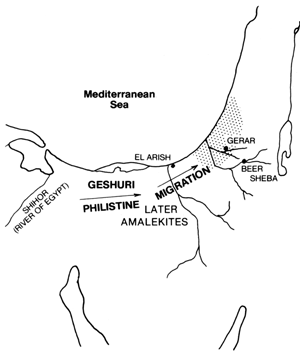
    Figure 9. Proposed route of migration of the Philistines from Egypt ot Palistine.

    The Philistines migrated out of Caphtor northeast to Canaan (Deuteronomy 2:23, Jeremiah 47:4. Amos 9:7) (see Figure 9), dispossessing the ancient Canaanites, locally called the Avims (Deuteronomy 2:23), some of whom were still in existence in the days of Joshua (Joshua 13:3). This migration was Egyptian, but in fact the stock were the later Philistines. It may have included more than just the Philistines, but the Philistines apparently superseded the others. They are called the 'remnant of the country of Caphtor' (Jeremiah 47:4).

    We have placed the end of the Chalcolithic of the Negev, En-gedi, Trans Jordan and Taleilat Ghassul at approximately 1870 B.C., being approximately at Abraham's 80th year. Early Bronze I Palestine (EB I) would follow this, significantly for our discussions. Stratum V therefore at early Arad (Chalcolithic) ends at 1870 B.C., and the next stratum, Stratum IV (EB I), would begin after this.

    Stratum IV begins therefore some time after 1870 B.C.. This is a new culture significantly different from Stratum V.112

    Belonging to Stratum IV, Amiram found a sherd with the name of Narmer (First Dynasty of Egypt),10, 13 and she dates Stratum IV to the early part of the Egyptian Dynasty I and the later part of Canaan EB I. Amiram feels forced to conclude a chronological gap between Stratum V (Chalcolithic) at Arad and Stratum IV EB I at Arad.12:116 However, this is based on the assumption of time periods on the accepted scale of Canaan's history, long time periods which are here rejected.

    The chronological conclusion is strong that Abraham's life-time corresponds to the Chalcolithic in Egypt, through at least a portion of Dynasty I of Egypt, which equals Ghassul IV through to EB I in Palestine. The possibilites for the Egyptian king of the Abrahamic narrative are therefore:-

    1. A late northern Chalcolithic king of Egypt, or
    2. Menes or Narmer, be they separate or the same king (Genesis 12:10-20).

    Of these, the chronological scheme would favour a late Chalcolithic (Gerzean) king of northern Egypt, just before the unification under Menes.

    Thus the Egyptian Dynastic period would start approximately 1860 B.C.. Clearly, if this were the case, by this scheme the Philistines were in Canaan already, and must therefore have at least begun their migration in the late Chalcolithic of Egypt and Palestine.

    Therefore, we need to look in southwest Canaan for evidence of Egyptian (cum Philistine) migration, beginning in the late Chalcolithic and possibly reaching into EB I (depending on the cause and rapidity of migration), in order to define the earliest Philistine settlement of Canaan from Egyptian stock. Is there such evidence? The answer is a clear and categorical YES.

    Amiram, Beit-Ariah and Glass14 discussed the same period in relationship between Canaan and Egypt. So did Oren.15

    Of the period Oren says:

    ‘Canaanite Early Bronze I-II and Egyptian late pre-Dynastic and early Dynastic periods’15:200

    He says of the findings in Canaan:

    ‘The majority of Egyptian vessels belong to the First Dynasty repertoire while a few sherds can be assigned with certainty to the late pre-Dynastic period.’15:203(emphasis mine)

    He continues:

    ‘The occurrence of Egyptian material which is not later than the First Dynasty alongside EB A I-II pottery types has been noted in surface collections and especially in controlled excavations in southern Canaan. This indicates that the appearance and distinction of the material of First Dynasty in northern Sinai and southern Canaan should be viewed as one related historical phenomenon.15:203(emphasis mine)

    The area surveyed was between Suez and Wadi El-Arish. ED I-II had intensive settlement in this area.

    He continues further:

    ‘Furthermore, the wide distribution of Egyptian material and the somewhat permanent nature of the sites in Sinai and southern Canaan can no longer be viewed as the results of trade relations only. In all likelihood Egypt used northern Sinai as a springboard for forcing her way into Canaan with the result that all of southern Canaan became an Egyptian domain and its resources were exploited on a large scale.’15:204(emphasis mine)

    And again:

    ‘The contacts which began in pre-Dynastic times, were most intensive during the First Dynasty period’15:204(emphasis mine)
    Ram Gopha16 is bolder about this event or phenomenon, insisting on it being a migration:
    ‘Today we seem to be justified in assuming some kind of immigration of people from Egypt to southern Canaan...’16:31

    Further:

    ‘the Egyptian migration during the First Dynasty period may be seen as an intensification of previously existing relationships between the two countries. These relations had already begun in the Ghassulian Chalcolithic period but reached sizable proportions only in the Late Pre-Dynastic period’ (first phases of Palestinian EB I).16:35(emphasis mine)

    The testimony is clear. Excavation at Tel Areini identifies such an Egyptian migration and settlement starting in the Chalcolithic period.17 There was definitely a migration of Egyptian people of some sort from northern Egypt into southern Palestine, and particularly the region that was later known as Philistia.16:32

    The testimony of Scripture is clear that there were Philistines who came from Egypt into Palestine in the days of Abraham. This revised chronology identifies such a migration in the days of the Ghassulians, who I insist, perished during the early days of Abraham's sojourn in Canaan. This period must then be grossly redated in accordance with biblical expectations, instead of evolutionary assumptions.

    Further details of the Philistines

    Although in this discussion we are concerning ourselves with the days of Abraham, it is pertinent that we also elaborate on the question of the Phiistines at a later period, in order that the overall perspective of these people be understood. Modern archaeological interpretation first allows the Philistines in the days of Ramesses III of the 20th Dynasty, dated 1182 to 1151 B.C.18

    An inscription of Ramesses III at Medinet Habu reports an attack made by the peoples of the sea, among whom are a group called the Peleset. Ramesses claims to have defeated these in a sea battle. The Peleset are said to have settled in the area of the Philistines at approximately this time, and naturally it is assumed that the Philistines therefore first settled in Palestine at this period, and that they originated from the Aegean area as the peoples of the sea.

    The Scripture, however, gives no credibility to such an interpretation. Thus, there is a conflict?

    It is clear, from what has been said before of the narratives of Abraham and Isaac, that the Philistines were already in Palestine at approximately 1850 B.C., some 700 years before present archaeological interpretation accepts them as there. The Scripture also seems to indicate that they originated from Egypt, and not from the Aegean area. Is there any way to satisfy both the biblical claims, and the artifactual archaeological evidence? I believe there is. But first we must accept the biblical statements at face value and scan the Scriptures for anything that might fit at approximately 1100 to 1000 B.C., and for a people who could in fact be identified with the Peleset 'of the relief of Ramesses III' Indeed, we do meet a people, first in 2 Samuel 8:18, and then subsequently in 2 Samuel 15:18 and 27:23, 1 Kings 1:38 and 44, 1 Chronicles 18:17, Ezekiel 25:16, and Zephaniah 2:5. They are called the Pelethites, and they are associated with the Cherethites and also, in at least one passage, the Gittites who were indeed a group of Philistines from the city of Gath.

    Now it does not take much to realise that the word 'Pelethite' is an even better match with the word 'Peleset' in the Egyptian reliefs than is the word 'Philistine'. So if the Bible allows a group of people by the name of Pelethites who clearly were associated in some way with the Philistine region, and who also were associated with the Cherethites (whom many believe to be the Cretians, who in one text, namely Ezekiel 25:16, are called the remnant of the sea coast), then we have all the conditions necessary to solve an apparent conflict. We have no need to reject the Philistines of Egyptian descent in Palestine at 1850 B.C., and we can accept a second wave of people known as the Pelethites and Cherethites, who settled on the sea coast before the days of Saul and David, who are evidenced by the archaeological record, and who apparently had an Aegean origin. There would still be some difficulty in this revised chronology in associating the initial settlement of the Pelethites and the Cherethites with the same event as recorded by Ramesses III. Rather, they would need to be seen as allies to the other peoples of the sea when they themselves were already settled in a land base in Philistia prior to the days of Ramesses III, but I will leave this to be detailed at another time. Sufficient to conclude here that the Pelethites and Cherethites of Scripture were first able to be identified at approximately 1012 B.C. in the later years of Saul, king of Israel. Contingents from these groups formed part of the guard of David, yet the true Philistines were of Egyptian descent and were already in the land of Palestine by 1850 B.C. in the days of Abraham. This narrative we should be able to accept literally as a direct statement of history, and to see it as most likely being the written correlation of the late Chalcolithic and Early Bronze I settlement of Egyptian stock in southern Palestine, as the archaeological record testifies.

    Summary

    In summary, Abraham entered the land of Canaan at approximately 1875 B.C.. In his days there was a settlement of Amorites in En-gedi, identified here with the Ghassul IV people. This civilization was ended by the attack of four Mesopotamian monarchs in a combined confederation of nations, here placed in the Uruk-Jemdat Nasr period in Mesopotamia. They were a significant force in ending the Chalcolithic of Palestine as we understand it archaeologically, and Abraham and his army were a significant force in ending the Jemdat Nasr domination of Mesopotamia, and thus the Chalcolithic of Mesopotamia, by their attack on these four Mesopotamian monarchs as they were returning home. Egypt was just about to enter its great dynastic period, and was beginning to consolidate into a united kingdom, when from northern Egypt a surge of Egyptian stock, including the Philistines, moved north into southern Palestine to settle, as well as to trade, identified in a number of sites in that region (most notably in the strata of Tel Areini, Level VI then V) as the Philistines with whom Abraham was able to talk face to face. The biblical narrative demands a redating of the whole of ancient history, as currently recognised, by something like a one thousand year shortening - a formidable claim and a formidable investigation, but one that must be undertaken.

    References

    1. Bright. J., 1972. A History of Israel, The Westminster Press and SCM Press Ltd., p.66.Return.
    2. Glueck, N.. 1958. Bulletin of the American Schools of Oriental Research, 152: 20.Return.
    3. Albright W.F.. 1961. Bulletin of the American Schools of Oriental Research, 163: 44.Return.
    4. Harrison, R.K., 1970. Old Testament Times, Eerdmans Publishing Co.. p.86.Return.
    5. Maser et al., 1966. En-gedi Excavations, Jerusalem.Return.
    6. Avi-Yonah, M., 1976. Encyclopaedia of Archaeological Excavations in the Holy Land. VII, Jerusalem and London. pp.370-380.Return.
    7. Bar-Adon, P., 1980. The Cave of the Treasure, Israel Exploration Society, Jerusalem.Return.
    8. Bar-Adon, P., 1962. Israel Exploration Journal, 12: 218-226.Return.
    9. Ghirshman, H.. 1954. Iran, Middlesex. England, p.45.Return.
    10. Amiram, R.. 1974. Israel Exploration Journal. 24: 4-12.Return.
    11. Yolvin, S.. 1960. Israel Exploration Journal 10: 193-203.Return.
    12. Amiram, R., 1978. Early Arad I, Jerusalem.Return.
    13. Amiram, R.. 1976. Israel Exploration Journal, 26: 45.Return.
    14. Amiram, Beit Arieh, and Glass, 1973. Israel Exploration Journal. 23: 193.Return.
    15. Oren, E.D.. 1973. Israel Exploration Journal, 23: 198-205.Return.
    16. Gophna, Ram, 1976. Tel Aviv, 3(1): 31-37.Return.
    17. Weinstein. J., 1984. Bulletin of the American Schools of Oriental Research, 256:61-69.Return.
    18. Gardiner, A.. 1961. Egypt of the Pharaohs. Oxford.Return.

Taken from: http://creation.com/the-times-of-abraham

Tuesday, May 18, 2010

The Biblical Account of Origins Compatible with Modern Genetics

Adam, Eve and Noah vs Modern Genetics

by Dr Robert W. Carter

Published: 11 May 2010(GMT+10)
Human mtDNA Migrations

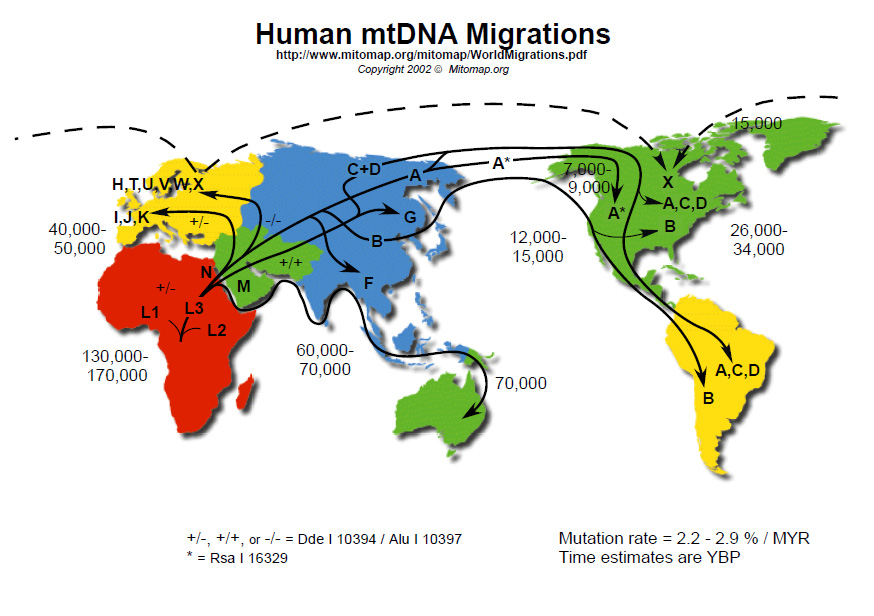
The evolutionary map of world migrations is startlingly close to the biblical account of a single dispersal of people from Babel. The evolutionary “Out of Africa” theory tells us there was a single dispersal of people, centered near and travelling through the Middle East, with three main mitochondrial lineages, with people traveling in small groups into previously uninhabited territory, and that all of this occurred in the recent past. Every item in that list is something directly predicted by the Tower of Babel account in the Bible. (Image www.mitomap.org).

It comes as a surprise to most people to hear that there is abundant evidence that the entire human race came from two people just a few thousand years ago (Adam and Eve), that there was a serious population crash (bottleneck) in the recent past (at the time of the Flood), and that there was a single dispersal of people across the world after that (the Tower of Babel).1 It surprises them even more to learn that much of this evidence comes from evolutionary scientists. In fact, an abundant testimony to biblical history has been uncovered by modern geneticists. It is there for anyone to see, if they know where to look!

For our purposes, the most important places to look are in the Y chromosome (which is only found in males and which is passed on directly from father to son) and in the mitochondrial DNA (a small loop of DNA that we inherit from our mothers only; males do not pass it on to their children). These two pieces of DNA record some startling facts about our past.

Over the last decade, a vast amount of information has been collected that allows us to answer questions that we could not even consider earlier. The tools of modern genetics allow us to specifically ask questions about history, for our genes carry a record that reflects where we came from and how we got to where we are. The tools at our disposal are powerful.

Creation and genetics

There are two brief passages in the Creation account we can use to draw some conclusions about human genetic history. Please note that we cannot use these verses for land animals (because we do not know how many of each kind were initially created) or any of the swimming critters (“with which the waters abounded” – Gen 1:21). These statements apply to people only:

And the Lord God formed man out of the dust of the ground, and breathed into his nostrils the breath of life; and the man became a living being.Gen 2:7
And the Lord God caused a deep sleep to fall on Adam, and he slept; and he took one of his ribs, and closed up the flesh in its place. Then the rib which the Lord God had taken from the man he made into a woman, and He brought her to the man.Gen 2:21–22

These simple statements have profound implications. They put a limit on the amount of diversity we should find in people living today. The Bible clearly says the human race started out with two people only. But how different were these two people? There is an intriguing possibility that Eve was a clone of Adam. The science of cloning involves taking DNA from an organism and using it to manufacture an almost perfect copy of the original. Here, God is taking a piece of flesh, with cells, organelles, and, importantly, Adam’s DNA, and using it to manufacture a woman. Of course, she could not be a perfect clone, because she was a girl! But what if God had taken Adam’s genome and used it to manufacture Eve? All he would have had to do was to leave out Adam’s Y chromosome and double his X chromosome and, voilá, instant woman!

I do not know if Eve was genetically identical to Adam. The only reason I bring this up is because we have two possibilities in our biblical model of human genetic history: one original genome or two. Either result is still vastly different from the most popular evolutionary models,2 but we need to discuss the range of possibilities that the Bible allows.

Your genome is like an encyclopedia (almost literally). And, like an encyclopedia, the genome is broken down into volumes, called chromosomes, but you have two copies of each volume (with the exception of the X and Y chromosomes; women have two Xs but men have one X and one Y). Imagine comparing two duplicate volumes side by side and finding that one word in a particular sentence is spelled differently in each volume (perhaps “color” vs “colour”). Can you see that if Eve was a clone of Adam, there would have been, at most, two possible variants at any point in the genome? If Eve was not a clone, however, there would have been, at most, four possible variants at any point in the genome (because each of the original chromosomes came in four copies). This still allows for a lot of diversity overall, but it restricts the variation at any one spot to 2, 3, or 4 original readings.

Does this fit the evidence? Absolutely! Most variable places in the genome come in two versions and these versions are spread out across the world. There are some highly variable places that seem to contradict this, but most of these are due to mutations that occurred in the different subpopulations after Babel.

There are indications, however, that Eve may not have been a clone. The ABO blood group is a textbook example of a gene with more than two versions.3 There are three main versions of the blood type gene (A, B, and O). However, many, but not all, people with type O blood carry something that looks very much like a mutant A (the mutation prevents the manufacturing of the type A trait on the outside of cells). So here is a gene with more than two versions, but one of the main versions is clearly a mutation. This is true for many other genes, although, as usual, there are exceptions. The important take home point is that essentially all of the genetic variation among people today could have been carried within two people, if you discount mutations that occurred after our dispersion across the globe. This is a surprise to many.

The Flood and genetics

Like in the Creation story, there are only a few verses in the Flood account that help us with our model. But as seen before, these verses are profound.

Like in the Creation story, there are only a few verses in the Flood account that help us with our model. But as seen before, these verses are profound. About 10 generations after Creation, a severe, short bottleneck occurred in the human population. From untold numbers of people, the entire world population was reduced to eight souls with only three reproducing couples.

So Noah, with his sons, his wife, and his sons’ wives, went into the ark because of the waters of the flood.Gen 7:7
Now the sons of Noah who went out of the ark were Shem, Ham, and Japheth… These three were the sons of Noah, and from these the whole earth was populated.Gen 9:18–19

We can draw many important deductions from these statements. For instance, based on Genesis 7 and 9, how many Y chromosomes were on the Ark? The answer: one. Yes, there were four men, but Noah gave his Y chromosome to each of his sons. Unless there was a mutation (entirely possible), each of the sons carried the exact same Y chromosome. We do not know how much mutation occurred prior to the flood. With the long life spans of the antediluvian patriarchs, it may be reasonable to assume little mutation had taken place, but all of Creation, including the human genome, had been cursed, so it may not be wise to conclude that there was no mutation prior to the Flood. The amount of mutation may be a moot point, however, for, if it occurred, the Flood should have wiped out most traces of it (all of it in the case of the Y chromosome).

How many mitochondrial DNA lineages were on the Ark? The answer: three. Yes, there were four women, but the Bible does not record Noah’s wife as having any children after the Flood (in this case, girl children). And notice the claim in Gen 9:19, “These three were the sons of Noah, and from these the whole earth was populated.” This is a strong indication that Noah’s wife did not contribute anything else to the world’s population. With no prohibition against sibling marriage, yet,4 one or more of the daughters-in-law may have been her daughter, but this does not change the fact that, at first glance, we expect a maximum of three mitochondrial lineages in the current world population. There is a chance that there will be less, if there was very little mutation before the Flood or if several of the daughters-in-law were closely related. At most, we do not expect more than four.

How many X chromosome lineages were on the Ark? That depends. If you count it all up, you get eight. If, by chance, Noah’s wife passed on the same X chromosome to each of her three sons (25% probability), then there were seven. If Noah had a daughter after the Flood (not expected, but possible), there could be as many as nine X chromosome lineages. Either way, this is a considerable amount of genetic material. And since X chromosomes recombine (in females), we are potentially looking at a huge amount of genetic diversity within the X chromosomes of the world.

Does this fit the evidence? Absolutely! It turns out that Y chromosomes are similar worldwide. According to the evolutionists, no “ancient” (i.e., highly mutated or highly divergent) Y chromosomes have been found.5 This serves as a bit of a puzzle to the evolutionist, and they have had to resort to calling for a higher “reproductive variance” among men than women, high rates of “gene conversion” in the Y chromosome, or perhaps a “selective sweep” that wiped out the other male lines.6 For the biblical model, it is a beautiful correlation and we can take it as is.

The evidence from mitochondrial DNA fits our model just as neatly as the Y chromosome data. As it turns out, there are three main mitochondrial DNA lineages found across the world. The evolutionists have labeled these lines “M”, “N”, and “R”, so we’ll refer to them by the same names. They would not say these came off the Ark. They claim they were derived from older lines found in Africa, but this is based on a suite of assumptions (I discussed these in detail in a recent article in the Journal of Creation7). It also turns out that M, N, and R differ by only a few mutations. This gives us some indication of the amount of mutation that occurred in the generations prior to the Flood.

Let’s assume ten female generations from Eve to the ladies on the Ark. M and N are separated by about 8 mutations (a small fraction of the 16,500 letters in the mitochondrial genome). R is only 1 mutation away from N. This is an indication of the mutational load that occurred before the Flood. Given the assumption that mutations occur at equal rates in all lines, about four mutations separate M and N each from Eve (maybe four mutations in each line in ten generations). But what about R? It is very similar to N. Were N and R sisters, or perhaps more closely related to each other than they were to M? We’ll never know, but it sure is fascinating to think about.

One more line of evidence crops up in the amount of genetic diversity that has been found within people worldwide. Essentially, much less has been found than most (i.e., evolutionists!) predicted. The general lack of diversity among people is the reason the Out of Africa model has humanity going through a disastrous, near-extinction bottleneck with only about 10,000 (and perhaps as few as 1,000)8 people surviving. However, the reason for this lack of diversity is twofold. First, the human race started out with only two people. Second, the human race is not that old and has not accumulated a lot of mutations, despite the high mutation rate. Third, there actually was a bottleneck event, Noah’s Flood!

The Tower of Babel and genetics

The Tower of Babel has been a favorite bedtime story for generations. But is it more than a fairy tale? Could it be possible that there is evidence to back up this tale of rebellion and judgment? Like the Creation and Flood accounts, there are only a couple of verses that apply to our model of genetics. But, like the others, these verses are as profound as they are simple.

Now the whole earth had one language and one speech.Gen 11:1
And they said, ‘Come, let us build ourselves a city, and a tower whose top is in the heavens; let us make a name for ourselves, lest we be scattered abroad over the face of the whole earth.’” Gen 11:4

It sounds like they were in a homogenous culture, but what do people in that situation do? Would you expect them to mix freely? Were language or cultural barriers present that would have prevented the sons of Shem from marrying the daughters of Japheth? Would the daughters of Ham be expected to marry freely with the sons of any of the three men? Note in Gen 11:4 that they knew about the potential for spreading out and getting separated from one another and intentionally did the opposite! However, this was against the express command of God, who had ordered them to spread out (to populate the earth). So, He took matters into His own hands.

’Come, let Us go down and confuse their language, that they may not understand one another’s speech.’ So the Lord scattered them abroad from there over the face of all the earth, and they ceased building the city.Gen 11:7–8

There are tremendous implications that come from the Babel account. First it explains the amazing cultural connectivity of ancient peoples—like pyramid building, common flood legends, and ancient, non-Christian genealogies that link people back to biblical figures (e.g., many of the royal houses of pagan northern Europe go back to Japheth, the son of Noah9 ).

The dramatic rise in world population over the past several decades is a well known fact. From a biblical perspective, the current human population easily fits into the standard model of population growth using very conservative parameters.10 In fact, starting with 6 people and doubling the population every 150 years more than accounts for the current human population (a growth rate of less than 0.5% per year!). Population size would have increased quickly given the rate at which the post-Flood population reestablished agriculture, animal husbandry, industry and civilization. So we must ask the question, “Why are there so few people in the world today?” The answer is that the world is young and we have not been here many thousands of years.

When did the dispersion occur? Our best clue about the timing of the event comes from Genesis 10:25. In referencing the 5th generation descendent of Shem, a man named Peleg, it says, “in his days the earth was divided.” To what is this referring? Many people believe this is referring to a division of the landmasses (plate tectonics). This may be true, but it would require a huge amount of geologic activity after the Flood, and this would have occurred in historical times with no record of the events. The interpretation I favor is that this passage is referring to the division of people at Babel. Just a few verses after the Peleg reference, the section is summed up with another reference to the division at Babel. This fits both the context and the science. In context, Peleg was closely associated with Babel.

How large was the population at the time? We would expect rapid population growth, but we cannot know exactly. There are 16 named sons born to the three brothers, Shem, Ham and Japheth. If we assume about the same number of daughters, Noah had on the order of 30 grandchildren. At that rate of growth, there would have been about 150 children in Salah’s generation, about 750 in Eber’s generation, and about 3,750 in Peleg’s generation. Of course, these generations overlap, etc., so let’s say there were between 1,000 and 10,000 people alive at the time of Babel. This fits nicely with the available data. It is a high rate of growth, but wars and disease had yet to start taking their toll.

There is one more verse in this section that we need to discuss:

These were the families of the sons of Noah, according to their generations, in their nations; and from these the nations were divided on the earth after the flood.Gen 10:32

At Babel, God did not separate the nations according to language. He used language to separate them according to paternal (male) ancestry! This has monumental significance and is the key to understanding human genetic history.

Do you see the implication in this simple verse? At Babel, God did not separate the nations according to language. He used language to separate them according to paternal (male) ancestry! This has monumental significance and is the key to understanding human genetic history. Paternal sorting would lead to specific Y chromosome lineages in different geographical locations. Since males and females from the three main families should have been freely intermixing prior to this, it also leads to a mixing of the mitochondrial lines. It is as if God put all the people into a giant spreadsheet and hit a button called “Sort According to Father.” He then took that list and used it to divide up and separate the nations.

We already saw that Y chromosomes have little variation among them. We now add the fact that this little bit of variation is almost always geographically specific. That is, after the nations were separated according to Y chromosome, mutations occurred in the various lines. Since the lines were sent to specific geographical areas, the mutations are geographically specific. The current distribution of Y chromosome lines is a tremendous confirmation of the biblical model.

Mitochondrial DNA (mtDNA) adds another confirmation. We have already learned that there are three main lineages of mtDNA. We now add the fact that these three lineages are more or less randomly distributed across the world. Also, the various mutations within each of the three main families of mtDNA are geographically specific as well.11 In other words, as the three mixed mitochondrial lines were carried along with the Y chromosome dispersal, each line in each area began to pick up new mutations, just like we would predict.

After the Flood

The last remaining significant reference in the Bible that will help us build our model of human genetic history is called The Table of Nations. It is found in Genesis chapters 9 and 10. The Table of Nations is a record of the post-Babel tribes, who they descended from, and where they went. If the Bible is an accurate source of history, one might expect to be able to find a significant amount of evidence for the Table of Nations in genetic data. The truth is not that simple, however, and it is important to keep several things in mind. First, the account was written by a person in the Middle East and from a Middle Eastern perspective. It is incomplete in that there are huge sections of the world that are not discussed (sub-Saharan Africa, Northern Europe, Most of Asia, Australia, the Americas, and Oceania). It also reflects a snapshot in time. It was written after the dispersion began, but not necessarily before the dispersion was complete. Indeed, much has changed in the intervening years. People groups have migrated, cultures have gone extinct, languages have changed, separate cultures have merged, etc. The history of man has been full of ebb and flow as people mixed or fought, resisted invasion or were conquered. The history of man since Babel is very complicated. Modern genetics can answer some of the big questions, but answers to many of the smaller details may elude us forever.

This is an important topic for the creation model. The world does not look at the Bible in a favorable light. In fact, it disparages it, sometimes with open hostility. Attacks are often centered on the claim that the Bible is not reliable on historical grounds, and if the history of the Bible is inaccurate, what about the theology? Think about what Jesus told Nicodemus in John 3:12, “If I have told you earthly things and you do not believe, how will you believe if I tell you heavenly things?” Many people today see no history in the Bible; therefore, the spiritual implications are meaningless to them. What would happen for evangelism if the history of the Bible turns out to be true after all?

Related articles

Notes and References

  1. See Nelson, J.W., Genetics and Biblical demographic events, Journal of Creation [formerly TJ] 17(1):21–23, 2003; http://creation.com/genetics-and-biblical-demographic-events Return to text.
  2. The most common version of the Out of Africa Theory has people living in Africa (as Homo erectus) for about a million years. Several tens of thousands of years ago (the data varies from author to author), a sudden bottleneck event reduced the population to 10,000 people or less. Modern humans came out of this bottleneck, our population grew and diversified a little, and then we left Africa and colonized the rest of the world. Return to text.
  3. Criswell D., ABO Blood and Human Origins, Acts & Facts 37(2):10, 2008; ; Sarfati, J., Blood types and their origin (Countering the Critics), Journal of Creation (then called CEN Technical Journal) 11(1):31–32, 1997. Return to text.
  4. Prohibitions against marrying close relatives were first given in Lev. 18 and 20, about 2,500 years after Creation. Indeed, Abraham, Isaac and Jacob each married close relatives from their own family. Return to text.
  5. Jobling, M.A., Tyler-Smith, C., The human Y chromosome: an evolutionary marker comes of age, Nature Reviews 4:598–612, 2003. Return to text.
  6. Garrigan, D. and Hammer, M.F., Reconstructing human origins in the genomic era, Nature Reviews 7:669–680, 2006. Return to text.
  7. Carter, R.W., The Neutral Model of evolution and recent African origins, Journal of Creation 23(1):70–77, 2009. Return to text.
  8. Harpending, H.C., et al., The genetic structure of ancient populations, Current Anthropology 34:483, 1993. Return to text.
  9. A five part series on this subject was printed in the Journal of Creation (then called CEN Technical Journal) in the early 1990s. See Cooper, W.R., The early history of man: Part 1. The table of nations. CEN Tech J 4:67–92, 1990. Return to text.
  10. Batten, D., Where are all the people? Creation 23(3):52–55, 2001; http://creation.com/where-are-all-the-people. You can do your own simulation in a spreadsheet program using the formula N = Noekt, where No = the starting population size (6), k = growth rate per year (experiment with different rates and see what happens), and t = time (in years). Return to text.
  11. Torroni, A., et al., Harvesting the fruit of the human mtDNA tree, TRENDS in Genetics 22(6):339–345, 2006. Return to text.

Saturday, April 17, 2010

Twelve Sons of Patriarch Jacob and Corresponding Twelve Stones

Twelve Sons, Twelve Stones

The twelve stones in the breastplate of the ancient Hebrew high priest can now be identified, with the corresponding tribes of Israel.

The Lord instructed Moses to have the names of the twelve sons of Israel engraved on twelve stones in the breastplate of the high priest. The exact order, arrangement, and type of each stone were explicitly stated (Ex. 28:17-21), but the name to be written on each stone was not given, perhaps because it was obvious to Moses. After the destruction of the temple, the knowledge of which tribe was associated with which stone was lost, and even the identity of some of the stones has been uncertain. This article attempts to restore this lost knowledge by use of the birth dates of those twelve sons, and the correspondence of those dates to the twelve zodiac constellations, as presented in last month's article.[1]

Birthstones

Do you have any jewelry containing your birthstone? What is the origin of the birthstones? Are they just a way for jewelers to peddle their wares, or is their really some significance to these twelve stones? And if so, is it the chemical makeup of the stone that is important, or is it the color, or both? And should the stones be associated with months of our Gregorian year, or perhaps the Hebrew months, or maybe the 30-day signs of the zodiac, or how about the actual zodiac constellations in the heavens?

What about the colors associated with certain nations, such as the colors of their flags? Why are so many of the flags of Europe colored red, white and blue?[2] What about the colors in heraldry, the colors on your family crest? Are they significant? What do colors have to do with families and nations?

Figure 1. The high priest's breastplate contained twelve stones.

The origin of our twelve birthstones and their colors is rooted in the twelve colored stones in the breastplate of the high priest of ancient Israel. The fact that our birthstones are not only associated with different tribes, but also with different months, shows that there was a strong tradition that each of the twelve sons of Jacob was born at a distinct time of year. So if our birthstones trace back to a Biblical origin, the question arises of just how accurate our modern list of birthstones is.

The Problem

Unfortunately, we have known neither the stones nor the associated tribes, much less the time of year for each stone. One of the long unsolved mysteries in the Bible is the identification of the twelve stones in the breastplate of the high priest. Most of those stones are mentioned only in that context, and so they have been extremely hard to identify. Most scholars have given up the identification as a lost cause. Many lists have been published, purporting to be authentic, but in fact they are based only on speculation, such as assuming that the order of the stones is the birth order of the sons.[3]

As an example of the confusion of the translation of the stone names, the fourth stone is called "emerald" in the King James version, "carbuncle" in the Greek translation (Septuagint), "turquoise" in the New American Standard version, and "garnet" in Strong's dictionary. Note that the colors of those modern stones are all different (green, red, blue, blackish red), so we end up confused both on colors and stones. To add to the confusion, many stones come in a variety of colors: Sapphires are not just blue, they are also colorless, pink, orange, yellow, green, purple and black.[4] And another problem is that some of the ancient names that we recognize, used to refer to different stones. For example, before medieval times, "sapphire" referred to the blue stone lapis lazuli for at least many centuries.[5] So it has appeared to be a hopeless tangle of yarn that no one has been able to unravel.

Figure 2. The twelve stones each had a name engraved on it.

These, however, are some of the most difficult examples. The colors of some stones in the list are perfectly known, such as the first one, odem, which means "red" in Hebrew. In other cases, all translators agree on the identification of the stone, such as topaz and amethyst. They might all be wrong, but at least there is a consensus.

The Solution

This paper attempts to provide a definitive correlation of all twelve stones to their modern names, colors, and tribes of Israel. The solution is based on using information from two other sources: birth dates and birth constellations.

First, as mentioned above, the fact that there is a strong tradition that each of the twelve stones is associated with the time of birth of one of the twelve sons of Jacob is a big clue. Sometimes a general idea is preserved over time while the details are lost. The fact that each stone is associated with a different month and also with a tribe of Israel definitely indicates a tradition that it was the time of birth of those twelve sons that identified them with a specific stone. Last month a list of birth dates, derived from sacred calendars, was proposed for each of the twelve sons of Jacob. They were spread out during the year, which agrees with this tradition.

Secondly, that same article also identified each tribe with a constellation of the zodiac. That is also a big clue to solve the puzzle, because the Lord apparently also alludes to several of the constellations as the same precious stones of the breastplate of the high priest. He said to the prophet Ezekiel,

Thou hast been in Eden the garden of God; every precious stone was thy covering, the sardius, topaz, and the diamond, the beryl, the onyx, and the jasper, the sapphire, the emerald, and the carbuncle, and gold: the workmanship of thy tabrets and of thy pipes was prepared in thee in the day that thou wast created. (Ezek 28:13).

Nine of these stones covered Eden.

Those nine stones are nine of the twelve stones of the high priest. The fact that he says the stones were the "covering" in the Garden of Eden, suggests that he might be referring to the canopy of the heavens, and that each of those stones is associated with a zodiac constellation. This argument is not compelling, but if this suggestion is not correct, then just what does the scripture mean? The scriptures do tell us that some of these stones were found in the Garden (Gen. 2:12), but when so many of the stones are listed as a "covering," it seems more likely that it refers to the heavens.

Let us now use these two new lists of birth dates and constellations to identify the stones. Those who wish only to know the answer can skip the somewhat detailed derivation which follows to Table 4 near the end of this article.

Unravelling the Mystery

Let us now solve the mystery of the stones one step at a time. The solution is based upon a few postulates.

Postulates

1. Twelve Tribes. The twelve stones in the breastplate correspond to the original twelve sons of Jacob, not to the tribes of Ephraim and Manasseh, which were later adopted as sons, effectively doubling the inheritance for their father Joseph. That seems to be implied in the text.

New Jerusalem has walls of jasper.

2. Twelve Foundations. The twelve foundations of the New Jerusalem are garnished with the same twelve precious stones, as named by John the Revelator (Rev. 21:19-20). While those stones are associated with the twelve apostles, they are also near the twelve gates that are named for the twelve tribes of Israel. This postulate is perhaps the most important, because John is writing in Greek some fifteen hundred years after Moses. He is referring to stones that he recognized and understood. Because Greek is so much better known, and those words can be found in so many other documents, this postulate greatly simplifies the problem.

You might ask yourself how well you know gemstones. Suppose you had had the Revelation given to John. How would you have described the foundation stones? Most of us know that rubies are red and emeralds are green, but perhaps not many more. Apparently John knew his gems well, right down to recognizing sardonyx as a specific form of onyx.

3. Twelve Colors. It is proposed that it is the twelve colors of the stones that are most important, and that representative stones were chosen for those colors. The stones had to be large enough to engrave the names of the tribes upon, whereas in other contexts, such as a gem inlaid in a ring, a smaller, more precious stone could be used to represent the tribe equally well.

4. Twelve Constellations. It is also proposed that the twelve zodiac constellations each had a unique color for the figure and that the twelve stones also correspond to those colors. This postulate is a key element that will allow some of the most difficult relations to be discovered.

5. Order. The final order discovered should make sense. That is a vague requirement, but God's house is a house of order, and the order certainly will not be random. The trouble is, almost every time the twelve tribes are listed, they are given in a different order (Gen 27, 49; Num 2; Deut 33; Rev. 7). The names of the tribes were also engraved on stones on the shoulders of the priest, with six on each shoulder according to their birth (Ex. 28). That would be the most logical order to assume for the twelve stones on the breastplate, and indeed, that is usually the case in most studies, as shown in Figure 2.[6] This study will not require birth order, but at least some sort of reasonable order.

Hebrew Names

Let us proceed step by step, making sure the ground is firm beneath our feet before each new step is taken. One mistake could lead us down a false path. Table 1 lists the stones in order by Hebrew name in the first column and the King James translation in the second. The third column lists the name used in the Greek translation of the Bible done in the third century B.C. (called the Septuagint). That is extremely important because it gives us the understanding of the Hebrews at that time of the meaning of the stones. We still use nearly all of the same Greek names today to refer to the same stones, so if that translation were totally correct, we would just about have the entire answer we are looking for. The final column lists other places in the Old Testament where the name of the stone is used again to describe a color. Unfortunately there are very few such references; most of the stone names appear only in the context of being a precious stone, which doesn't help distinguish one from another.

There are three lists in the Old Testament of these stones: 1) when the Lord instructs Moses how to fashion the breastplate (Ex. 28:17-20), when the breastplate was completed (Ex. 39:10-13), and in a revelation to Ezekiel, when the Lord compares the Garden of Eden's "covering" with nine of these twelve stones, given in a different order (Ezek. 28:13). None of those three references helps us identify the stones, except that some of the meanings refer to colors. The stones mentioned in only those three places are listed with "none" in the column for other references.

Hebrew Name

King James

Septuagint

Color

Other Refs.

1. Odem

Sardius

Sardius

red

"red" (Hebrew); not ruby, which is "paniyn" (Lam. 4:7)

2. Pitdah

Topaz

Topaz

topaz

from Ethiopia (Job 28:19)

3. Bareqeth

Carbuncle
(Garnet)

Emerald

green?

color of "lightning," (Dan. 10:6), "green" (Greek)

4. Nophek

Emerald

Anthrax
(Garnet)

red-black

precious, Ezek 27:16, "coal" (Greek)

5. Sappiyr

Sapphire

Sapphire

blue

sky blue, Ex. 24:10

6. Yahalom

Diamond

Jasper

many

none

7. Leshem

Ligure

Ligure

?

none; ligure is unknown

8. Shebuw

Agate

Agate

many

none

9. Aclamah

Amethyst

Amethyst

purple

none

10. Tarshish

Beryl

Chrysolite

yellow

color of heavenly chariot wheels (Ezek. 1:16, 10:9 ); color of a heavenly man's body, whose face was like lightning (Dan 10:6)

11. Shoham

Onyx

Beryl

white

"whiten" (Hebrew); on high priest's shoulders (Ex. 28:9)

12. Jashepheh

Jasper

Onyx

many

none

Table 1. Hebrew names of the Twelve Breastplate stones.

Now let's see what we can learn about the identity and colors of the stones from this table.

Odem, meaning red, refers to the sard.

Odem (Red). The first stone odem means "red" in Hebrew[7] and nearly all translations agree that it refers to a sard (also called sardius), which is a very red stone. Note that while some translations list this stone as a ruby,[8] one would be hard pressed to find a ruby large enough to engrave a name on, and even then it would require a diamond to write it. Moreover, most rubies are not as red as sard. Thus the first stone and color are well-identified. If all of the stones were this easy, the puzzle would have been solved long ago.

Sapphire represents blue.

Sappiyr (Blue). Our word sapphire comes from the Greek, which in turn comes from the Hebrew sappiyr. At the time of John the Revelator, the name referred to lapis lazuli, a very blue stone. The confirmation that the ancient stone was also this color comes in a vision at the time of Moses, when the Lord appeared on a pavement of sappiyr, described as being as blue as a clear blue sky (Ex. 24:10).

Amethyst is a deep purple.

Aclamah (Purple). All the translations agree that aclamah refers to the amethyst and there seems to be almost no doubt about this identification. While the scriptures don't specify that the color is purple, that is the only color of amethyst.

The second stone is topaz.

Pitdah (Yellow Brown). The other stone on which all translations agree is that the second stone pitdah is the topaz. Although topaz comes in many colors, the principal color associated with the most common variety is a very light yellowish brown color. That is almost certainly the color implied for this stone.

Chrysolite was yellow, like this chrysoberyl.

Tarshish (Yellow). This stone is most likely a golden color, matching the translation in the Septuagint of chrysolite ("golden stone" in Greek). It is the color used by Daniel to describe a man seen in heavenly vision, who face is described like lightning (Daniel 10:6). The name of the third stone is derived from that same word for "lightning" and is presumably a similar golden color. The name Tarshish is the same as the Mediterranean country (Jonah 1:3, probably Spain) and hence also came to mean "Merchant Vessel" (see 2 Chron. 9:21, Psalm 48:7, Isa. 23:1).

Beryl symbolized white or clear.

Shoham (White). The eleventh stone shoham almost certainly refers to a white stone because the root of the name means "to whiten."[9] It has been translated both as onyx and beryl, both of which have white varieties.

Thus, only six of the stones are clearly identified with colors by the stone itself, by other passages or by name derivations. Note also that there are some serious questions about some of the King James translations. "Diamond" almost certainly is not correct because nothing would be available hard enough to inscribe the name into it, and it would have to be a very large diamond! The name Jasper was probably chosen only because it is similar to the Hebrew word. Nine of the names of the stones only appear in the context of being a precious stone, with no clues at all to color or other identifying characteristics. So let us now turn to other clues.

Greek Translation

In the third century B.C. the Old Testament was translated into the Greek version called the Septuagint. At that time, the temple at Jerusalem was functioning, and the breastplate was not just a memory, but was actually used by the high priest. This translation is extremely important because Greek words would be used to describe those gems, words that should give us excellent understanding of just what stones are implied. Many of our words for minerals today derive directly from these very Greek words. We must be cautious because many have changed in meaning, but they give us a big step up in understanding. Let's consider what is implied about the colors of the stones.

Known Colors. Several of the stones have known colors, either because the Greek word includes the color name, or is synonymous with that color, or because the stone is well known and only comes in one color. As listed in the table, the known colors are: sardius is red, emerald was a synonym for green, sapphire was a synonym for blue, amethyst only comes in purple, "chrysolite" means "golden stone" or "yellow stone," and beryl meant only the white or cream colored variety.

Unknown Colors. On the other hand, jasper, agate, and onyx come in a variety of colors, and often are striped. And to complicate the issue, the meaning of the Greek "ligure" has been entirely lost. While that word is used in English, as in the King James Version, its meaning is unknown, but it is usually associated with the jacinth. Now let us consider other color considerations.

Bareqeth (lightning or green?). The third stone bareqeth derives in Hebrew as the same word for "lightning," supposedly because it represents the same color. For example, Daniel compares the facial color of a man he saw in vision to that of lightning (Dan. 10:6). But the Greek translation is "emerald," which was synonymous with "green" in Greek. Most people would not say lightning is green, and we could hardly think of an angel with a countenance like lightning as having a green face. The solution to the problem proposed in this article explains both translations.

Carbuncle (glowing coal) usually means garnet.

Nophek (reddish black). This stone is a great key to the entire puzzle, which I discovered only after I had solved it the hard way. The Greek translation of nophek is "anthrax," which in turn is translated as "carbuncle" into English. Both are said to mean a dark red stone. "Carbuncle" also refers to red, inflamed boils, and the sheep disease "anthrax" was supposedly named for the dark red streaks and spots that appear. My research showed me that this was definitely correct and that the stone must be a dark red color as a substitute for pure black, the color of the tribe of Dan,[10] and probably refers to the garnet.

The origin of both the words "anthrax" and "carbuncle" describe the color implied very well. Carbuncle comes from the work carbon, meaning coal, with the "cle" on the end meaning "little," like a "particle" is a "little part." What was implied was the idea that it was a hot, "glowing coal," in the sense that one might speak of barbecuing over the hot "coals" of a fire. Similarly, "anthrax" also means "glowing coal." We still use that Greek root in our word "anthracite" coal. One dictionary definition of "carbuncle" is "deep-red garnet," deriving the word as meaning "glowing ember," which indeed described the color of many garnets perfectly.

"Glowing ember" also exactly matches the description of one of the foundation stones, as described in the next section, which greatly simplifies the puzzle. Just for the record, I only looked up these meanings after I had solved the puzzle the hard way, so to me this derivation comes as comforting confirmation that the solution is correct. It is a lesson in the importance of understanding the origin of words.

The royal blue lapis lazuli.

Sappiyr (blue). The meaning of sapphire has clearly changed over the centuries. All agree that sapphire refers to stones of a blue color, but the exact meaning is unclear. The Greek word sapphire was derived from the Hebrew sappiyr (stone #5). Fortunately, we have a clear reference of exactly what color was indicated. The Lord appeared on a sappiyr colored pavement to the seventy with Moses, which was compared to the color of a clear blue sky (Ex. 24:10). The Greek word sapphire referred to lapis lazuli, which is a royal blue stone. And today in English, sapphire refers to an entirely different blue stone and even to stones of other colors.

New Jerusalem has walls of jasper.

Foundation Stones

Now let us look at the twelve stones that John describes as forming the foundation of the New Jerusalem. All of the twelve Greek stone names are essentially identical to names still used today to describe semi-precious stones, so they are much better understood than the ancient Hebrew names. According to Postulate 2, they should be identical to the twelve breastplate stones, or at least be stones of the same colors.

The twelve foundation stones are listed in alphabetical order in Table 2. The order given in Revelation apparently corresponds to the twelve apostles (Rev. 21:14), and that is not the subject of this article. Let it now suffice simply to correlate the stones to the twelve tribes of Israel.

Greek

Modern Stone

Color

Other Refs.

Amethyst

Amethyst

Purple

none

Beryl

Beryl

White or Cream

none

Chalcedony

Chalcedony

Light Blue

none

Chrysolite

Chrysolite

Yellow (Gold)

"golden stone"

Chrysoprase

Chrysoprase, Peridot

Yellow Green (Gold)

"golden leek"

Emerald

Emerald

Green

"green"

Jacinth

Jacinth (Hyacinth)
or Garnet

Reddish Black

color of smoke,
Rev. 9:17

Jasper

Jasper

Orange or
Fiery Red

Yellow-Red, Rev. 4:3 & Ezek. 1:27. Walls of New Jerusalem, Rev. 21:11,18.

Sapphire

Lapis Lazuli

Royal Blue

"blue"

Sardius

Sard

Red

"red" Rev. 4:3

Sardonyx

Sardonyx

Red & White layers

none

Topaz

Topaz

Yellow Brown

none

Table 2. The Foundation Stones in alphabetical order, with colors

If we compare these twelve stones to those given in the King James translation, we find that eight of them agree (if we equate sardonyx with onyx). But before we get too excited about believing all the correlations, we need to remember that the King James translators had no clue (literally) as to what many of the stones names referred to. Often, they simply picked the name of a modern precious stone (like "diamond") to use in the translation.

Cameo carved from sardonyx.

Three new stones. If we compare these twelve Greek names for the foundation stones to the Greek translations of the breastplate stones given in the Septuagint, we find that nine are identical. That is very encouraging because the Greek Septuagint translation was done some three centuries before John wrote Revelation. It is the fact that most of them are the same, which lends credence to Postulate 2 — that all twelve must correspond. The remaining three stones mentioned in Revelation, which thus need to be matched with the Hebrew names, are chrysoprase (yellow-green), chalcedony (light blue), and jacinth (also called hyacinth, referring to either a red or blue form of zircon). Gem books note that the original meaning of jacinth is unclear. The modern meaning refers to a yellow-red to red-brown from of zircon, but many believe that the ancient stone was blue. The three stones on the Greek breastplate list that are not on the foundation list are carbuncle, ligure, and agate. The two stones of onyx and sardonyx can probably be safely equated because sardonyx is merely a special form of onyx in which the layers are alternately red and white. Sardonyx is used for making cameos, by cutting away one colored layer to form a background for the picture. Thus, specifying "sardonyx" indicates the colors, because onyx can come in many colors, including not only white, but also black.

Jacinth is Carbuncle. In Greek, jacinth sometimes refers to a dark red color and sometimes a dark blue. There is one scripture that seems to tip the scale as to what color the stone "jacinth" represented to John the Revelator. He states,

And thus I saw the horses in the vision, and them that sat on them, having breastplates of fire, and of jacinth, and brimstone: and the heads of the horses were as the heads of lions; and out of their mouths issued fire and smoke and brimstone. (Revelation 9:17)

Here we are told the horsemen had breastplates of fire (red), jacinth (?), and brimstone (sulfur or yellow). But then in a parallel construction we are told they breathed out fire, smoke, and brimstone. That construction strongly suggests that the color of jacinth corresponds to the color of the smoke accompanying the fire. That favors the dark red interpretation. Moreover, now that we know the meaning of "carbuncle," it is a perfect with the idea of "glowing ember" because smoke often contains glowing sparks. So let us equate jacinth to carbuncle (Greek anthrax).

Yellow Jasper (silex) has red streaks.

Yellow/Red Jasper. The stone Jasper comes in a wide variety of colors, but John gives us enough clues to deduce that it is the yellow variety with red streaks (silex) that is indicated. The being on the throne is described by John as being the color of Sard and Jasper (Rev. 4:3). Sard is red, but what color is Jasper? Fortunately, in a parallel revelation given to Ezekiel, the being is described has being colored like amber (yellow) filled with swirling fire (red) in the upper body, and like fire in the lower (Ezek. 1:27). So here again a being with two colors is described, even as John compared the colors to two stones. Clearly the red fire corresponds to sard, which leaves the red swirling within yellow to be the jasper. As shown in the illustration, the exactly describes one kind of jasper. Note that this fills in the color wheel area for "orange," but does so in a more picturesque fashion than the simple color orange. Similarly, the opal with an orange color is called the "fire opal," which serves well as a gem of this color.

Chrysoprase is yellow-green.

Golden-green Chrysoprase. One of the new stones on John's list is chrysoprase, which means "golden-green" or "yellow-green" in Greek. This color fits well to be that of bareqeth (stone #3) which was described both as like "lightning" (a golden color) and also as green (emerald). Let us tentatively make this identification, which refers to the modern gem stone peridot or olivine.[11]

Chalcedony is light blue.

Sky Blue Chalcedony. There are two sacred colors of blue in the scriptures and there are two blue stones of those colors, so let us match them. John adds chalcedony to the list, which is a light blue (sky blue) stone. The other blue stone he lists is called sapphire in Greek, which during his time referred to the stone we call lapis lazuli, which is a royal blue color. In the Old Testament, the stone sappiyr is compared to the azure blue sky, so let us equate that stone to chalcedony.

Royal Blue Ligure. In the temple, the blue color used for the high priest's robe (Ex. 28:31) was a royal blue color that exactly matches that of lapis lazuli (see Figure 1). Let us equate the unknown Greek "ligure" to lapis lazuli. Most translators equate ligure to the blue form of jacinth (blue zircon), but that would yield too many blue stones. I propose that about 280 BC, when that Septuagint was translated, that the Greek "sapphire" referred to the azure blue chalcedony, the color of sappiyr. Nearly four centuries later when John wrote, I propose that the Greek word sapphire had changed in meaning to refer to the deeper blue lapis lazuli. That seems like a reasonable conjecture, and as will be seen in the final order, it is apparently an important key to unlocking the order of these stones.

Agate can be light or dark green.

Green Agate. By elimination, we are left to equate the Hebrew shebuw, translated as "agate" in the Septuagint, with the stone John describes as emerald. Is that reasonable? It is, because agate refers to any of a wide variety of colors of quartz rock, named more for their stripes or variegated patterns than for their color. One green form of agate is called moss agate, which could be the foundation stone. Another possibility is called "emerald quartz." Let's try equating agate to green and see how well everything fits together.

Sardonyx has alternate red and white layers.

Red/White Sardonyx. It is worth noting how much information was added by John the Revelator when he named one stone as "sardonyx" rather than merely onyx. Onyx refers to a layered rock that usually has white, red, or black layers. Sometimes it is all white or all black, so the name onyx alone does not specify color. But the variety with alternate red and white stripes has the specific name "sardonyx." Sardonyx is used to make cameos by carving out one layer to leave a raised picture. The same is done with onyx made of black and white layers of stone.

Table 3 lists the twelve breastplate stones with their Greek translations from the Septuagint, along with the proposed correlation to the twelve foundation stones, and also to gems of similar color.

Hebrew

Greek

Foundation

Gem

Color

1. Odem

Sardius

Sard

Ruby

Red

2. Pitdah

Topaz

Topaz

Topaz

Tan

3. Bareqeth

Emerald

Chrysoprase

Peridot

Yellow green
(Golden)

4. Nophek

Anthrax

Jacinth

Garnet

Reddish black

5. Sappiyr

Sapphire

Chalcedony

Aqua-
marine

Light Blue

6. Yahalom

Jasper

Jasper

Fire Opal

Orange

7. Leshem

Ligure

Lapis Lazuli

Sapphire

Royal Blue

8. Shebuw

Agate

Emerald

Emerald

Green

9. Aclamah

Amethyst

Amethyst

Amethyst

Purple

10. Tarshish

Chrysolite

Chrysolite

Chrysoberyl

Yellow

11. Shoham

Beryl

Beryl, Onyx

Diamond,
Beryl

White

12. Jashepheh

Onyx

Sardonyx,
Rose Quartz

Pink Tourmaline

Red/White stripes, or
Pink

Table 3. Identification of the twelve stones and colors.

Now let us turn to matching these colors to the constellations.

Constellation Colors

The classic constellations were associated with colors, some of which have been explicitly recorded from antiquity. Others can be deduced, and some are related to the roles of Jesus Christ, which were discussed in an earlier article.[12]

Scriptural Clues

Cornerstone Constellations. The colors associated with the four "cornerstone" constellations are the best established, and were discussed in detail in an earlier article.[13] They are that the Lion is red, the Scorpion is black, the Water Bearer is blue, and the Bull is white. All four of those colors show up in the colors of the stones, choosing the royal blue color, which was one of the four principal colors used in the temple. The black would correspond to the red-black of garnet, which makes a more beautiful stone than a straight black color. Similarly, a clear stone like diamond can probably be substituted for white.

One of the Fishes (Pisces).

Purple Fishes. The four colors of the temple were red, blue, white and purple. The colors of the four cornerstone tribes are red (Judah), blue (Reuben), white (Joseph) and black (Dan). It appears that the four temple colors represent the four cornerstone tribes, and hence all of Israel, except that for some reason purple was substituted for black. I propose that such is the case, perhaps for the reason that black is not a good temple color (it also having the connotation of evil, like the black scorpion), and hence another tribe's color was substituted into its place. What is the logical tribe to use for temple work? Is it not Levi, whose tribe was dedicated to temple service? To me it seems clear that purple must be Levi's color. The constellation associated with Christ's role as the Great High Priest is the Fishes (the two fish representing his church), and the high priest was chosen from the tribe of Levi. Thus, purple is the proposed color of the fishes.

As long as we are noting that sometimes black is dropped from the four colors representing Israel, the suggestion arises that this might explain why the colors red, white and blue are so common in the flags of Europe, where scattered Israel migrated.

Golden Ram and Scales. The Ram was often called the Ram with the Golden Fleece, and the ancient Greek authority Homer referred to the Scales as the "golden scales."[14] There are two "golden" colors in the constellations, one being yellow and one yellow-green. Let us associate those two colors with those two constellations, with the option of switching them if the resultant order requires it.

Fire Opal can be orange like jasper.

Fiery Archer. The archer almost certainly needs to be the fiery orange color described for the heavenly beings. The Archer has wings in the older pictures, such as that at Denderah in Egypt, but in the modern pictures, taken from the Greek, the wings were mistaken for a cloak flowing in the breeze above the Archer.

Tan Crab. The light yellowish brown (tan) color of topaz matches the color of the Fiddler crab very well, and hence is proposed as a tentative identification. It also matches a common color for the donkey, which is also associated with these stars.

The red and white Twins.

Red/White Twins. Let us match the red and white stripes of sardonyx with the Twins for two reasons. First, the twins are associated with the first and second coming of Jesus Christ. He is usually shown in white in pictures of his first coming, and yet he will be dressed in red at his second coming (Rev. 19:13). Moreover, the Twins are the constellation of Benjamin, and that tribe was split into two halves, part going with Judah (red) and part with Ephraim (white). And finally, the red and white stripes so common in flags (including the U.S.) may tie to Benjamin.

Emerald symbolizes green.

Green Sea Goat. By elimination, the last constellation of the Sea Goat must be matched with the color green. That is not unreasonable because green is a color that can fit the sea, which is often a blue-green color, and also the land with green plants.

Let us now list this tentative correlation in a table, along with the tribes of Israel which correspond to these twelve constellations, from last month's article.

Hebrew

Foundation

Color

Zodiac

Tribe

1. Odem

Sard

Red

Lion

Judah

2. Pitdah

Topaz

Tan

Crab

Issachar

3. Bareqeth

Chrysoprase

Yellow Green

Ram

Zebulon

4. Nophek

Jacinth

Red Black

Scorpion

Dan

5. Sappiyr

Chalcedony

Light Blue

Maiden

Naphtali

6. Yahalom

Jasper

Orange

Archer

Gad

7. Leshem

Lapis Lazuli

Royal Blue

Water Bearer

Reuben

8. Shebuw

Emerald Quartz

Green

Sea Goat

Simeon

9. Aclamah

Amethyst

Purple

Fishes

Levi

10. Tarshish

Chrysolite

Yellow

Scales

Asher

11. Shoham

Beryl

White

Bull

Joseph

12. Jashepheh

Sardonyx

Red & White

Twins

Benjamin

Table 4. The Twelve stones, colors and tribes.

The Order

What is the order of these stones? That is, what is the order of the tribes as listed in Table 4? Before considering this, note that many commentators assume is that they must be listed in order of birth date, and they assign Reuben (the first born) to odem, and so on, and consider the problem solved by assumption. This conclusion probably comes from the fact that on the shoulders of the high priest, the names were engraved with six names on each of two (white) beryl stones, with six on each stone, "according to their birth" (Ex. 28:10). Let's examine even that meaning before proceeding.

Shoulder Stone Order

When Moses was told to list the twelve tribes on the two shoulder stones "according to their birth," what did he understand that to mean? Was it strictly in order by birth date? A careful reading of Genesis 29-30 shows that the actual of order of birth of the twelve sons of Jacob is not even given. Rather, what is given is the order of birth by wife. That is, the order of birth of Leah's six sons was Reuben, Simeon, Levi, Judah, Issachar, and Zebulon. Similarly, the order of birth of Bilhah's sons was Dan and Naphtali, of Zilpah's sons was Gad and Asher, and of Rachel's sons was Joseph and Benjamin. If you were Moses, how would you arrange these names onto two stones with six per stone?

Aquamarine is light blue like chalcedony.

If you say that you would put Leah's six children all on one stone, with the others on the other stone in the order just listed, then you agree with the standard Jewish interpretation. To me, that is almost certainly correct. It is the order in Genesis, except that all of Leah's children are grouped together, and it just seems to make to most sense to group both by family and order of birth. Another nice touch is that if the priest faced east (the sacred direction), then his right shoulder would face south, which was Reuben's direction, and the left would be north, which was Dan's direction. Thus, the stone on the right shoulder would start with Reuben's name with Dan leading the list on the left shoulder. That also fits with Reuben being the firstborn, which is associated with the son of the right hand. We know that because of his actions, Reuben lost that blessing of being the firstborn, but that does not change the birth order.

Figure 3. Breastplate reconstruction by A. Paul Davis.

This shoulder stone order is usually assumed to be the same order as the stones on the breastplate. The reproductions shown in both Figure 2 at the beginning of this article and Figure 3 here both have the names engraved in this order. Note that the first stone in both cases is in the upper right-hand corner of the illustration, consistent with Hebrew reading from right to left.

Encampment Order

In support of this shoulder order interpretation, consider the order of their names when the tribes encamped in a square fashion, with three tribes in each direction. The order given is Judah, Issachar, Zebulon (east), Reuben, Simeon, Gad (south), Ephraim, Manasseh, Benjamin (west), and Dan, Asher, Naphtali (north) (Num. 2:3-29). What order are they listed in here? The order is almost the same as just proposed for the two shoulder stones. Judah, Issachar and Zebulon are the last three on Leah's stone in the same order. Why would Judah's three be listed first? Perhaps it is because Judah is associated with the east, and east is the most important direction. Then Reuben, Simeon and Levi would have been the next three, except that Levi was removed from this list when he became head of the priestly tribe, which was protected in the middle of these armies. It would make sense for Gad, the first born of Leah's handmaid Zilpah, to take Levi's place. If so, then the next three are explained. Asher would then have moved up one place and we'd expect the north three to be Dan, Naphtali and Asher. Those are the three encamped on the north, but I have no explanation for why Naphtali and Asher have their order reversed. Perhaps it has to do with when the tribes actually migrated. Finally, the tribe of Joseph was split into Ephraim and Manasseh, which perfectly explains the order of the west encampment. Thus, with the exception of the Naphtali/Asher swap, the encampment order is perfectly explained by starting with the proposed shoulder order and then replacing Levi. Note that the four "cornerstone" tribes of Reuben, Judah, Dan, and Joseph (Ephraim) are each at the head of one of the four cardinal directions in the encampment order. That is in agreement with their each being the leaders for that direction, and their colors of blue, red, black and white representing those four directions.

Breastplate Order

Ruby is red like sard.

Now we are finally prepared to consider the order proposed for the breastplate. Looking at Table 4, we see that the order is very similar to the encampment order, but before Levi was replaced. The first three stones correspond to Judah, Issachar and Zebulon, exactly as in the encampment order. The next three correspond to the north direction, being Dan, Naphtali, and Asher. This time the three are still in the order expected from the shoulder order, rather than having Naphtali and Asher swapped. The next three correspond to south in the exact birth order expected: Reuben, Simeon and Levi. Finally the last three also are in perfect order: Asher, Joseph and Benjamin.

Another way to look at it is that the order is identical to the shoulder order broken into sets of three, and rearranged to have Judah head the list, as in the encampment order. So the order comes out perfectly, with only a slight modification from the standard Hebrew interpretation. That this resultant order would match so closely what was expected, and that it was derived from considerations about the colors of constellations and roles of Christ, is totally beyond chance. Thus, it is proposed that Table 4 indeed lists the correct correlations of the stones to the constellations, colors, and tribes.

Modern Birth Stones

How does all of this relate to our modern list of twelve birthstones? Jewelers pretty much agree on a list of ancient birth stones as correlated to months, and also have a similar modern list. They are presented in Table 5 along with the months according to the actual birthdates proposed for the twelve sons of Israel. The last column lists the gems proposed in this article to represent each of the twelve constellations and tribes.

Month

Modern

Ancient

Tribe

Birthday

Proposed

January

Garnet

Garnet


February

Amethyst

Amethyst

Levi

5 Feb

Amethyst

March

Aquamarine

Jasper

Zebulon

4 Mar

Peridot

April

Diamond

Sapphire

Joseph

6 Apr

Diamond

May

Emerald

Agate

Benjamin,
Issachar

25 May,
29 May

Pink Tourmaline
Topaz

June

Moonstone

Emerald

Judah

19 Jun

Ruby

July

Ruby

Onyx


August

Peridot

Carnelian

Naphtali

17 Aug

Aquamarine

September

Sapphire

Peridot

Asher

23 Sep

Chrysoberyl

October

Opal,
Pink Tourmaline

Aquamarine

Dan

9 Oct

Garnet

November

Topaz, Citrine

Topaz

Gad

2 Nov

Fire Opal

December

Turquoise or
Blue Topaz

Ruby

Simeon, Reuben

16 Dec
23 Dec

Emerald
Sapphire

Table 5. Modern, ancient, and proposed birthstones.

Pink Tourmaline can replace red/white sardonyx.

One thing to note from the table, which may be surprising, is that four of the modern stones seems to be "correct" in that they match the proposed stones from this research. Amethyst for February, Diamond for April, Ruby for July, and Blue Topaz for December all match the colors well. In the table, Ruby (red) is associated with late June, but it really fits most of July well too. But that is how the stones matched the birth dates 3,800 years ago when these 12 men were born. Let us now discuss why that is not how they would be today.

Constellation Colors

Let us now return to the question of whether the stones correlate to months of our year, or of the Hebrew year, or to the 30 day "signs" used in modern astrology, or to the actual position of the sun in the zodiac constellation at the time of birth. Using the twelve sons of Jacob as a model, the answer is, that it is the actual position of the sun in the constellation at the time of birth which determines the stone. Note from Table 5 that none of the proposed dates for the births of the twelve sons of Jacob occurs in our modern months of January or July, nor is there one birth in each Hebrew month. Moreover, they do not all occur in the twelve equal periods of astrological "signs," beginning about the 21st of each month. On the contrary, the proposed dates of birth for Benjamin, Issachar and Judah all occurred between May 21 and June 21. But all twelve of the births do indeed occur when the sun is actually located in the zodiac constellation associated with that tribe and the stone is the color of that constellation.

One motivation for me as an astronomer to solve this puzzle was simply to be able to create a color picture of the zodiac constellations. Figure 4 is the result of this labor, with the position of the sun indicated for the time of birth of each of the twelve sons of Israel. Note that the constellations are all different sizes. That means not all stones get an equal length of time each year, but that the great constellation of the Maiden has the most people born at that time, whereas the tiny Scales and Crab have fewer who can claim those gems.

Figure 4. The Zodiac Constellations in the proposed colors.

Precession of the Equinoxes

Another matter that is bound to raise questions has to do with what is called the "precession of the equinoxes." The north pole of the earth does not always point to the same place in the sky, but rather it traces out a circle in the sky in about 26,000 years. That causes our solar year to shift through the zodiac constellations by about one constellation every 2,160 years.

Figure 5. The sun's position at the spring equinox.

Figure 5 shows the position of the sun on March 21 (the spring equinox when the sun rises due east) from 2000 BC to AD 2000 on the small scale beneath Aries and Pisces. At the birth of Jacob's sons, the sun was in the Ram on 21 Mar, and then at the birth of Christ it moved into the Fishes, where it still is. Modern astrologers mostly use the "signs" (constellations) associated with a birth date back in ancient times. That is, they say a person in our day born in the 30 days beginning on March 21 is an "Aries" (Ram), whereas the sun was actually in Pisces (the Fishes).


Peridot today is called chrysolite, but is the color of chysoprase

Proposed Stones for Our Day

Some readers will want to know what the "true" birthstones are for our age, based on the current position of the sun in the constellations. Because of the precession of the equinoxes, they would differ by about two months from the "Proposed" column in Table 4 for the twelve tribes. That is, the diamond (or beryl) would be the stone for those born when the sun was in the Bull, which would now be from mid-May to mid-June rather than from late March to early April as at the time of these patriarchs. It is not clear to me yet how to determine exactly where the boundary lines are between constellations for this purpose, but I will venture a preliminary proposal. Judging from the birth dates of these twelve tribes, it appears that the divisions between the constellations may be made according to a calendar based on the 7-day week, such that the sun always enters a zodiac constellation on a Sunday. Looking at the current position of the year in the zodiac the following table should suffice for the current decade.

Constellation

Begins
Sunday
on or
after

Length
(weeks)

Gem Stone

1. Maiden (Virgo)

12 Sep

7

Aquamarine

2. Scales (Libra)

31 Oct

3

Chrysoberyl

3. Scorpion (Scorpius)

21 Nov

4

Garnet

4. Archer (Sagittarius)

19 Dec

4

Fire Opal

5. Sea Goat (Capricornus)

16 Jan

4

Emerald

6. Water Bearer (Aquarius)

13 Feb

4

Blue Sapphire

7. Fishes (Pisces)

14 Mar

5

Amethyst

8. Ram (Aries)

18 Apr

3

Peridot

9. Bull (Taurus)

9 May

6

Diamond

10. Twins (Gemini)

20 Jun

4

Pink Tourmaline

11. Crab (Cancer)

18 Jul

3

Topaz

12. Lion (Leo)

8 Aug

5

Ruby

Table 6. Proposed Birth Constellations and Gems for current decade.

For example, in 2005 the day 12 Sep falls on a Monday, so the sun would enter Virgo on the following Sunday (18 Sep). On the other hand, 13 Feb falls on a Sunday, so that day would begin Aquarius. This is only a tentative proposal, but it should suffice until a more accurate model can be deduced. The three close birthdays of Benjamin, Issachar and Judah would be explained if the Crab began at that time on the Sunday on or after 26 May.

Conclusion

An identification is proposed of the twelve stones of the ancient Israelite high priest's breastplate with a) modern stone names, b) the colors, c) the foundation stones of the New Jerusalem, d) the associated zodiac constellations and e) the corresponding tribes of Israel. The derivation was based on name meanings, stone colors, traditional zodiac constellation colors and proposed birth dates for the twelve sons of Israel. The resultant order of the twelve tribes is entirely compatible with other Biblical arrangements. Because there is virtually no possibility that the resultant order could be due to random chance, it is concluded that these correlations are correct and that the long-standing puzzle of the origin of our birthstones has been solved.

Notes

1. Pratt, John P., "Twelve Sons, Twelve Constellations," Meridian Magazine (13 Jul 2005).

2. The flags of the United Kingdom, France, the Netherlands, Czech Republic, Norway, Iceland, Luxembourg, Croatia, and Russia are red, white and blue (like the United States). The flags of Denmark, Switzerland, Poland, and Monaco are red and white (like Canada).

3. The Lord specified birth order for listing the names of six tribes on each of the two shoulder stones of the high priest (Ex. 28:10), so many scholars assume the same order for the twelve stones.

4. Schumann, Walter, Gemstones of the World (New York: Sterling, 1997), p. 86.

5. Schumann, p. 86

6. The ancient Jewish historian Josephus explicitly states that the order of the names on the breastplate stones was the birth order (Antiquities III.vii.5). But Josephus cannot be trusted in any detailed information. He lists the order of the stones differently in each of his books, and that differs from the order in the Greek version of the Old Testament, the Septuagint.

7. Strong, James, The Exhaustive Concordance of the Bible (McClean Virgina: MacDonald), Hebrew word 124. The Hebrew odem also has the same root as the name of "Adam." In earlier articles we have already identified red as the color of Judah, the Lion (Leo) as his constellation. Moreover, Adam was associated with the bright star in the Lion, so all of this is consistent with Adam also referring to red.

8. New American Standard Bible (Carol Stream, Ill.:Creation House, 1973).

9. Strong, word 7718, "to blanch."

10. Pratt, John P., "The Lion and Unicorn Testify of Christ, Part I: The Cornerstone Constellations," Meridian Magazine (8 Nov 2001). Section 2.7 identifies the four colors associated with the four principal tribes: Judah is red, Dan is black, Reuben is blue, and Joseph is white.

11. While peridot today are called chrysolite, there has been a shift in meaning, because it is clearly the yellow-green color implied by the name chrysoprase.

12. Pratt, John P., " The Constellations Tell of Christ," Meridian Magazine (15 Jun 2005), called "The Zodiac Testifies of Christ" on my website.

13. See footnote 10.

14. Allen, Richard H., Star Names, Their Lore and Meaning (New York: Dover, 1963), first published as Star-Names and Their Meanings by G.E. Stechert in 1899, pp. 78, 271. The quote there from Homer is "Th' Eternal Father hung His golden scales aloft."


Taken from: http://www.meridianmagazine.com/sci_rel/050803stones.html